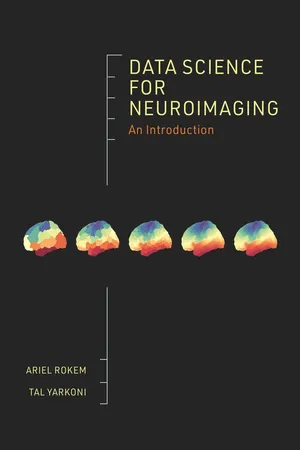
Data science methods and tools—including programming, data management, visualization, and machine learning—and their application to neuroimaging research
As neuroimaging turns toward data-intensive discovery, researchers in the field must learn to access, manage, and analyze datasets at unprecedented scales. Concerns about reproducibility and increased rigor in reporting of scientific results also demand higher standards of computational practice. This book offers neuroimaging researchers an introduction to data science, presenting methods, tools, and approaches that facilitate automated, reproducible, and scalable analysis and understanding of data. Through guided, hands-on explorations of openly available neuroimaging datasets, the book explains such elements of data science as programming, data management, visualization, and machine learning, and describes their application to neuroimaging. Readers will come away with broadly relevant data science skills that they can easily translate to their own questions.
• Fills the need for an authoritative resource on data science for neuroimaging researchers
• Strong emphasis on programming
• Provides extensive code examples written in the Python programming language
• Draws on openly available neuroimaging datasets for examples
• Written entirely in the Jupyter notebook format, so the code examples can be executed, modified, and re-executed as part of the learning process
- 393 pages
- English
- PDF
- Available on iOS & Android
eBook - PDF
About this book
Information
Publisher
Princeton University PressYear
2023Print ISBN
9780691222752
9780691222738
eBook ISBN
9780691222745
Table of contents
- Cover
- Contents
- Preface
- 1. Introduction
- PART I. The Data Science Toolbox
- PART II. Programming
- PART III. Scientific Computing
- PART IV. Neuroimaging in Python
- PART V. Image Processing
- PART VI. Machine Learning
- PART VII. Appendices
- Bibliography
- Index
Trusted by 375,005 students
Access to over 1.5 million titles for a fair monthly price.
Study more efficiently using our study tools.
Frequently asked questions
Yes, you can cancel anytime from the Subscription tab in your account settings on the Perlego website. Your subscription will stay active until the end of your current billing period. Learn how to cancel your subscription
No, books cannot be downloaded as external files, such as PDFs, for use outside of Perlego. However, you can download books within the Perlego app for offline reading on mobile or tablet. Learn how to download books offline
Perlego offers two plans: Essential and Complete
- Essential is ideal for learners and professionals who enjoy exploring a wide range of subjects. Access the Essential Library with 800,000+ trusted titles and best-sellers across business, personal growth, and the humanities. Includes unlimited reading time and Standard Read Aloud voice.
- Complete: Perfect for advanced learners and researchers needing full, unrestricted access. Unlock 1.5M+ books across hundreds of subjects, including academic and specialized titles. The Complete Plan also includes advanced features like Premium Read Aloud and Research Assistant.
We are an online textbook subscription service, where you can get access to an entire online library for less than the price of a single book per month. With over 1.5 million books across 990+ topics, we’ve got you covered! Learn about our mission
Look out for the read-aloud symbol on your next book to see if you can listen to it. The read-aloud tool reads text aloud for you, highlighting the text as it is being read. You can pause it, speed it up and slow it down. Learn more about Read Aloud
Yes! You can use the Perlego app on both iOS and Android devices to read anytime, anywhere — even offline. Perfect for commutes or when you’re on the go.
Please note we cannot support devices running on iOS 13 and Android 7 or earlier. Learn more about using the app
Please note we cannot support devices running on iOS 13 and Android 7 or earlier. Learn more about using the app
Yes, you can access Data Science for Neuroimaging by Ariel Rokem,Tal Yarkoni in PDF and/or ePUB format, as well as other popular books in Biological Sciences & Data Mining. We have over 1.5 million books available in our catalogue for you to explore.