How have the waves of democracy and decentralization that swept the developing world in recent decades affected states—among the most important drivers of poverty and prosperity—at national and local levels in Ghana and beyond?
State actors beneath the national level—what Barry Driscoll calls the local state—have considerable responsibility for carrying out state functions, but they are also forced to compete for these local state offices. How does a local state actually work in poor twentieth-century countries?
This book offers a descriptive account, as well as a causal explanation, of how political competition affects the local state in Ghana. Driscoll shows how closely fought elections drive local state institutions to provide patronage. The source of these demands for patronage comes not from rent-seeking bureaucrats or landed elites but from the government's own party volunteers. Driscoll explains how electoral competition affects how local state actors are insulated from such patronage demands.
Moreover, these highly competitive, patronage-providing local governments actually have relatively better-qualified senior civil servants at their disposal. Driscoll makes sense of this paradox by introducing the logic of building administrative capacity in order to provide patronage. He then abstracts from the case of Ghana to generalize about how the effect of political competition is shaped by the locally salient variety of clientelism, which in turn is conditioned by the strength of the party system.
The book draws on fourteen months of fieldwork in six of Ghana's districts, far from the nation's capital city. Ethnographic and interview data come from time spent with market traders, tax collectors, politicians, and other figures in local state offices. Quantitative data come from a survey covering almost all local governments. The result is a detailed account of Ghana's local state power dynamics that has relevant implications for states across the developing world.
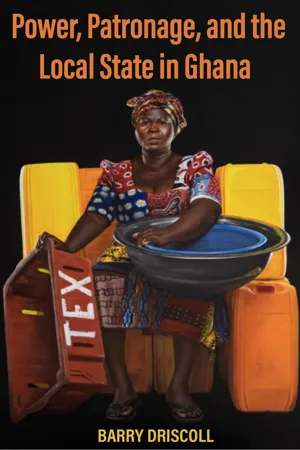
- 272 pages
- English
- ePUB (mobile friendly)
- Available on iOS & Android
eBook - ePub
Power, Patronage, and the Local State in Ghana
About this book
Information
Table of contents
- Cover
- Series Page
- Title Page
- Copyright
- Contents
- List of Illustrations
- Preface
- Acknowledgments
- Introduction: The Local State in the Twenty-First Century
- 1. Why Some Districts Are Competitive: The Order of Local State Formation
- 2. Why Some Districts Fear Their Party Activists
- 3. Why (and How) Some Party Activists Get Patronage
- 4. Beyond Case Studies: Countrywide Analysis
- 5. Why Patronage and State Capacity Can Coexist
- 6. Some Comparative Perspective
- Appendix
- Notes
- References
- Index
Trusted by 375,005 students
Access to over 1.5 million titles for a fair monthly price.
Study more efficiently using our study tools.
Frequently asked questions
Yes, you can cancel anytime from the Subscription tab in your account settings on the Perlego website. Your subscription will stay active until the end of your current billing period. Learn how to cancel your subscription
No, books cannot be downloaded as external files, such as PDFs, for use outside of Perlego. However, you can download books within the Perlego app for offline reading on mobile or tablet. Learn how to download books offline
Perlego offers two plans: Essential and Complete
- Essential is ideal for learners and professionals who enjoy exploring a wide range of subjects. Access the Essential Library with 800,000+ trusted titles and best-sellers across business, personal growth, and the humanities. Includes unlimited reading time and Standard Read Aloud voice.
- Complete: Perfect for advanced learners and researchers needing full, unrestricted access. Unlock 1.5M+ books across hundreds of subjects, including academic and specialized titles. The Complete Plan also includes advanced features like Premium Read Aloud and Research Assistant.
We are an online textbook subscription service, where you can get access to an entire online library for less than the price of a single book per month. With over 1.5 million books across 990+ topics, we’ve got you covered! Learn about our mission
Look out for the read-aloud symbol on your next book to see if you can listen to it. The read-aloud tool reads text aloud for you, highlighting the text as it is being read. You can pause it, speed it up and slow it down. Learn more about Read Aloud
Yes! You can use the Perlego app on both iOS and Android devices to read anytime, anywhere — even offline. Perfect for commutes or when you’re on the go.
Please note we cannot support devices running on iOS 13 and Android 7 or earlier. Learn more about using the app
Please note we cannot support devices running on iOS 13 and Android 7 or earlier. Learn more about using the app
Yes, you can access Power, Patronage, and the Local State in Ghana by Barry Driscoll in PDF and/or ePUB format, as well as other popular books in Politics & International Relations & Development Economics. We have over 1.5 million books available in our catalogue for you to explore.