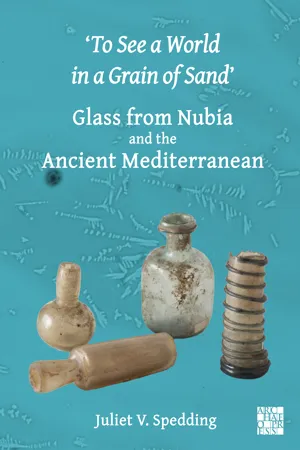
'To See a World in a Grain of Sand' uses modern scientific methods to examine glass beads and vessel fragments dating from the Meroitic (c. 350 BC-AD 350) and Early Nobadia (c. AD 350-600) periods to provide a new assessment of glass from Nubia (ancient Sudan), a subject hitherto little-studied. The resulting identification of their chemical makeup is not simply about artefact reclassification but permits the tracking of similar compositions and—by extension—the raw materials for glass production that were used throughout Nubia, Egypt, and the Mediterranean. The results reveal interrelationships between trade, technological understanding, and manufacturing choices made across these cultures. Comparing glasses from Nubia with those from Egyptian and Mediterranean contexts has also shown how the same primary production centres were providing glass to sites in Turkey, Albania, Egypt, and Nubia. The identification of different glass groups and rare types of glass within Nubia shows the extent and variation to be found in a material that is present not only at a single site but also across the whole region, while the data presented reveals the diverse and complex nature of glass objects discovered there. That multiple interactions were being employed in glass manufacture shows how the examination of artefacts and their component materials must include consideration of both international trade and 'home-based' practices.
eBook - PDF
'To See a World in a Grain of Sand': Glass from Nubia and the Ancient Mediterranean
- 202 pages
- English
- PDF
- Available on iOS & Android
eBook - PDF
'To See a World in a Grain of Sand': Glass from Nubia and the Ancient Mediterranean
About this book
Information
Subtopic
ArchaeologyIndex
Social SciencesTable of contents
- Cover
- Title Page
- Copyright Page
- Contents Page
- List of Figures and Tables
- Abbreviations
- Chemical Oxides (Symbols and Meaning)
- Timeline of Ancient Egypt and Nubia
- Acknowledgements
- Nubian History, Glass, and Mediterranean Trade
- Chemical Analysis and Archaeological Context
- Results of Chemical Analyses
- Nubia and the Mediterranean: International Connections through Glass
- High Lead Glasses and Other Vitreous Materials
- Conclusions
- Appendices
- Egyptian Glass Results
- Nubian Low-Lead Glass Comparisons to Published Material: Scatterplots
- Published Material Comparison to Pergamon, Bubastis, and Butrint: Scatterplots
- Bibliography
- Back cover
Trusted by 375,005 students
Access to over 1.5 million titles for a fair monthly price.
Study more efficiently using our study tools.
Frequently asked questions
Yes, you can cancel anytime from the Subscription tab in your account settings on the Perlego website. Your subscription will stay active until the end of your current billing period. Learn how to cancel your subscription
No, books cannot be downloaded as external files, such as PDFs, for use outside of Perlego. However, you can download books within the Perlego app for offline reading on mobile or tablet. Learn how to download books offline
Perlego offers two plans: Essential and Complete
- Essential is ideal for learners and professionals who enjoy exploring a wide range of subjects. Access the Essential Library with 800,000+ trusted titles and best-sellers across business, personal growth, and the humanities. Includes unlimited reading time and Standard Read Aloud voice.
- Complete: Perfect for advanced learners and researchers needing full, unrestricted access. Unlock 1.5M+ books across hundreds of subjects, including academic and specialized titles. The Complete Plan also includes advanced features like Premium Read Aloud and Research Assistant.
We are an online textbook subscription service, where you can get access to an entire online library for less than the price of a single book per month. With over 1.5 million books across 990+ topics, we’ve got you covered! Learn about our mission
Look out for the read-aloud symbol on your next book to see if you can listen to it. The read-aloud tool reads text aloud for you, highlighting the text as it is being read. You can pause it, speed it up and slow it down. Learn more about Read Aloud
Yes! You can use the Perlego app on both iOS and Android devices to read anytime, anywhere — even offline. Perfect for commutes or when you’re on the go.
Please note we cannot support devices running on iOS 13 and Android 7 or earlier. Learn more about using the app
Please note we cannot support devices running on iOS 13 and Android 7 or earlier. Learn more about using the app
Yes, you can access 'To See a World in a Grain of Sand': Glass from Nubia and the Ancient Mediterranean by Juliet V. Spedding in PDF and/or ePUB format, as well as other popular books in Social Sciences & Archaeology. We have over 1.5 million books available in our catalogue for you to explore.