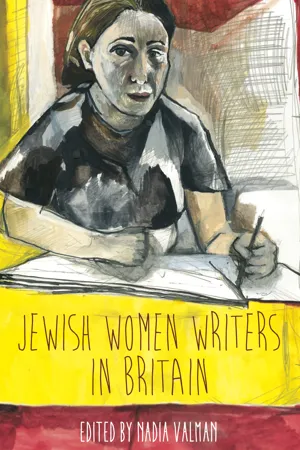
Against a background of enormous cultural change during the nineteenth and twentieth centuries, writing by British Jewish women grappled with shifting meanings of Jewish identity, the pressure of social norms, and questions of assimilation. Until recently, however, the distinctive experiences and perspectives of Jewish women have been absent from accounts of both British Jewish literature and women's writing in Britain. Drawing on new research in Jewish studies, postcolonial criticism, trauma theory and cultural geography, contributors in Jewish Women Writers in Britain examine the ways that these women writers interpreted the experience of living between worlds and imaginatively transformed it for a wide general readership. Editor Nadia Valman brings together contributors to consider writers whose Jewish identity was central to their practice as well as those whose relationship to their Jewish heritage was oblique, complicated, or mobile and figured in their work in varied and often unexpected ways. The chapters cover a range of genres including didactic fiction, devotional writing, modernist poetry, autobiographical fiction, the postmodern novel, memoir, and public poetry. Among the writers discussed are Grace Aguilar, Celia and Marion Moss, Katie Magnus, Lily Montagu, Amy Levy, Nina Salaman, Mina Loy, Betty Miller, Eva Figes, Ruth Fainlight, Elaine Feinstein, Anita Brookner, Julia Pascal, Diane Samuels, Jenny Diski, Linda Grant, and Sue Hubbard. Expanding the concerns of Jewish literature beyond existing male-centered narratives of the heroic conflict between family expectations and personal aspirations, women writers also produced fiction and poetry exploring the female body, maternity, sexual politics, and the transmission of memory. While some sought to appropriate traditional Jewish literary forms, others used formal and stylistic experimentation to challenge a religious establishment and social conventions that constrained women's public freedoms. The extraordinary range of responses to Jewish culture and history in the work of these writers will appeal to literary scholars and readers interested in Jewish women's history.
- 312 pages
- English
- ePUB (mobile friendly)
- Available on iOS & Android
eBook - ePub
Jewish Women Writers in Britain
About this book
Trusted by 375,005 students
Access to over 1.5 million titles for a fair monthly price.
Study more efficiently using our study tools.
Information
Table of contents
- Cover
- Title Page
- Copyright
- Dedication
- Contents
- Acknowledgments
- Introduction. Feeling at Home: Jewish Women Writers in Britain, 1830–2010
- 1. From Domestic Paragon to Rebellious Daughter: Victorian Jewish Women Novelists
- 2. “And we are not what they have been”: Anglo-Jewish Women Poets, 1839–1923
- 3. Worldly Exile: Mina Loy’s “Anglo-Mongrels and the Rose”
- 4. Betty Miller and the Marrano Self
- 5. “Almost an Englishwoman”: Jewish Women Refugee Writers in Britain
- 6. Forgotten Words: Trauma, Memory, and Herstory in Eva Figes’s Fiction
- 7. Otherness and Transcendence: The Poetry of Ruth Fainlight and Elaine Feinstein
- 8. The Trauma of Assimilation: Anita Brookner as Jewish Novelist
- 9. Dramatizing Britain’s Holocaust Memory
- 10. Jewish Mothers and Jewish Memory in Contemporary Memoirs
- 11. Opening Spaces: Sue Hubbard’s Poetry of Place
- Contributors
- Index
Frequently asked questions
Yes, you can cancel anytime from the Subscription tab in your account settings on the Perlego website. Your subscription will stay active until the end of your current billing period. Learn how to cancel your subscription
No, books cannot be downloaded as external files, such as PDFs, for use outside of Perlego. However, you can download books within the Perlego app for offline reading on mobile or tablet. Learn how to download books offline
Perlego offers two plans: Essential and Complete
- Essential is ideal for learners and professionals who enjoy exploring a wide range of subjects. Access the Essential Library with 800,000+ trusted titles and best-sellers across business, personal growth, and the humanities. Includes unlimited reading time and Standard Read Aloud voice.
- Complete: Perfect for advanced learners and researchers needing full, unrestricted access. Unlock 1.5M+ books across hundreds of subjects, including academic and specialized titles. The Complete Plan also includes advanced features like Premium Read Aloud and Research Assistant.
We are an online textbook subscription service, where you can get access to an entire online library for less than the price of a single book per month. With over 1.5 million books across 990+ topics, we’ve got you covered! Learn about our mission
Look out for the read-aloud symbol on your next book to see if you can listen to it. The read-aloud tool reads text aloud for you, highlighting the text as it is being read. You can pause it, speed it up and slow it down. Learn more about Read Aloud
Yes! You can use the Perlego app on both iOS and Android devices to read anytime, anywhere — even offline. Perfect for commutes or when you’re on the go.
Please note we cannot support devices running on iOS 13 and Android 7 or earlier. Learn more about using the app
Please note we cannot support devices running on iOS 13 and Android 7 or earlier. Learn more about using the app
Yes, you can access Jewish Women Writers in Britain by Nadia Valman in PDF and/or ePUB format, as well as other popular books in Literature & European Literary Collections. We have over 1.5 million books available in our catalogue for you to explore.