- 416 pages
- English
- ePUB (mobile friendly)
- Available on iOS & Android
About this book
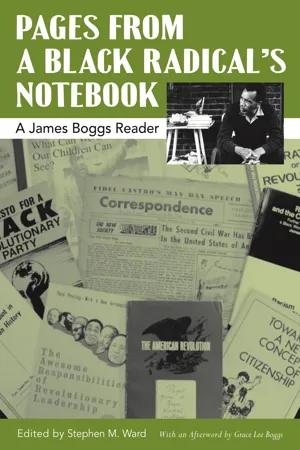
Collects nearly four decades' worth of writings by Detroit political and labor activist James Boggs.
Born in the rural American south, James Boggs lived nearly his entire adult life in Detroit and worked as a factory worker for twenty-eight years while immersing himself in the political struggles of the industrial urban north. During and after the years he spent in the auto industry, Boggs wrote two books, co-authored two others, and penned dozens of essays, pamphlets, reviews, manifestos, and newspaper columns to become known as a pioneering revolutionary theorist and community organizer. In Pages from a Black Radical's Notebook: A James Boggs Reader, editor Stephen M. Ward collects a diverse sampling of pieces by Boggs, spanning the entire length of his career from the 1950s to the early 1990s.
Pages from a Black Radical's Notebook is arranged in four chronological parts that document Boggs's activism and writing. Part 1 presents columns from Correspondence a newspaper written during the 1950s and early 1960s. Part 2 presents the complete text of Boggs's first book, The American Revolution: Pages from a Negro Worker's Notebook, his most widely known work. In Part 3, "Black Power—Promise, Pitfalls, and Legacies, " Ward collects essays, pamphlets, and speeches that reflect Boggs's participation in and analysis of the origins, growth, and demise of the Black Power movement. Part 4 comprises pieces written in the last decade of Boggs's life, during the 1980s through the early 1990s. An introduction by Ward provides a detailed overview of Boggs's life and career, and an afterword by Grace Lee Boggs, James Boggs's wife and political partner, concludes this volume.
Pages from a Black Radical's Notebook documents Boggs's personal trajectory of political engagement and offers a unique perspective on radical social movements and the African American struggle for civil rights in the post–World War II years. Readers interested in political and ideological struggles of the twentieth century will find Pages from a Black Radical's Notebook to be fascinating reading.
Frequently asked questions
- Essential is ideal for learners and professionals who enjoy exploring a wide range of subjects. Access the Essential Library with 800,000+ trusted titles and best-sellers across business, personal growth, and the humanities. Includes unlimited reading time and Standard Read Aloud voice.
- Complete: Perfect for advanced learners and researchers needing full, unrestricted access. Unlock 1.4M+ books across hundreds of subjects, including academic and specialized titles. The Complete Plan also includes advanced features like Premium Read Aloud and Research Assistant.
Please note we cannot support devices running on iOS 13 and Android 7 or earlier. Learn more about using the app.
Information
Table of contents
- Cover
- Series Page
- Title Page
- Copyright
- Dedication
- Contents
- Preface
- Introduction: The Making of a Revolutionist
- Part I: Correspondence Newspaper
- Introduction to Part I
- Talent for Sale (1954)
- Viewing Negro History Week (1954)
- Negro Challenge (1954)
- The Paper and a New Society (1954)
- Sensitivity (1955)
- The Stage That We Have Reached (1955)
- A Report on the March on Washington (1957)
- Who Is for Law and Order? (1957)
- Who Is for Civilization? (1957)
- The Weakest Link in the Struggle (1958)
- Safeguarding Your Child’s Future (1959)
- Land of the Free and the Hungry (1960)
- The Winds Have Already Changed (1960)
- What Makes Americans Run (1960)
- New Orleans Faces We Still Haven’t Seen (1960)
- The First Giant Step (1961)
- A Visit From the FBI (1961)
- FBI Asks Me about Rob Williams (1961)
- Foreword to “Monroe, North Carolina . . . Turning Point in American History” (1962)
- Part II: The American Revolution: Pages from a Negro Worker’s Notebook
- Introduction to Part II
- The American Revolution: Pages from a Negro Worker's Notebook
- Part III: Black Power: Promise, Pitfalls, and Legacies
- Introduction to Part III
- Liberalism, Marxism, and Black Political Power (1963)
- The City Is the Black Man’s Land (1966)
- Black Power: A Scientific Concept Whose Time Has Come (1967)
- Culture and Black Power (1967)
- The Myth and Irrationality of Black Capitalism (1969)
- Manifesto for a Black Revolutionary Party (1969)
- The American Revolution: Putting Politics in Command (1970)
- Beyond Rebellion (1972)
- Beyond Nationalism (1973)
- Think Dialectically, Not Biologically (1974)
- Toward a New Concept of Citizenship (1976)
- The Next Development in Education (1977)
- Liberation or Revolution? (1978)
- The Challenge Facing Afro-Americans in the 1980s (1979)
- Part IV: Community Building and Grassroots Leadership in Post-Industrial Detroit
- Introduction to Part IV
- Letter to Friends and Comrades (1984)
- Going Where We Have Never Been: Creating New Communities for Our Future (1986)
- Community Building: An Idea Whose Time Has Come (1987)
- Rebuilding Detroit: An Alternative to Casino Gambling (1988)
- We Must Stop Thinking Like Victims (1990)
- What Does It Mean to Be a Father? (1990)
- Why Are We at War with One Another? (1990)
- A “No” Vote Will Say Detroiters Want to Save What’s Left (1991)
- How Will We Make a Living? (1991)
- Why Are Our Children So Bored? (1991)
- What Can We Be That Our Children Can See? (1991)
- Time to Act Like Citizens, Not Subjects (1992)
- What Time Is It in Detroit and the World? (1992)
- We Can Run But We Can’t Hide (1993)
- Beyond Civil Rights (1993)
- Why Detroit Summer? (1993)
- Afterword by Grace Lee Boggs
- Notes
- Index