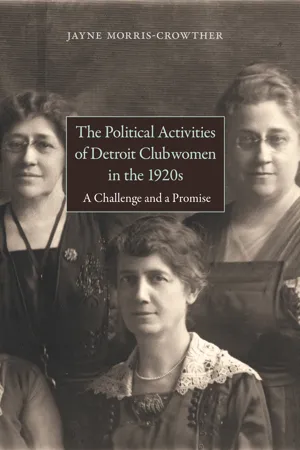
In the early 1900s, Detroit's clubwomen successfully lobbied for issues like creating playgrounds for children, building public baths, raising the age for child workers, and reforming the school board and city charter. But when they won the vote in 1918, Detroit's clubwomen, both black and white, were eager to incite even greater change. In the 1920s, they fought to influence public policy at the municipal and state level, while contending with partisan politics, city politics, and the media, which often portrayed them as silly and incompetent. In this fascinating volume, author Jayne Morris-Crowther examines the unique civic engagement of these women who considered their commitment to the city of Detroit both a challenge and a promise.By the 1920s, there were eight African American clubs in the city (Willing Workers, Detroit Study Club, Lydian Association, In As Much Circle of Kings Daughters, Labor of Love Circle of Kings Daughters, West Side Art and Literary Club, Altar Society of the Second Baptist Church, and the Earnest Workers of the Second Baptist Church); in 1921, they joined together under the Detroit Association of Colored Women's Clubs. Nearly 15, 000 mostly white clubwomen were represented by the Detroit Federation of Women's Clubs, which was formed in 1895 by the unification of the Detroit Review Club, Twentieth Century Club, Detroit Woman's Club, Woman's Historical Club, Clio Club, Wednesday History Club, Hypathia, and Zatema Club. Morris-Crowther begins by investigating the roots of the clubs in pre-suffrage Detroit and charts their growing power. In the end, Morris-Crowther shows that Detroit's clubwomen pioneered new lobbying techniques like personal interviews, and used political education in savvy ways to bring politics to the community level. An appendix contains the 1926 Directory of the Detroit Federation of Women's Clubs.
eBook - ePub
The Political Activities of Detroit Clubwomen in the 1920s
A Challenge and a Promise
- 264 pages
- English
- ePUB (mobile friendly)
- Available on iOS & Android
eBook - ePub
The Political Activities of Detroit Clubwomen in the 1920s
A Challenge and a Promise
About this book
Information
Table of contents
- Cover
- Series Page
- Title Page
- Copyright
- Dedication
- Contents
- Acknowledgments
- Introduction
- 1. Early Twentieth-Century Detroit and the Beginning of Women’s Activism: “The Growing Power of Women’s Clubs in Detroit”
- 2. The Club Work of Enfranchised Women: “Vote, Women Vote”
- 3. Policies That Affect Women and Children: “We believe in the glory of woman,Her influence, her motherhood blest . . .”
- 4. Protecting the Home against Enemies: “If there is one thing that clubwomen the country over stand formore than another, it is the American home”
- 5. Home as Part of the Urban Environment: “The water supply and our garbage pails remind us that somethingis managed for us, not by us”
- 6. The Limits of Enfranchised Citizens: “Plan is not practical . . . it is just like a woman”
- Conclusion: “No effort is in vain; the reward is in the doing”
- Appendix: Directory of the Detroit Federation of Women’s Clubs, 1926
- Notes
- Selected Bibliography
- Index
Trusted by 375,005 students
Access to over 1.5 million titles for a fair monthly price.
Study more efficiently using our study tools.
Frequently asked questions
Yes, you can cancel anytime from the Subscription tab in your account settings on the Perlego website. Your subscription will stay active until the end of your current billing period. Learn how to cancel your subscription
No, books cannot be downloaded as external files, such as PDFs, for use outside of Perlego. However, you can download books within the Perlego app for offline reading on mobile or tablet. Learn how to download books offline
Perlego offers two plans: Essential and Complete
- Essential is ideal for learners and professionals who enjoy exploring a wide range of subjects. Access the Essential Library with 800,000+ trusted titles and best-sellers across business, personal growth, and the humanities. Includes unlimited reading time and Standard Read Aloud voice.
- Complete: Perfect for advanced learners and researchers needing full, unrestricted access. Unlock 1.5M+ books across hundreds of subjects, including academic and specialized titles. The Complete Plan also includes advanced features like Premium Read Aloud and Research Assistant.
We are an online textbook subscription service, where you can get access to an entire online library for less than the price of a single book per month. With over 1.5 million books across 990+ topics, we’ve got you covered! Learn about our mission
Look out for the read-aloud symbol on your next book to see if you can listen to it. The read-aloud tool reads text aloud for you, highlighting the text as it is being read. You can pause it, speed it up and slow it down. Learn more about Read Aloud
Yes! You can use the Perlego app on both iOS and Android devices to read anytime, anywhere — even offline. Perfect for commutes or when you’re on the go.
Please note we cannot support devices running on iOS 13 and Android 7 or earlier. Learn more about using the app
Please note we cannot support devices running on iOS 13 and Android 7 or earlier. Learn more about using the app
Yes, you can access The Political Activities of Detroit Clubwomen in the 1920s by Jayne Morris-Crowther in PDF and/or ePUB format, as well as other popular books in History & North American History. We have over 1.5 million books available in our catalogue for you to explore.