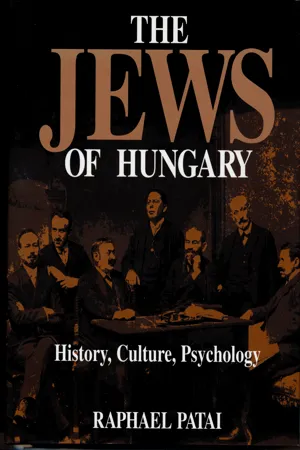
The Jews of Hungary is the first comprehensive history in any language of the unique Jewish community that has lived in the Carpathian Basin for eighteen centuries, from Roman times to the present. Noted historian and anthropologist Raphael Patai, himself a native of Hungary, tells in this pioneering study the fascinating story of the struggles, achievements, and setbacks that marked the flow of history for the Hungarian Jews. He traces their seminal role in Hungarian politics, finance, industry, science, medicine, arts, andliterature, and their surprisingly rich contributions to Jewish scholarship and religious leadership both inside Hungary and in the Western world. In the early centuries of their history Hungarian Jews left no written works, so Patai had to piece together a picture of their life up to the sixteenth century based on documents and reports written by non-Jewish Hungarians and visitors from abroad. Once Hungarian Jewish literary activity began, the sources covering the life and work of the Jews rapidly increased in richness. Patai made full use of the wealth of information contained in the monumental eighteen-volume series of the Hungarian Jewish Archives and the other abundant primary sources available in Latin, German, Hebrew, Hungarian, Yiddish, and Turkish, the languages in vogue in various periods among the Jews of Hungary. In his presentation of the modern period he also examined theliterary reflection of Hungarian Jewish life in the works of Jewish and non-Jewish Hungarian novelists, poets, dramatists, andjournalists.Patai's main focus within the overall history of the Hungarian Jews is their culture and their psychology. Convinced that what is most characteristic of a people is the culture which endows its existence with specific coloration, he devotes special attention to the manifestations of Hungarian Jewish talent in the various cultural fields, most significantly literature, the arts, and scholarship. Based on the available statistical data Patai shows that from the nineteenth century, in all fields ofHungarian culture, Jews played leading roles not duplicated in any other country. Patai also shows that in the Hungarian Jewish culture a specific set of psychological motivations had a highly significant function. The Hungarian national character trait of emphatic patriotism was present in an even more fervent form in the Hungarian Jewish mind. Despite their centuries-old struggle against anti-Semitism, and especially from the nineteenth century on, Hungarian Jews remained convinced that they were one hundred percent Hungarians, differing in nothing but denominational variation from the Catholic and Protestant Hungarians. This mindset kept them apart and isolated from the Jewries of the Western world until overtaken by the tragedy of the Holocaust in the closing months of World War II.
- 736 pages
- English
- ePUB (mobile friendly)
- Available on iOS & Android
eBook - ePub
About this book
Information
Table of contents
- Cover
- Title Page
- Copyright
- Dedication
- Contents
- Preface
- Acknowledgments
- 1. The Jews in Roman Pannonia and Dacia
- 2. Medieval Origins and the Khazar Question
- 3. After the Magyar Conquest
- 4. The Jews in Early Hungarian Law (Eleventh to Thirteenth Centuries)
- 5. Expulsion and Recall (Fourteenth Century)
- 6. The Jew Judge and the “Perfidious Jews” (Thirteenth to Fifteenth Centuries)
- 7. From Sigismund to Matthias (1385–1490)
- 8. The Jewish Prefects: The Mendels (1475–1531)
- 9. The First Scholars and the First Blood Libel (Fifteenth and Sixteenth Centuries)
- 10. Jewish Physicians in the Fourteenth to Eighteenth Centuries
- 11. Jewish Criminals in the Sixteenth to Eighteenth Centuries
- 12. Emericus Fortunatus (Fifteenth and Sixteenth Centuries)
- 13. Transylvania and the Sabbatarians (Sixteenth and Seventeenth Centuries)
- 14. The Jews in Turkish-Occupied Hungary (1526–1686)
- 15. The Jews in Royal Hungary (1526–1686)
- 16. The Jews in Reunited Hungary (1686–1740)
- 17. Jewish Women in the Sixteenth to Eighteenth Centuries
- 18. Conversions in the Seventeenth and Eighteenth Centuries
- 19. The Jews Under Maria Theresa (1740–80)
- 20. The Jews Under Joseph II (1780–90)
- 21. The Theben Story (Eighteenth and Nineteenth Centuries)
- 22. Early Struggles for Emancipation (1790–1848)
- 23. Religious Reform (1798–1852)
- 24. New Horizons (1800–48)
- 25. The Patriotic Imperative (1800–48)
- 26. The 1848 Revolution
- 27. Neoabsolutism I: The Harsh Years (1849–59)
- 28. Neoabsolutism II: The Moderate Years (1860–67)
- 29. Emancipation, Congress, and Schism (1867–69)
- 30. Zionism: Precursors, Founders, Opponents (1839–97)
- 31. Istóczy and Tiszaeszlár
- 32. The Fin de Siècle and Its Aftermath I: Economy and Society
- 33. The Fin de Siècle and Its Aftermath II: Explorers and Scholars
- 34. The Fin de Siècle and Its Aftermath III: Literature, Criticism, and the Arts
- 35. Demography and Occupations (1890–1920)
- 36. Zionism and Anti-Semitism in the Early Twentieth Century
- 37. World War I and the Communist Interlude
- 38. The White Terror and the Numerus Clausus
- 39. The Interwar Years
- 40. The First and Second Jewish Laws (1938–39)
- 41. World War II (1939–45)
- 42. The Hungarian Holocaust: The Beginnings
- 43. The Destruction of Provincial Jewry
- 44. How Half of Budapest Jewry Was Saved
- 45. Liberation
- 46. Old Trends and the Post-Holocaust Stance
- 47. Under Communist Rule
- 48. Reconstruction
- Appendix: Post-Holocaust Jewish Authors
- Bibliography
- Index
- Comments and Corrections
- Also by Raphael Patai
Trusted by 375,005 students
Access to over 1.5 million titles for a fair monthly price.
Study more efficiently using our study tools.
Frequently asked questions
Yes, you can cancel anytime from the Subscription tab in your account settings on the Perlego website. Your subscription will stay active until the end of your current billing period. Learn how to cancel your subscription
No, books cannot be downloaded as external files, such as PDFs, for use outside of Perlego. However, you can download books within the Perlego app for offline reading on mobile or tablet. Learn how to download books offline
Perlego offers two plans: Essential and Complete
- Essential is ideal for learners and professionals who enjoy exploring a wide range of subjects. Access the Essential Library with 800,000+ trusted titles and best-sellers across business, personal growth, and the humanities. Includes unlimited reading time and Standard Read Aloud voice.
- Complete: Perfect for advanced learners and researchers needing full, unrestricted access. Unlock 1.5M+ books across hundreds of subjects, including academic and specialized titles. The Complete Plan also includes advanced features like Premium Read Aloud and Research Assistant.
We are an online textbook subscription service, where you can get access to an entire online library for less than the price of a single book per month. With over 1.5 million books across 990+ topics, we’ve got you covered! Learn about our mission
Look out for the read-aloud symbol on your next book to see if you can listen to it. The read-aloud tool reads text aloud for you, highlighting the text as it is being read. You can pause it, speed it up and slow it down. Learn more about Read Aloud
Yes! You can use the Perlego app on both iOS and Android devices to read anytime, anywhere — even offline. Perfect for commutes or when you’re on the go.
Please note we cannot support devices running on iOS 13 and Android 7 or earlier. Learn more about using the app
Please note we cannot support devices running on iOS 13 and Android 7 or earlier. Learn more about using the app
Yes, you can access The Jews of Hungary by Raphael Patai in PDF and/or ePUB format, as well as other popular books in History & European History. We have over 1.5 million books available in our catalogue for you to explore.