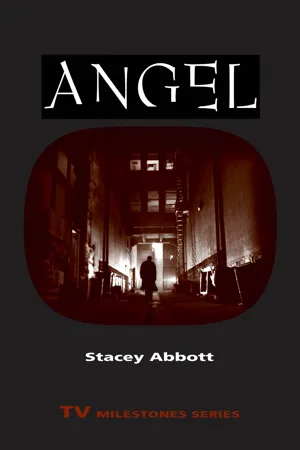
Angel
About this book
Examines the innovative approach to genre, aesthetics, narrative, and the representation of masculinity in the television series Angel.
Following the phenomenal success of the first three seasons of Buffy the Vampire Slayer on the WB Network, writers and producers Joss Whedon and David Greenwalt moved their character Angel to his own spin-off series in 1999. While Angel, which followed its namesake vampire with a soul who had become Buffy's tragic love interest, never quite matched the popularity of Buffy, the spin-off was notable for being specifically aimed at adult audiences and acquiring an intensely loyal following. In this in-depth study of Angel, Stacey Abbott demonstrates that producers of the show used the commercial convention of the spin-off not simply to repeat Buffy's successful formula but to create a complex televisual experience with its own distinct identity and creativity.
Through close textual analysis of a range of individual episodes, this volume focuses on the series' unique visual style and the ways it experiments with the conventions and form of television programming. Abbott clearly situates Angel within traditions of the horror genre on television and in so doing addresses how the horror genre has evolved to suit the changing landscape of contemporary television. She also challenges the tendency to attribute the success of contemporary cult television to a sole auteur by examining the contribution of Angel's writing team and addressing how contemporary television is characterized by a collective creativity. Finally, while there has been a vast amount of scholarly interest in Angel's parent show in terms of feminist issues, this volume positions Angel as a key text within gender and feminist studies that offers a clever deconstruction of contemporary masculinity.
In all, Abbott argues that Angel uses narrative, genre, visual style, and theme to create an ambiguous moral landscape in which characters struggle to negotiate the correct path when the consequences of their actions are unknown. Fans of Angel and students and scholars of film and television studies will enjoy this thought-provoking analysis of the series.
Frequently asked questions
- Essential is ideal for learners and professionals who enjoy exploring a wide range of subjects. Access the Essential Library with 800,000+ trusted titles and best-sellers across business, personal growth, and the humanities. Includes unlimited reading time and Standard Read Aloud voice.
- Complete: Perfect for advanced learners and researchers needing full, unrestricted access. Unlock 1.4M+ books across hundreds of subjects, including academic and specialized titles. The Complete Plan also includes advanced features like Premium Read Aloud and Research Assistant.
Please note we cannot support devices running on iOS 13 and Android 7 or earlier. Learn more about using the app.
Information
Table of contents
- Cover Page
- Title Page
- Copyright Page
- Dedication
- Contents
- Acknowledgments
- Introduction: “A Seminal Show Canceled by the Idiot Networks”
- 1. “Grrr Aaargh!” The Collective Vision of Mutant Enemy
- 2. “Creeped out and Comforted at the Same Time”: The Generic Hybridity of Angel
- 3. “Does Giant Tentacle Spew Come out with Dry Cleaning?” Angel and TV Horror
- 4. “Cavemen vs. Astronauts—Weapons to Be Determined”: Angel, Masculinity, and Male Friendship
- 5. “It’s a Little Outside the Box”: How Angel Breaks the Rules
- Notes
- Works Cited
- Index