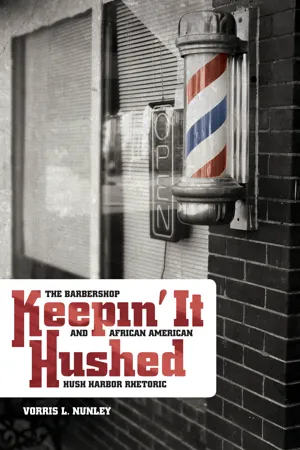
Keepin' It Hushed
The Barbershop and African American Hush Harbor Rhetoric
- 224 pages
- English
- ePUB (mobile friendly)
- Available on iOS & Android
About this book
Examines the barbershop as a rhetorical site in African American culture across genres, including fiction, film, poetry, and theater.
In Keepin' It Hushed: The Barbershop and African American Hush Harbor Rhetoric, Vorris L. Nunley investigates the role of the hush harbor (a safe place for free expression among African American speakers) as a productive space of rhetorical tradition and knowledge generation. Nunley identifies the barbershop as an important hush harbor for black males in particular and traces the powerful cultural trope and its hidden tradition of African American knowledge through multiple texts. From Dunbar's "We Wear the Mask" to the recent Barbershop movies and the provocative rhetoric of Reverend Jeremiah Wright, Nunley's study touches on a range of time periods and genres.
Nunley's introduction connects African American Hush Harbor Rhetoric (AAHHR) to everyday considerations of what may or may not be spoken in public and how African American speakers manage numerous hidden transcripts. In the first three chapters, Nunley charts different iterations of hush harbors and their function in the context of residual and emergent rhetorical traditions. He investigates public sphere theory and its application (and misapplication) to black civil society and hush harbors and connects AAHHR to nommo, the power of the word. In chapters 4 and 5, Nunley examines the ubiquity of the hush harbor trope in African American culture and considers barbershops as pedagogical sites, using literature, poetry, philosophy, and film to make his case. In chapter 6, he analyzes the Barbershop movie in detail, arguing that the movie's commodified, neoliberal version of AAHHR did not represent a hush harbor, although that was ostensibly the aim.
Keepin' It Hushed concludes with a presentation of a hush harbor pedagogy in chapter 7 and a distinctive analysis of hush harbor oriented speeches by then-Senator Obama and Rev. Jeremiah Wright. Rhetoricians and readers interested in African American life and culture will appreciate the cogent analysis in Nunley's volume.
Frequently asked questions
- Essential is ideal for learners and professionals who enjoy exploring a wide range of subjects. Access the Essential Library with 800,000+ trusted titles and best-sellers across business, personal growth, and the humanities. Includes unlimited reading time and Standard Read Aloud voice.
- Complete: Perfect for advanced learners and researchers needing full, unrestricted access. Unlock 1.4M+ books across hundreds of subjects, including academic and specialized titles. The Complete Plan also includes advanced features like Premium Read Aloud and Research Assistant.
Please note we cannot support devices running on iOS 13 and Android 7 or earlier. Learn more about using the app.
Information
Table of contents
- Cover Page
- Title Page
- Copyright Page
- Contents
- Acknowledgments
- Overture/Head: We Wear the Mask and the Bit
- 1 Beyond Difference: Mapping and Theorizing Hush Harbor Spatiality Rhetoric and Knowledge
- 2 Hush Harbors: Spatiality, Race, and Not-So-Public Spheres
- 3 Wingin’ It: Barbershops and the Work of Nommo in the Novel
- 4 Poetic Hush Harbors: Barbershops as Black Paideias
- 5 Barbers and Customers as Philosophers in Memoir and Drama
- 6 Commodifying Neoliberal Blackness: Faux Hush Harbor Rhetoric in Barbershop
- 7 Hush Harbor Pedagogy: Pathos-Driven Hearing and Pedagogy
- 8 A Question of Ethics? Hush Harbor Rhetoric and Rationalities in a Neoliberal Age
- Notes
- Bibliography
- Index