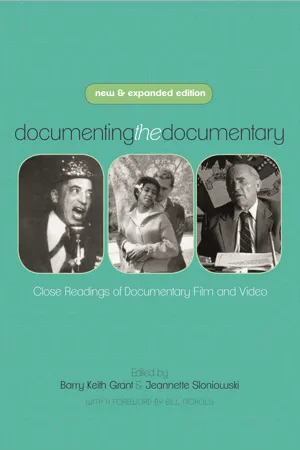
Documenting the Documentary
Close Readings of Documentary Film and Video, New and Expanded Edition
- 600 pages
- English
- ePUB (mobile friendly)
- Available on iOS & Android
Documenting the Documentary
Close Readings of Documentary Film and Video, New and Expanded Edition
About this book
Originally released in 1998, Documenting the Documentary responded to a scholarly landscape in which documentary film was largely understudied and undervalued aesthetically, and analyzed instead through issues of ethics, politics, and film technology. Editors Barry Keith Grant and Jeannette Sloniowski addressed this gap by presenting a useful survey of the artistic and persuasive aspects of documentary film from a range of critical viewpoints. This new edition of Documenting the Documentary adds five new essays on more recent films in addition to the text of the first edition. Thirty-one film and media scholars, many of them among the most important voices in the area of documentary film, cover the significant developments in the history of documentary filmmaking from Nanook of the North (1922), the first commercially released documentary feature, to contemporary independent film and video productions like Werner Herzog's Grizzly Man (2005) and the controversial Borat (2006). The works discussed also include representative examples of many important national and stylistic movements and various production contexts, from mainstream to avant-garde. In all, this volume offers a series of rich and revealing analyses of those "regimes of truth" that still fascinate filmgoers as much today as they did at the very beginnings of film history. As documentary film and visual media become increasingly important ways for audiences to process news and information, Documenting the Documentary continues to be a vital resource to understanding the genre. Students and teachers of film studies and fans of documentary film will appreciate this expanded classic volume.
Tools to learn more effectively

Saving Books

Keyword Search

Annotating Text

Listen to it instead
Information
Table of contents
- Cover
- Series Page
- Title Page
- Copyright
- Dedication
- Contents
- Foreword to New and Expanded Edition
- Preface to First Edition
- Acknowledgments
- Introduction
- 1. The Filmmaker as Hunter: Robert Flaherty’s Nanook of the North
- 2. “Peace between Man and Machine”: Dziga Vertov’s Man with a Movie Camera
- 3. Paradise Regained: Sergei Eisenstein’s Que viva México! as Ethnography
- 4. Synthetic Vision: The Dialectical Imperative of Luis Buñuel’s Las Hurdes
- 5. The Art of National Projection: Basil Wright’s Song of Ceylon
- 6. The Mass Psychology of Fascist Cinema: Leni Riefenstahl’s Triumph of the Will
- 7. American Documentary Finds Its Voice: Persuasion and Expression in The Plow That Broke the Plains and The City
- 8. “Men Cannot Act before the Camera in the Presence of Death”: Joris Ivens’s The Spanish Earth
- 9. The Poetics of Propaganda: Humphrey Jennings and Listen to Britain
- 10. “It was an Atrocious Film”: Georges Franju’s Blood of the Beasts
- 11. The “Dialogic Imagination” of Jean Rouch: Covert Conversations in Les maîtres fous
- 12. Documenting the Ineffable: Terror and Memory in Alain Resnais’s Night and Fog
- 13. Making the Past Present: Peter Watkins’s Culloden
- 14. “Don’t You Ever Just Watch?”: American Cinema Verité and Dont Look Back
- 15. “Ethnography in the First Person”: Frederick Wiseman’s Titicut Follies
- 16. The Two Avant-Gardes: Solanas and Getino’s The Hour of the Furnaces
- 17. Seeing with Experimental Eyes: Stan Brakhage’s The Act of Seeing with One’s Own Eyes
- 18. “A Bastard Union of Several Forms”: Style and Narrative in An American Family
- 19. The Documentary of Displaced Persona: Michael Rubbo’s Daisy: The Story of a Facelift
- 20. Gender, Power, and a Cucumber: Satirizing Masculinity in This Is Spinal Tap
- 21. Documentary Film and the Discourse of Hysterical/Historical Narrative: Ross McElwee’s Sherman’s March
- 22. Subjectivity Lost and Found: Bill Viola’s I Do not Know What It Is I am Like
- 23. Mirrors without Memories: Truth, History, and The Thin Blue Line
- 24. Documentaphobia and Mixed Modes: Michael Moore’s Roger & Me
- 25. Silence and Its Opposite: Expressions of Race in Tongues Untied
- 26. Containing Fire: Performance in Paris Is Burning
- 27. Contested Territory: Camille Billops and James Hatch’s Finding Christa
- 28. Spike Lee’s 4 Little Girls: The Politics of the Documentary Interview
- 29. The Gleaners and “Us”: The Radical Modesty of Agnès Varda’s Les glaneurs et la glaneuse
- 30. “You Must Never Listen to This”: Lessons on Sound, Cinema, and Mortality from Werner Herzog’s Grizzly Man
- 31. Cultural Learnings of Borat for Make Benefit Glorious Study of Documentary
- Bibliography
- Contributors
- Index
Frequently asked questions
- Essential is ideal for learners and professionals who enjoy exploring a wide range of subjects. Access the Essential Library with 800,000+ trusted titles and best-sellers across business, personal growth, and the humanities. Includes unlimited reading time and Standard Read Aloud voice.
- Complete: Perfect for advanced learners and researchers needing full, unrestricted access. Unlock 1.4M+ books across hundreds of subjects, including academic and specialized titles. The Complete Plan also includes advanced features like Premium Read Aloud and Research Assistant.
Please note we cannot support devices running on iOS 13 and Android 7 or earlier. Learn more about using the app