In chemistry, good problem-solving requires a balanced combination of scientific intuition and
methodical analysis. Additionally, thoughtfully presented diagrams and infographics can convey
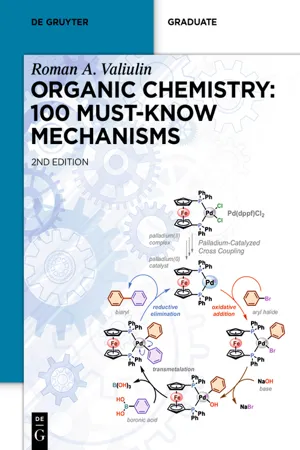
a large amount of complex information in a more intuitive and accessible manner. 100 Must-Know
Mechanisms (Second Edition) strives to be at the intersection of these two key principles. Its
thorough visualizations enable experienced readers to use it as a quick reference for specific
mechanisms of interest. At the same time, the book's breadth of covered reactions, from classic to
cutting-edge, make it a good study-aid for the developing chemist. A slow and consistent study of
the entire series of mechanisms can help set the foundation for good scientific intuition, while its
detailed infographics and careful navigation features encourage coming back to it frequently. This
edition includes over 40 new illustrations, numerous new mechanistic schemes, enhanced original
figures with a variety of real-case examples, and more
- 289 pages
- English
- ePUB (mobile friendly)
- Available on iOS & Android
eBook - ePub
Organic Chemistry: 100 Must-Know Mechanisms
About this book
Information
Topic
Sciences physiquesSubtopic
Chimie physique et théoriqueTable of contents
- Title Page
- Copyright
- Contents
- Second Edition
- List of Acronyms and Abbreviations
- 1 Electrophilic Addition Mechanism
- 2 Nucleophilic Substitution Mechanism
- 3 Aromatic Electrophilic Substitution Mechanism
- 4 Aromatic Nucleophilic Substitution Mechanism
- 5 Aromatic Radical Nucleophilic Substitution Mechanism
- 6 Elimination Mechanism
- 7 Acyloin Condensation
- 8 Alkyne Zipper Reaction
- 9 Arbuzov Reaction
- 10 Arndt–Eistert Synthesis
- 11 Baeyer–Villiger Oxidation
- 12 Barton Decarboxylation
- 13 Baylis–Hillman Reaction
- 14 Beckmann Rearrangement
- 15 Benzoin Condensation
- 16 Benzyne Mechanism
- 17 Bergman Cyclization
- 18 Birch Reduction
- 19 Bischler‒Napieralski Cyclization
- 20 Brown Hydroboration
- 21 Buchwald–Hartwig Cross-Coupling
- 22 Cannizzaro Reaction
- 23 Chan–Evans–Lam Cross-Coupling
- 24 Chichibabin Amination
- 25 Claisen Condensation
- 26 Claisen Rearrangement
- 27 Cope Elimination
- 28 Cope Rearrangement
- 29 Criegee and Malaprade Oxidation
- 30 CuAAC
- 31 Curtius Rearrangement
- 32 Darzens Condensation
- 33 Dess–Martin Oxidation
- 34 Diazotization (Diazonium Salt)
- 35 Diels–Alder Cycloaddition
- 36 Di-π-Methane Rearrangement
- 37 Favorskii Rearrangement
- 38 Fischer Indole Synthesis
- 39 Friedel–Crafts Acylation and Alkylation
- 40 Gabriel Synthesis
- 41 Gewald Reaction
- 42 Glaser–Eglinton–Hay Coupling
- 43 Grignard Reaction
- 44 Grob Fragmentation
- 45 Haloform Reaction
- 46 Heck Cross-Coupling
- 47 Hell–Volhard–Zelinsky Reaction
- 48 Hiyama Cross-Coupling
- 49 Hofmann Elimination
- 50 Horner–Wadsworth–Emmons Olefination
- 51 Jones Oxidation
- 52 Kucherov Reaction
- 53 Kumada Cross-Coupling
- 54 Ley–Griffith Oxidation
- 55 Liebeskind–Srogl Cross-Coupling
- 56 Mannich Reaction
- 57 McMurry Coupling
- 58 Meerwein–Ponndorf–Verley Reduction
- 59 Michael Addition
- 60 Minisci Reaction
- 61 Mitsunobu Reaction
- 62 Miyaura Borylation
- 63 Mukaiyama RedOx Hydration
- 64 Nazarov Cyclization
- 65 Nef Reaction
- 66 Negishi Cross-Coupling
- 67 Norrish Type I and II Reactions
- 68 Olefin (Alkene) Metathesis
- 69 Oppenauer Oxidation
- 70 Ozonolysis
- 71 Paal–Knorr Syntheses
- 72 Paternò–Büchi Reaction
- 73 Pauson–Khand Reaction
- 74 Peptide (Amide) Coupling
- 75 Pictet–Spengler Reaction
- 76 Pinacol–Pinacolone Rearrangement
- 77 Polonovski Reaction
- 78 Prilezhaev Epoxidation
- 79 Prins Reaction
- 80 Pummerer Rearrangement
- 81 Ramberg–Bäcklund Rearrangement
- 82 Reformatsky Reaction
- 83 Robinson Annulation
- 84 Shapiro Reaction
- 85 Sonogashira Cross-Coupling
- 86 Staudinger Reaction
- 87 Steglich Esterification
- 88 Stille Cross-Coupling
- 89 Suzuki Cross-Coupling
- 90 Swern Oxidation
- 91 Ugi Reaction
- 92 Ullmann Aryl–Aryl Coupling
- 93 Upjohn Dihydroxylation
- 94 Vilsmeier–Haack Reaction
- 95 Wacker Oxidation
- 96 Wagner–Meerwein Rearrangement
- 97 Weinreb Ketone Synthesis
- 98 Wittig Reaction
- 99 Wohl–Ziegler Reaction
- 100 Wolff–Kishner Reduction
- Acknowledgments
Trusted by 375,005 students
Access to over 1.5 million titles for a fair monthly price.
Study more efficiently using our study tools.
Frequently asked questions
Yes, you can cancel anytime from the Subscription tab in your account settings on the Perlego website. Your subscription will stay active until the end of your current billing period. Learn how to cancel your subscription
No, books cannot be downloaded as external files, such as PDFs, for use outside of Perlego. However, you can download books within the Perlego app for offline reading on mobile or tablet. Learn how to download books offline
Perlego offers two plans: Essential and Complete
- Essential is ideal for learners and professionals who enjoy exploring a wide range of subjects. Access the Essential Library with 800,000+ trusted titles and best-sellers across business, personal growth, and the humanities. Includes unlimited reading time and Standard Read Aloud voice.
- Complete: Perfect for advanced learners and researchers needing full, unrestricted access. Unlock 1.5M+ books across hundreds of subjects, including academic and specialized titles. The Complete Plan also includes advanced features like Premium Read Aloud and Research Assistant.
We are an online textbook subscription service, where you can get access to an entire online library for less than the price of a single book per month. With over 1.5 million books across 990+ topics, we’ve got you covered! Learn about our mission
Look out for the read-aloud symbol on your next book to see if you can listen to it. The read-aloud tool reads text aloud for you, highlighting the text as it is being read. You can pause it, speed it up and slow it down. Learn more about Read Aloud
Yes! You can use the Perlego app on both iOS and Android devices to read anytime, anywhere — even offline. Perfect for commutes or when you’re on the go.
Please note we cannot support devices running on iOS 13 and Android 7 or earlier. Learn more about using the app
Please note we cannot support devices running on iOS 13 and Android 7 or earlier. Learn more about using the app
Yes, you can access Organic Chemistry: 100 Must-Know Mechanisms by Roman Valiulin in PDF and/or ePUB format, as well as other popular books in Sciences physiques & Chimie physique et théorique. We have over 1.5 million books available in our catalogue for you to explore.