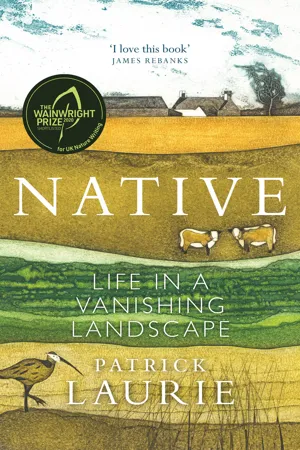
Native
eBook - ePub

Native

Life in a Vanishing Landscape

  1. 256 pages
  2. English
  3. ePUB (mobile friendly)
  4. Available on iOS & Android
eBook - ePub

Native

Life in a Vanishing Landscape

About this book

A Times Bestseller

Shortlisted for the Wainwright Prize for UK Nature Writing 2020

'Remarkable, and so profoundly enjoyable to read ... Its importance is huge, setting down a vital marker in the 21st century debate about how we use and abuse the land' - Joyce McMillan, Scotsman

Desperate to connect with his native Galloway, Patrick Laurie plunges into work on his family farm in the hills of southwest Scotland. Investing in the oldest and most traditional breeds of Galloway cattle, the Riggit Galloway, he begins to discover how cows once shaped people, places and nature in this remote and half-hidden place. This traditional breed requires different methods of care from modern farming on an industrial, totally unnatural scale.

As the cattle begin to dictate the pattern of his life, Patrick stumbles upon the passing of an ancient rural heritage. Always one of the most isolated and insular parts of the country, as the twentieth century progressed, the people of Galloway deserted the land and the moors have been transformed into commercial forest in the last thirty years. The people and the cattle have gone, and this withdrawal has shattered many centuries of tradition and custom. Much has been lost, and the new forests have driven the catastrophic decline of the much-loved curlew, a bird which features strongly in Galloway's consciousness. The links between people, cattle and wild birds become a central theme as Patrick begins to face the reality of life in a vanishing landscape.

Frequently asked questions

Yes, you can cancel anytime from the Subscription tab in your account settings on the Perlego website. Your subscription will stay active until the end of your current billing period. Learn how to cancel your subscription.
No, books cannot be downloaded as external files, such as PDFs, for use outside of Perlego. However, you can download books within the Perlego app for offline reading on mobile or tablet. Learn more here.
Perlego offers two plans: Essential and Complete
  • Essential is ideal for learners and professionals who enjoy exploring a wide range of subjects. Access the Essential Library with 800,000+ trusted titles and best-sellers across business, personal growth, and the humanities. Includes unlimited reading time and Standard Read Aloud voice.
  • Complete: Perfect for advanced learners and researchers needing full, unrestricted access. Unlock 1.4M+ books across hundreds of subjects, including academic and specialized titles. The Complete Plan also includes advanced features like Premium Read Aloud and Research Assistant.
Both plans are available with monthly, semester, or annual billing cycles.
We are an online textbook subscription service, where you can get access to an entire online library for less than the price of a single book per month. With over 1 million books across 1000+ topics, we’ve got you covered! Learn more here.
Look out for the read-aloud symbol on your next book to see if you can listen to it. The read-aloud tool reads text aloud for you, highlighting the text as it is being read. You can pause it, speed it up and slow it down. Learn more here.
Yes! You can use the Perlego app on both iOS or Android devices to read anytime, anywhere — even offline. Perfect for commutes or when you’re on the go.
Please note we cannot support devices running on iOS 13 and Android 7 or earlier. Learn more about using the app.
Yes, you can access Native by Patrick Laurie in PDF and/or ePUB format, as well as other popular books in Physical Sciences & Geology & Earth Sciences. We have over one million books available in our catalogue for you to explore.

Information

Table of contents

  1. Cover
  2. Title
  3. Copyright
  4. Contents
  5. Maps
  6. Beginnings
  7. Granite
  8. Hills
  9. Whaup
  10. Grass
  11. Crop
  12. Calves
  13. Hay
  14. Bull
  15. Harvest
  16. Mart
  17. Endings
  18. Acknowledgements