In the context of the 2016 presidential election, which was rife with charges of sexist actions, this book explains how common such behavior is among executives, why law doesn't protect victims, and how female professionals can bring change.
Who do you report sexism to when the offender owns the company?
"Overt and intentional sexism" against women by powerful men in politics, business, academia, and across the white-collar world in public and private institutions is common. Elizabeth C. Wolfe, a conflict analysis and resolution specialist, details how female executives, even at the pinnacle of their careers, remain vulnerable to their male colleagues.
In this book, women executives from nine countries explain how their career advancement and earning potential are continuously harmed though overt sexism, sexist social behavior, and microaggressions-those damaging behaviors that are in a gray area but are not legally actionable. Wolfe further examines why law does not protect these women: sexism, like racism, is a way of thinking and so cannot be legislated. Each "-ism" has legal protections against documentable actions, but ways of thinking, socializing rituals, and microaggressions are not actionable by law. Wolfe details the minds of sexists, describes how sexism is "socialized," and explains how to name each sexist behavior, address it, and take action to stop it.
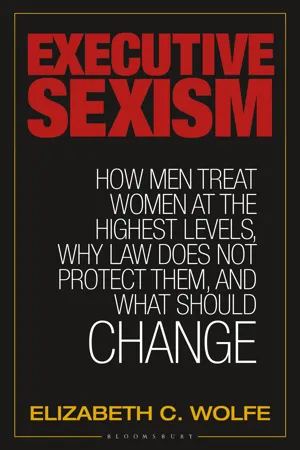
eBook - ePub
Executive Sexism
How Men Treat Women at the Highest Levels, Why Law Does Not Protect Them, and What Should Change
- 312 pages
- English
- ePUB (mobile friendly)
- Available on iOS & Android
eBook - ePub
Executive Sexism
How Men Treat Women at the Highest Levels, Why Law Does Not Protect Them, and What Should Change
About this book
Information
Table of contents
- Cover
- Title Page
- Copyright
- Dedication
- Contents
- Acknowledgments
- Part One: Facing Gradual and Sudden Sexism
- Part Two: Why Bystanders Don’t Speak Up
- Part Three: Intervention Strategies to Activate Bystanders
- References
- Index
Trusted by 375,005 students
Access to over 1.5 million titles for a fair monthly price.
Study more efficiently using our study tools.
Frequently asked questions
Yes, you can cancel anytime from the Subscription tab in your account settings on the Perlego website. Your subscription will stay active until the end of your current billing period. Learn how to cancel your subscription
No, books cannot be downloaded as external files, such as PDFs, for use outside of Perlego. However, you can download books within the Perlego app for offline reading on mobile or tablet. Learn how to download books offline
Perlego offers two plans: Essential and Complete
- Essential is ideal for learners and professionals who enjoy exploring a wide range of subjects. Access the Essential Library with 800,000+ trusted titles and best-sellers across business, personal growth, and the humanities. Includes unlimited reading time and Standard Read Aloud voice.
- Complete: Perfect for advanced learners and researchers needing full, unrestricted access. Unlock 1.5M+ books across hundreds of subjects, including academic and specialized titles. The Complete Plan also includes advanced features like Premium Read Aloud and Research Assistant.
We are an online textbook subscription service, where you can get access to an entire online library for less than the price of a single book per month. With over 1.5 million books across 990+ topics, we’ve got you covered! Learn about our mission
Look out for the read-aloud symbol on your next book to see if you can listen to it. The read-aloud tool reads text aloud for you, highlighting the text as it is being read. You can pause it, speed it up and slow it down. Learn more about Read Aloud
Yes! You can use the Perlego app on both iOS and Android devices to read anytime, anywhere — even offline. Perfect for commutes or when you’re on the go.
Please note we cannot support devices running on iOS 13 and Android 7 or earlier. Learn more about using the app
Please note we cannot support devices running on iOS 13 and Android 7 or earlier. Learn more about using the app
Yes, you can access Executive Sexism by Elizabeth C. Wolfe in PDF and/or ePUB format, as well as other popular books in Social Sciences & History & Theory in Psychology. We have over 1.5 million books available in our catalogue for you to explore.