Many world-class thinkers and creators have been concerned about the state of education in the United States. Discover their thoughts on how children really learn and what teachers must do to optimally tap children's latent abilities.
During the last three decades, education reformers have pushed standardized testing and policies like No Child Left Behind and Common Core to improve test scores and proficiency in basic skills. However, during this period that author Thomas Armstrong calls the "miseducation of America," a number of troubling trends have surfaced, including a decrease in creative thinking scores among children in kindergarten through third grade.
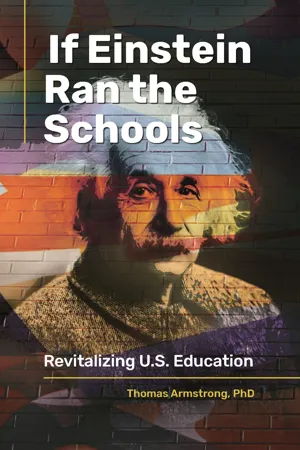
Rather than focus on what's wrong with the education system that has produced these outcomes, Armstrong lays out what creative thinkers know about how children should be educated. In an extended thought experiment, he asks what would happen if we turned the reins of educational policy over, not to the politicians and educational bureaucrats, but to eminent thinkers and creators like Albert Einstein, Pablo Picasso, Martin Luther King Jr., Rachel Carson, Doris Lessing, Jane Goodall, and other seminal culture-builders. What might they say about the best way to educate a child? If Einstein Ran the Schools suggests that the answers to this intriguing question should guide future efforts to reform our nation's schools.
- 200 pages
- English
- ePUB (mobile friendly)
- Available on iOS & Android
eBook - ePub
About this book
Information
Table of contents
- Cover
- Title
- Copyright
- Dedication
- Contents
- Chapter One: The Purpose of Education: Introducing Incredible Kids to an Amazing World
- Chapter Two: Imagination: Unleashing Our Children’s Ability to Mentally Soar
- Chapter Three: Love of Learning: Affirming the Most Important Goal of Education
- Chapter Four: Creativity: Teaching outside the Box
- Chapter Five: Playfulness: Restoring Childhood to Preschool and Kindergarten
- Chapter Six: Curiosity: Feeding Our Children’s Hunger for Knowledge
- Chapter Seven: Wonder: Reawakening Our Children’s Sense of Awe for the Mystery of Life
- Chapter Eight: Individuality: Resisting Standardization, Datafication, and Depersonalization in Education
- Chapter Nine: Neurodiversity: Emphasizing the Strengths of Kids with Special Needs
- Chapter Ten: Compassion: Educating the Heart in the “Selfie” Generation
- Chapter Eleven: Care for Nature: Cultivating a Reverence for All Living Things
- Chapter Twelve: Tolerance: Nurturing a Deep Respect for Human Differences
- Chapter Thirteen: Beauty: Sensitizing Kids to an Aesthetic Appreciation of the World
- Chapter Fourteen: The Einstein Classroom: Education for Our Children’s Future
- Appendix A: Weapons of Mass Instruction: Fifteen Reasons Standardized Tests Are Worthless
- Appendix B: Leonardo da Vinci’s IEP Meeting: The Problem with Special Education
- Appendix C: A Resource Guide for Revitalizing U.S. Education
- Notes
- Index
- About the Author
Trusted by 375,005 students
Access to over 1.5 million titles for a fair monthly price.
Study more efficiently using our study tools.
Frequently asked questions
Yes, you can cancel anytime from the Subscription tab in your account settings on the Perlego website. Your subscription will stay active until the end of your current billing period. Learn how to cancel your subscription
No, books cannot be downloaded as external files, such as PDFs, for use outside of Perlego. However, you can download books within the Perlego app for offline reading on mobile or tablet. Learn how to download books offline
Perlego offers two plans: Essential and Complete
- Essential is ideal for learners and professionals who enjoy exploring a wide range of subjects. Access the Essential Library with 800,000+ trusted titles and best-sellers across business, personal growth, and the humanities. Includes unlimited reading time and Standard Read Aloud voice.
- Complete: Perfect for advanced learners and researchers needing full, unrestricted access. Unlock 1.5M+ books across hundreds of subjects, including academic and specialized titles. The Complete Plan also includes advanced features like Premium Read Aloud and Research Assistant.
We are an online textbook subscription service, where you can get access to an entire online library for less than the price of a single book per month. With over 1.5 million books across 990+ topics, we’ve got you covered! Learn about our mission
Look out for the read-aloud symbol on your next book to see if you can listen to it. The read-aloud tool reads text aloud for you, highlighting the text as it is being read. You can pause it, speed it up and slow it down. Learn more about Read Aloud
Yes! You can use the Perlego app on both iOS and Android devices to read anytime, anywhere — even offline. Perfect for commutes or when you’re on the go.
Please note we cannot support devices running on iOS 13 and Android 7 or earlier. Learn more about using the app
Please note we cannot support devices running on iOS 13 and Android 7 or earlier. Learn more about using the app
Yes, you can access If Einstein Ran the Schools by Thomas Armstrong Ph.D. in PDF and/or ePUB format, as well as other popular books in Éducation & Théorie et pratique de l'éducation. We have over 1.5 million books available in our catalogue for you to explore.