This book examines the dynamics that lead to anger in individuals, within groups, and between groups; identifies the role of the media in angry group behavior; and offers solutions for dealing with angry groups and channeling that negative energy in positive ways.
In today's society, we see angry groups in many forms—from animal rights and climate crisis activists to citizens opposed to allowing more immigrants of certain ethnicities or religions into the country, militia groups frustrated by acts of domestic terrorism and legislation that limits gun ownership and the ability to carry weapons in public, and those outraged by what they see as police brutality or the unnecessary use of deadly force against people of color.
More than just evidence of civil unrest in society, angry groups across history and nations often ultimately affect our politics and our government, for better or worse, and sometimes result in injury, bloodshed, or financial costs that hit otherwise-uninvolved taxpayers. This book demonstrates how people across our nation are involved in, affected by, or harmed by angry groups; covers historical and modern perspectives on angry groups; ands offers suggestions for predicting and influencing the expression of angry group behavior. It provides readers with an understanding of such conflicts and of their origins and dynamics that may offer insights to successful resolution, and it identifies strategies that can reduce the suffering that comes from such conflicts.
eBook - ePub
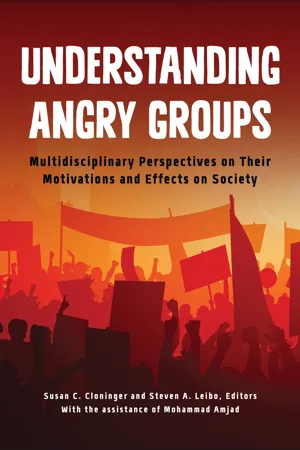
Understanding Angry Groups
Multidisciplinary Perspectives on Their Motivations and Effects on Society
- 456 pages
- English
- ePUB (mobile friendly)
- Available on iOS & Android
eBook - ePub
Understanding Angry Groups
Multidisciplinary Perspectives on Their Motivations and Effects on Society
About this book
Information
Table of contents
- Cover
- Title Page
- Copyright
- Contents
- Introduction
- Section I: From the Social Sciences and the Humanities
- Section II: From a Historical to Geopolitical Context
- Conclusion
- About the Editors and Contributors
- Index
Trusted by 375,005 students
Access to over 1.5 million titles for a fair monthly price.
Study more efficiently using our study tools.
Frequently asked questions
Yes, you can cancel anytime from the Subscription tab in your account settings on the Perlego website. Your subscription will stay active until the end of your current billing period. Learn how to cancel your subscription
No, books cannot be downloaded as external files, such as PDFs, for use outside of Perlego. However, you can download books within the Perlego app for offline reading on mobile or tablet. Learn how to download books offline
Perlego offers two plans: Essential and Complete
- Essential is ideal for learners and professionals who enjoy exploring a wide range of subjects. Access the Essential Library with 800,000+ trusted titles and best-sellers across business, personal growth, and the humanities. Includes unlimited reading time and Standard Read Aloud voice.
- Complete: Perfect for advanced learners and researchers needing full, unrestricted access. Unlock 1.5M+ books across hundreds of subjects, including academic and specialized titles. The Complete Plan also includes advanced features like Premium Read Aloud and Research Assistant.
We are an online textbook subscription service, where you can get access to an entire online library for less than the price of a single book per month. With over 1.5 million books across 990+ topics, we’ve got you covered! Learn about our mission
Look out for the read-aloud symbol on your next book to see if you can listen to it. The read-aloud tool reads text aloud for you, highlighting the text as it is being read. You can pause it, speed it up and slow it down. Learn more about Read Aloud
Yes! You can use the Perlego app on both iOS and Android devices to read anytime, anywhere — even offline. Perfect for commutes or when you’re on the go.
Please note we cannot support devices running on iOS 13 and Android 7 or earlier. Learn more about using the app
Please note we cannot support devices running on iOS 13 and Android 7 or earlier. Learn more about using the app
Yes, you can access Understanding Angry Groups by Susan C. Cloninger, Steven A. Leibo, Susan C. Cloninger,Steven A. Leibo in PDF and/or ePUB format, as well as other popular books in Social Sciences & History & Theory in Psychology. We have over 1.5 million books available in our catalogue for you to explore.