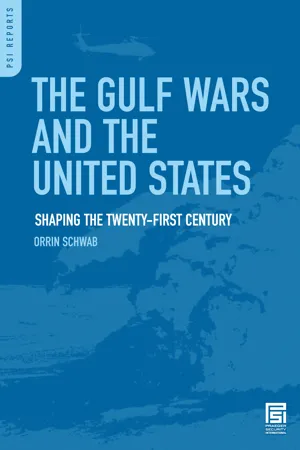
Schwab's work is five-part analysis of US policy and strategy in the Persian Gulf from 1990-2003. He begins the work by analyzing the prominence of the Persian Gulf in US global strategic thinking during the last decade of the Cold War. By that time, gulf oil had secured a paramount place in the minds of the Reagan and Bush administrations. Part two dissects the relationship that individuals and regional governments in the Persian Gulf shared with the US. Here, Schwab also examines US perceptions of those entities and demonstrates how they helped shape the policies of the US and define the status of those nations in the eyes of US policymakers. When Saddam Hussein invaded Kuwait in 1990, the paradigm shifted dramatically. Part three examines US decision-making in the period immediately after that invasion. Schwab demonstrates that while forging a broad coalition to turn back Iraq was a significant diplomatic achievement, the international determination that defined the conflict in 1990-1991 eroded and gave way to a cumbersome policy of containment. That policy ultimately resulted in the dissolution of the coalition forged by the first Bush administration and burdened his successors as they struggled to achieve the longstanding goal of creating stability throughout the region. Part four explores the efforts of the Clinton and second Bush administrations in the Gulf. Saddam was one of the primary concerns of the Clinton administration, but so too were al-Qaeda, North Korea, China, and especially Yugoslavia. Indeed, his was the first administration to truly attempt to deal with these kinds of problems in a post-Cold War world. Despite their differences, there was a tremendous amount of continuity in the policies pursued by Clinton and George W. Bush. September 11 changed that, however, as Schwab chronicles in part five. In that section he explores how the current administration's adoption of a more proactive strategy of retaliation and preventative war has given rise to a new national security regime increasingly designed to fight asymmetric war while eliminating perceived threats to our national security and interests.
Schwab's work is five-part analysis of US policy and strategy in the Persian Gulf from 1990-2003. He begins the work by analyzing the prominence of the Persian Gulf in US global strategic thinking during the last decade of the Cold War. By that time, gulf oil had secured a paramount place in the minds of the Reagan and Bush administrations. Part two dissects the relationship that individuals and regional governments in the Persian Gulf shared with the US. Here, Schwab also examines US perceptions of those entities and demonstrates how they helped shape US policy and define the status of those nations in the eyes of US policymakers. When Saddam Hussein invaded Kuwait in 1990, the paradigm shifted dramatically. Part three examines US decision-making in the period immediately after that invasion. Schwab demonstrates that while forging a broad coalition to turn back Iraq was a significant diplomatic achievement, the international determination that defined the conflict in 1990-1991 eroded and gave way to a cumbersome policy of containment. That policy ultimately resulted in the dissolution of the coalition forged by the first Bush administration and burdened his successors as they struggled to achieve the longstanding goal of creating stability throughout the region. Part four explores the efforts of the Clinton and second Bush administrations in the Gulf. Saddam was one of the primary concerns of the Clinton administration, but so too were al-Qaeda, North Korea, China, and especially Yugoslavia. Indeed, his was the first administration to truly attempt to deal with these kinds of problems in a post-Cold War world. Despite their differences, there was a tremendous amount of continuity in the policies pursued by Clinton and George W. Bush. September 11 changed that, however, as Schwab chronicles in part five. In that section he explores how the current administration's adoption of a more proactive strategy of retaliation and preventative war has given rise to a new national security regime increasingly designed to fight asymmetric war while eliminating perceived threats to our national security and interests.
- 181 pages
- English
- PDF
- Available on iOS & Android
eBook - PDF
About this book
Information
Table of contents
- Contents
- Preface
- Acknowledgments
- Chapter One: The Gulf Wars and American Foreign Relations
- Chapter Two:The Persian Gulf and the Late Cold War
- Chapter Three: The First Gulf War
- Chapter Four: The Interregnum: Clinton and the Gulf
- Chapter Five: The Third Act: George W. Bush and the Gulf
- Chapter Six: The Second Gulf War
- Chapter Seven: The Liberal Technocratic Order in the Persian Gulf
- Notes
- Index
Trusted by 375,005 students
Access to over 1.5 million titles for a fair monthly price.
Study more efficiently using our study tools.
Frequently asked questions
Yes, you can cancel anytime from the Subscription tab in your account settings on the Perlego website. Your subscription will stay active until the end of your current billing period. Learn how to cancel your subscription
No, books cannot be downloaded as external files, such as PDFs, for use outside of Perlego. However, you can download books within the Perlego app for offline reading on mobile or tablet. Learn how to download books offline
Perlego offers two plans: Essential and Complete
- Essential is ideal for learners and professionals who enjoy exploring a wide range of subjects. Access the Essential Library with 800,000+ trusted titles and best-sellers across business, personal growth, and the humanities. Includes unlimited reading time and Standard Read Aloud voice.
- Complete: Perfect for advanced learners and researchers needing full, unrestricted access. Unlock 1.5M+ books across hundreds of subjects, including academic and specialized titles. The Complete Plan also includes advanced features like Premium Read Aloud and Research Assistant.
We are an online textbook subscription service, where you can get access to an entire online library for less than the price of a single book per month. With over 1.5 million books across 990+ topics, we’ve got you covered! Learn about our mission
Look out for the read-aloud symbol on your next book to see if you can listen to it. The read-aloud tool reads text aloud for you, highlighting the text as it is being read. You can pause it, speed it up and slow it down. Learn more about Read Aloud
Yes! You can use the Perlego app on both iOS and Android devices to read anytime, anywhere — even offline. Perfect for commutes or when you’re on the go.
Please note we cannot support devices running on iOS 13 and Android 7 or earlier. Learn more about using the app
Please note we cannot support devices running on iOS 13 and Android 7 or earlier. Learn more about using the app
Yes, you can access The Gulf Wars and the United States by Orrin Schwab in PDF and/or ePUB format, as well as other popular books in Storia & Storia militare e marittima. We have over 1.5 million books available in our catalogue for you to explore.