Resource allocation decisions made by school boards, principals, and teachers are critical for they determine the adequacy and equity of resources actually made available for specific schools, educational programs and individual students. The most important resources are often concealed by aggregate state or district measures such as dollars per student. For these decisions, the most important resources are elements such as basic and supplemental staffing levels, staff time, funding amounts for textbooks and supplies, selection of new equipment (particularly technology), and support for new or renovated facilities.
The authors review current practices at each important decision-making level in school districts, from the school board to the classroom. At each juncture, the findings are interpreted to reveal both the causes of the practices and their implications for improving school effectiveness. This book provides new research in helping to inform and improve resource allocation practices in schools. The general conclusion is that improvement in the resource allocation practices in education requires a shift in focus to results instead of inputs, a strong emphasis on student learning as the primary focus of decisions, and systematic evaluation of results.
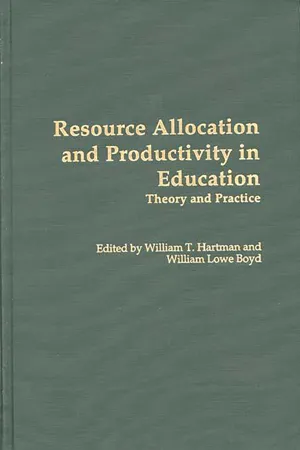
eBook - PDF
Resource Allocation and Productivity in Education
Theory and Practice
- 262 pages
- English
- PDF
- Available on iOS & Android
eBook - PDF
Resource Allocation and Productivity in Education
Theory and Practice
About this book
Information
Table of contents
- Contents
- Introduction and Overview
- 1: Productive Schools from a Policy Perspective: Desiderata, Designs, and Dilemmas
- 2: The Politics of Educational Productivity
- 3: The New Politics of Information in Education: Five Dimensions of the Change from District-Level to School-Site Financial Analysis
- 4: The Role of the School Board in Resource Allocation
- 5: Reconciling Equity and Excellence: Resource Allocation in School Districts
- 6: Understanding Resource Allocation in High Schools
- 7: Allocation and Distribution of Resources in High Schools
- 8: Transcending the Effects of School Size on the High School Curriculum
- 9: Resource Use and Student Achievement in Elementary Schools
- 10: A Policy Framework for School Resource Allocation
- Index
- About the Editors and Contributors
Trusted by 375,005 students
Access to over 1.5 million titles for a fair monthly price.
Study more efficiently using our study tools.
Frequently asked questions
Yes, you can cancel anytime from the Subscription tab in your account settings on the Perlego website. Your subscription will stay active until the end of your current billing period. Learn how to cancel your subscription
No, books cannot be downloaded as external files, such as PDFs, for use outside of Perlego. However, you can download books within the Perlego app for offline reading on mobile or tablet. Learn how to download books offline
Perlego offers two plans: Essential and Complete
- Essential is ideal for learners and professionals who enjoy exploring a wide range of subjects. Access the Essential Library with 800,000+ trusted titles and best-sellers across business, personal growth, and the humanities. Includes unlimited reading time and Standard Read Aloud voice.
- Complete: Perfect for advanced learners and researchers needing full, unrestricted access. Unlock 1.5M+ books across hundreds of subjects, including academic and specialized titles. The Complete Plan also includes advanced features like Premium Read Aloud and Research Assistant.
We are an online textbook subscription service, where you can get access to an entire online library for less than the price of a single book per month. With over 1.5 million books across 990+ topics, we’ve got you covered! Learn about our mission
Look out for the read-aloud symbol on your next book to see if you can listen to it. The read-aloud tool reads text aloud for you, highlighting the text as it is being read. You can pause it, speed it up and slow it down. Learn more about Read Aloud
Yes! You can use the Perlego app on both iOS and Android devices to read anytime, anywhere — even offline. Perfect for commutes or when you’re on the go.
Please note we cannot support devices running on iOS 13 and Android 7 or earlier. Learn more about using the app
Please note we cannot support devices running on iOS 13 and Android 7 or earlier. Learn more about using the app
Yes, you can access Resource Allocation and Productivity in Education by William L. Boyd,William T. Hartman in PDF and/or ePUB format, as well as other popular books in Education & Education General. We have over 1.5 million books available in our catalogue for you to explore.