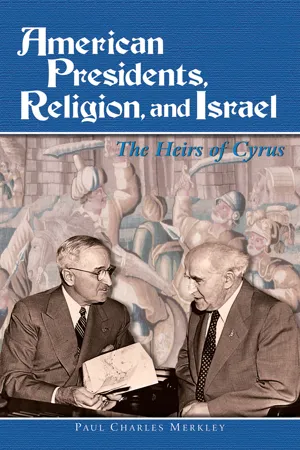
Shortly after the end of the Second World War, President Harry S Truman declared his support for the creation and maintenance of the modern state of Israel, basing that support on religious and theological grounds. This is the first book to explore the connection between the religious backgrounds and beliefs of U.S. presidents in relation to their policies toward Israel. From Truman to Ford, U.S. presidents relied, in part, on their religious and moral commitments to support their policies and views toward Israel. Beginning with Carter, however, presidents have abandoned the role of champions of Israel to become champion of the Peace Process, stressing peace and a secular approach that rises above the religious and theological fray. And yet, even in the context of this attempted fair-mindedness, U.S. presidents reveal their personal religious and moral beliefs in their responses to the issue of Israel. Today, George W. Bush, one of the most vocally religious presidents, seems poised to take up the tradition once again of relying on his religious convictions to justify his positions toward the Arab-Israeli conflict. Here, Merkley argues that while faith alone does not determine action, or that it even has a controlling influence, religious belief does play a role in the policies that U.S. presidents, and the nation, adopt toward Israel.
When Truman declared, I am Cyrus, he was emphatically grounding his support of the modern state of Israel in his belief in the Bible. Referring to the Persian king who allowed the Jews to return to Israel, and to build the Second Temple, Truman revealed his religious commitments and supported his policies on biblical grounds. Bringing to the fore neglected evidence of the role of religious belief in policies toward Israel, Merkley explores an overlooked aspect of presidential decision-making, suggesting that religion, while not the only factor, is at least among the influences that determine a president's view of the Arab-Israeli conflict. From Truman to Ford, policies often reflected the Evangelical traditions that dictated unyielding support of Israel, but with Carter's commitment to the peace process above all else, the trend turned toward moral absolutes and more general religious beliefs that could sustain arguments for a negotiated peace. George W. Bush, thus far, however, has clearly demonstrated his personal religious beliefs and may, in the end, reclaim the mantle of Cyrus.
- 296 pages
- English
- PDF
- Available on iOS & Android
eBook - PDF
About this book
Information
Table of contents
- Contents
- Introduction
- Chapter 1: The Champion of Israel
- Chapter 2: In Pursuit of “Evenhandedness“
- Chapter 3: The Camp David Process
- Chapter 4: Living with the Legacy of Camp David
- Chapter 5: The Worldwide War on Terrorism: Its Impact on Presidential Attitudes Toward Israel
- Retrospect and Conclusions
- Notes
- Selected Bibliography
- Index
Trusted by 375,005 students
Access to over 1.5 million titles for a fair monthly price.
Study more efficiently using our study tools.
Frequently asked questions
Yes, you can cancel anytime from the Subscription tab in your account settings on the Perlego website. Your subscription will stay active until the end of your current billing period. Learn how to cancel your subscription
No, books cannot be downloaded as external files, such as PDFs, for use outside of Perlego. However, you can download books within the Perlego app for offline reading on mobile or tablet. Learn how to download books offline
Perlego offers two plans: Essential and Complete
- Essential is ideal for learners and professionals who enjoy exploring a wide range of subjects. Access the Essential Library with 800,000+ trusted titles and best-sellers across business, personal growth, and the humanities. Includes unlimited reading time and Standard Read Aloud voice.
- Complete: Perfect for advanced learners and researchers needing full, unrestricted access. Unlock 1.5M+ books across hundreds of subjects, including academic and specialized titles. The Complete Plan also includes advanced features like Premium Read Aloud and Research Assistant.
We are an online textbook subscription service, where you can get access to an entire online library for less than the price of a single book per month. With over 1.5 million books across 990+ topics, we’ve got you covered! Learn about our mission
Look out for the read-aloud symbol on your next book to see if you can listen to it. The read-aloud tool reads text aloud for you, highlighting the text as it is being read. You can pause it, speed it up and slow it down. Learn more about Read Aloud
Yes! You can use the Perlego app on both iOS and Android devices to read anytime, anywhere — even offline. Perfect for commutes or when you’re on the go.
Please note we cannot support devices running on iOS 13 and Android 7 or earlier. Learn more about using the app
Please note we cannot support devices running on iOS 13 and Android 7 or earlier. Learn more about using the app
Yes, you can access American Presidents, Religion, and Israel by Paul Merkley in PDF and/or ePUB format, as well as other popular books in Theology & Religion & Religion. We have over 1.5 million books available in our catalogue for you to explore.