The abolitionists of the 1830s-1850s risked physical harm and social alienation as a result of their refusal to ignore what they considered a national sin, contrary to the ideals upon which America was founded. Derived from the moral accountability called for by the Great Awakening and the Quaker religion, the abolitionist movement demanded not just the gradual dismantling of the system or a mandated political end to slavery, but an end to prejudice in the hearts of the American people. Primary documents, illustrations and biographical sketches of notable figures illuminate the conflicted struggle to end slavery in America.
Some called them fanatics; others called them liberators and saints. Immeasurable though their ultimate impact may have been, the abolitionists of the 1830s-1850s risked physical harm and social alienation as a result of their refusal to ignore what they considered a national sin, contrary to the ideals upon which America was founded. Derived from the moral accountability called for by the Great Awakening and the Quaker religion, the abolitionist movement demanded not just the gradual dismantling of the system or a mandated political end to slavery, but an end to prejudice in the hearts of the American people. Claudine Farrell's concluding essay draws parallels between the abolitionists' struggles and the Civil Rights movement of the 1950s-1970s, demonstrating the significant amount of ground being gained in a still-unfinished war.
Five narrative chapters explore the abolitionist movement's religious beginnings, the conflict between moral justice and union preservation, and the revolts, divisions and conflicts leading up to the Civil War. Biographical portraits of such notable figures as Frederick Douglass, William Lloyd Garrison, and the Grimke sisters supplement the discussion, and selections from some of the most influential documents in American history—including the Emancipation Proclamation, the US Constitution, and The Writings of Thomas Jefferson—provide actual historical evidence of the events. Twelve illustrations, a chronology, index and extensive annotated bibliography make this an ideal starting point for students looking to understand the battle for and against slavery in America.
- 246 pages
- English
- PDF
- Available on iOS & Android
eBook - PDF
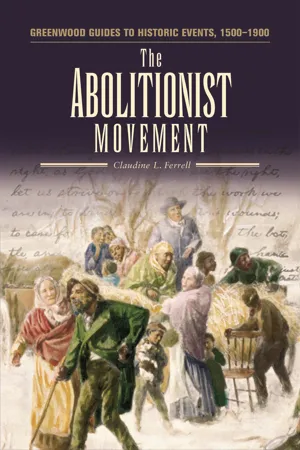
The Abolitionist Movement
Table of contents
- Contents
- Series Foreword
- Preface
- Acknowledgments
- Chronology of Events
- Chapter 1 Historical Overview
- Chapter 2 “In Matters of Right and Equity”: From Quakers to Revolution
- Chapter 3 “Justice Is in One Scale, and Self-Preservation in the Other”: Slavery and Anti-Slavery in the New Nation
- Chapter 4 “Though the Heavens Should Fall”: Abolitionism Takes Shape—The 1830s
- Chapter 5 “Contrary to the Laws of God and the Rights of Man”: Politics versus Spirituality—The 1840s
- Chapter 6 “The Storm, the Whirlwind, and the Earthquake”: From Politics and Violence to Freedom—The 1850s–1860s
- Chapter 7 Concluding Interpretive Essay
- Biographies: Personalities of the Abolitionist Movement
- Primary Documents of Abolitionism
- Annotated Bibliography
- Index
- Photographs follow page 86.
Trusted by 375,005 students
Access to over 1.5 million titles for a fair monthly price.
Study more efficiently using our study tools.
Frequently asked questions
Yes, you can cancel anytime from the Subscription tab in your account settings on the Perlego website. Your subscription will stay active until the end of your current billing period. Learn how to cancel your subscription
No, books cannot be downloaded as external files, such as PDFs, for use outside of Perlego. However, you can download books within the Perlego app for offline reading on mobile or tablet. Learn how to download books offline
Perlego offers two plans: Essential and Complete
- Essential is ideal for learners and professionals who enjoy exploring a wide range of subjects. Access the Essential Library with 800,000+ trusted titles and best-sellers across business, personal growth, and the humanities. Includes unlimited reading time and Standard Read Aloud voice.
- Complete: Perfect for advanced learners and researchers needing full, unrestricted access. Unlock 1.5M+ books across hundreds of subjects, including academic and specialized titles. The Complete Plan also includes advanced features like Premium Read Aloud and Research Assistant.
We are an online textbook subscription service, where you can get access to an entire online library for less than the price of a single book per month. With over 1.5 million books across 990+ topics, we’ve got you covered! Learn about our mission
Look out for the read-aloud symbol on your next book to see if you can listen to it. The read-aloud tool reads text aloud for you, highlighting the text as it is being read. You can pause it, speed it up and slow it down. Learn more about Read Aloud
Yes! You can use the Perlego app on both iOS and Android devices to read anytime, anywhere — even offline. Perfect for commutes or when you’re on the go.
Please note we cannot support devices running on iOS 13 and Android 7 or earlier. Learn more about using the app
Please note we cannot support devices running on iOS 13 and Android 7 or earlier. Learn more about using the app
Yes, you can access The Abolitionist Movement by Claudine L. Ferrell in PDF and/or ePUB format, as well as other popular books in History & North American History. We have over 1.5 million books available in our catalogue for you to explore.