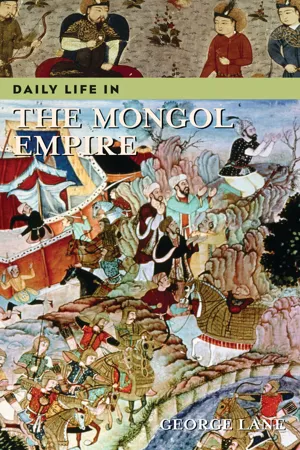
The Mongol Empire comes to life in this vivid account of the lives of ordinary people who lived under the rule of Ghengis Khan. The book allows the reader to enjoy traditional Mongol folktales and experience life in a yurt, the tent in which the nomadic Mongols lived. It explains why the Mongols had a reputation for being savage barbarians by describing their fur-lined clothes and their heavy, meat- and alcohol-based diet. It supplies first-hand accounts of fighting in Ghengis Khan's decimalized army, and explores the various tasks that were left up to the women, such as loading and unloading the wagons when traveling. High school students and undergraduates can compare and contrast religious beliefs and various laws of the Mongols with those of other cultures they are studying. From traditional medicinal treatments to the Great Yasa law system, readers young and old can enjoy this comprehensive, in-depth study of everyday living during the Mongol Empire.
The Mongol Empire comes to life in this vivid account of the lives of ordinary people who lived under the rule of Ghengis Khan. The book allows the reader to enjoy traditional Mongol folktales and experience life in a yurt, the tent in which the nomadic Mongols lived. It explains why the Mongols had a reputation for being savage barbarians by describing their fur-lined clothes and their heavy, meat- and alcohol-based diet. It supplies first-hand accounts about fighting in Ghengis Khan's army and explores the various tasks that were left up to the women, such as loading and unloading the wagons when traveling. High school students and undergraduates can compare and contrast religious beliefs and various laws of the Mongols with those of other cultures they are studying. From traditional medicinal treatments to the Great Yasa law system, readers young and old can enjoy this comprehensive, in-depth study of everyday living during the Mongol Empire.
In addition to general questions, Lane delves into specific situations of everyday living during the Mongol Empire. Questions such as How did the judicial system of the Mongol Empire work? and What spices were generally used in Mongol cooking? are answered in this extensive study. Subjects include: the structure of steppe society; clothes and hairstyles; the evolution of the nomadic life to one more permanent; the decimalization of the Mongol army; and the shaman's methods of healing sick patients. Other topics are: the Mongols' insatiable thirst for airag, an alcoholic beverage; Hu Szu-hui's royal cookbook; the liberal religious beliefs held by the Mongols; Ghengis Khan's strict law system; and the status of Mongol women. Passages from ancient texts and authors enhance this reference work, one that is essential to all school and public libraries.
eBook - PDF
Daily Life in the Mongol Empire
Table of contents
- Contents
- Epigraph
- Preface
- Chronology
- 1. Historical Overview: Genghis Khan and Mongol Rule
- 2. Steppe Life
- 3. Appearance
- 4. Dwellings
- 5. The Army
- 6. Health and Medicine
- 7. Drinking and the Mongols
- 8. Food
- 9. Religion and the Mongols
- 10. Law and Mongol Rule
- 11. Women and the Mongols
- 12. Folktales from Mongolia
- Appendix: Personages
- Glossary
- Primary Sources and those Available in Translation
- Secondary Sources: Annotated Bibliography
- Index
Trusted by 375,005 students
Access to over 1.5 million titles for a fair monthly price.
Study more efficiently using our study tools.
Frequently asked questions
Yes, you can cancel anytime from the Subscription tab in your account settings on the Perlego website. Your subscription will stay active until the end of your current billing period. Learn how to cancel your subscription
No, books cannot be downloaded as external files, such as PDFs, for use outside of Perlego. However, you can download books within the Perlego app for offline reading on mobile or tablet. Learn how to download books offline
Perlego offers two plans: Essential and Complete
- Essential is ideal for learners and professionals who enjoy exploring a wide range of subjects. Access the Essential Library with 800,000+ trusted titles and best-sellers across business, personal growth, and the humanities. Includes unlimited reading time and Standard Read Aloud voice.
- Complete: Perfect for advanced learners and researchers needing full, unrestricted access. Unlock 1.5M+ books across hundreds of subjects, including academic and specialized titles. The Complete Plan also includes advanced features like Premium Read Aloud and Research Assistant.
We are an online textbook subscription service, where you can get access to an entire online library for less than the price of a single book per month. With over 1.5 million books across 990+ topics, we’ve got you covered! Learn about our mission
Look out for the read-aloud symbol on your next book to see if you can listen to it. The read-aloud tool reads text aloud for you, highlighting the text as it is being read. You can pause it, speed it up and slow it down. Learn more about Read Aloud
Yes! You can use the Perlego app on both iOS and Android devices to read anytime, anywhere — even offline. Perfect for commutes or when you’re on the go.
Please note we cannot support devices running on iOS 13 and Android 7 or earlier. Learn more about using the app
Please note we cannot support devices running on iOS 13 and Android 7 or earlier. Learn more about using the app
Yes, you can access Daily Life in the Mongol Empire by George Lane in PDF and/or ePUB format, as well as other popular books in History & World History. We have over 1.5 million books available in our catalogue for you to explore.