Herbert Hoover, as Secretary of Commerce, and Benjamin Strong, as Governor of the Federal Reserve Bank of New York, played a critical role in the formulation of American monetary policy during the 1920s. Yet little attention has been given to the relationship between them—at first cooperative, then increasingly one of conflict and factionalism—or to the impact of that relationship on policy formulation. This book sheds new light on their roles in policy making and relates those roles to larger conflicts over where policy should be made, how the Federal Reserve System should be structured, and the balance that should be struck between international, national, and regional considerations.
Focusing on the Hoover-Strong relationship from a political rather than a purely economic perspective, the book's scope includes both domestic and international aspects of Federal Reserve policy formulation. New sources have enabled the author to provide both fresh details and a broader interpretation. Elaborating on the belief that the Depression resulted from policies developed during the autumn of 1927, the author contends that the foundation for those policies was laid with America's decision to underwrite the Dawes plan, the decision to underwrite England's return to the gold standard, and the involvement in European monetary stabilization—all issues over which Hoover and Strong disagreed.
eBook - PDF
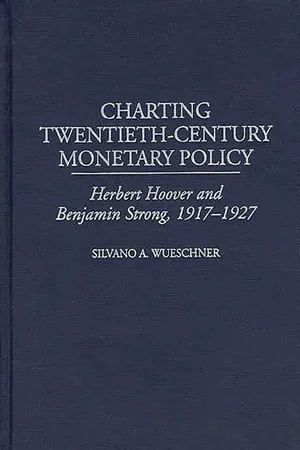
Charting Twentieth-Century Monetary Policy
Herbert Hoover and Benjamin Strong, 1917-1927
- 202 pages
- English
- PDF
- Available on iOS & Android
eBook - PDF
Charting Twentieth-Century Monetary Policy
Herbert Hoover and Benjamin Strong, 1917-1927
Table of contents
- Contents
- Foreword
- Introduction
- 1. The Emergence of Factions: Differing Views on the Roles for the Federal Reserve System
- 2. The Clash of Factions, 1921-1924
- 3. Foreign Developments: The Move to Stabilize
- 4. The Elusive Demon: Speculation
- 5. Stabilization: From Wall Street to Congress
- 6. Easy Money
- 7. Conclusion
- Glossary
- Bibliography
- Index
Trusted by 375,005 students
Access to over 1.5 million titles for a fair monthly price.
Study more efficiently using our study tools.
Frequently asked questions
Yes, you can cancel anytime from the Subscription tab in your account settings on the Perlego website. Your subscription will stay active until the end of your current billing period. Learn how to cancel your subscription
No, books cannot be downloaded as external files, such as PDFs, for use outside of Perlego. However, you can download books within the Perlego app for offline reading on mobile or tablet. Learn how to download books offline
Perlego offers two plans: Essential and Complete
- Essential is ideal for learners and professionals who enjoy exploring a wide range of subjects. Access the Essential Library with 800,000+ trusted titles and best-sellers across business, personal growth, and the humanities. Includes unlimited reading time and Standard Read Aloud voice.
- Complete: Perfect for advanced learners and researchers needing full, unrestricted access. Unlock 1.5M+ books across hundreds of subjects, including academic and specialized titles. The Complete Plan also includes advanced features like Premium Read Aloud and Research Assistant.
We are an online textbook subscription service, where you can get access to an entire online library for less than the price of a single book per month. With over 1.5 million books across 990+ topics, we’ve got you covered! Learn about our mission
Look out for the read-aloud symbol on your next book to see if you can listen to it. The read-aloud tool reads text aloud for you, highlighting the text as it is being read. You can pause it, speed it up and slow it down. Learn more about Read Aloud
Yes! You can use the Perlego app on both iOS and Android devices to read anytime, anywhere — even offline. Perfect for commutes or when you’re on the go.
Please note we cannot support devices running on iOS 13 and Android 7 or earlier. Learn more about using the app
Please note we cannot support devices running on iOS 13 and Android 7 or earlier. Learn more about using the app
Yes, you can access Charting Twentieth-Century Monetary Policy by Silvano A. Wueschner in PDF and/or ePUB format, as well as other popular books in Economics & Business General. We have over 1.5 million books available in our catalogue for you to explore.