The economy of the ancient Middle East and Greece is reinterpreted by Morris Silver in this provocative new synthesis. Silver finds that the ancient economy emerges as a class of economies with its own laws of motion shaped by transaction costs (the resources used up in exchanging ownership rights). The analysis of transaction costs provides insights into many characteristics of the ancient economy, such as the important role of the sacred and symbolic gestures in making contracts, magical technology, the entrepreneurial role of high-born women, the elevation of familial ties and other departures from impersonal economics, reliance on slavery and adoption, and the insatiable drive to accumulate trust-capital. The peculiar behavior patterns and mindsets of ancient economic man are shown to be facilitators of economic growth.
In recent years, our view of the economy of the ancient world has been shaped by the theories of Karl Polanyi. Silver confronts Polanyi's empirical propositions with the available evidence and demonstrates that antiquity knew active and sophisticated markets. In the course of providing an alternative analytical framework for studying the ancient economy, Silver gives critical attention to the economic views of the Assyriologists I.M. Diakonoff, W.F. Leemans, Mario Liverani, and J.N. Postgate; of the Egyptologists Jacob J. Janssen and Wolfgang Helck; and of the numerous followers of Moses Finley. Silver convincingly demonstrates that the ancient world was not static: periods of pervasive economic regulation by the state are interspersed with lengthy periods of relatively unfettered market activity, and the economies of Sumer, Babylonia, and archaic Greece were capable of transforming themselves in order to take advantage of new opportunities. This new synthesis is essential reading for economic historians and researchers of the ancient Near East and Greece.
- 288 pages
- English
- PDF
- Available on iOS & Android
eBook - PDF
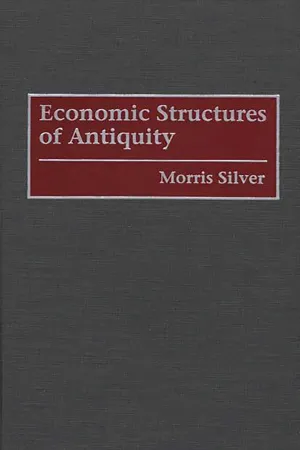
Economic Structures of Antiquity
Table of contents
- Contents
- Acknowledgments
- Author's Notes
- Chronological Table
- Introduction
- Part I: Structural Characteristics of the Ancient Economy
- Part II: Markets in Antiquity: The Challenge of the Evidence
- Part III: The Response to Changes in Economic Incentives and Public Policy
- Selected Bibliography
- Index
Trusted by 375,005 students
Access to over 1.5 million titles for a fair monthly price.
Study more efficiently using our study tools.
Frequently asked questions
Yes, you can cancel anytime from the Subscription tab in your account settings on the Perlego website. Your subscription will stay active until the end of your current billing period. Learn how to cancel your subscription
No, books cannot be downloaded as external files, such as PDFs, for use outside of Perlego. However, you can download books within the Perlego app for offline reading on mobile or tablet. Learn how to download books offline
Perlego offers two plans: Essential and Complete
- Essential is ideal for learners and professionals who enjoy exploring a wide range of subjects. Access the Essential Library with 800,000+ trusted titles and best-sellers across business, personal growth, and the humanities. Includes unlimited reading time and Standard Read Aloud voice.
- Complete: Perfect for advanced learners and researchers needing full, unrestricted access. Unlock 1.5M+ books across hundreds of subjects, including academic and specialized titles. The Complete Plan also includes advanced features like Premium Read Aloud and Research Assistant.
We are an online textbook subscription service, where you can get access to an entire online library for less than the price of a single book per month. With over 1.5 million books across 990+ topics, we’ve got you covered! Learn about our mission
Look out for the read-aloud symbol on your next book to see if you can listen to it. The read-aloud tool reads text aloud for you, highlighting the text as it is being read. You can pause it, speed it up and slow it down. Learn more about Read Aloud
Yes! You can use the Perlego app on both iOS and Android devices to read anytime, anywhere — even offline. Perfect for commutes or when you’re on the go.
Please note we cannot support devices running on iOS 13 and Android 7 or earlier. Learn more about using the app
Please note we cannot support devices running on iOS 13 and Android 7 or earlier. Learn more about using the app
Yes, you can access Economic Structures of Antiquity by Morris Silver in PDF and/or ePUB format, as well as other popular books in History & Ancient History. We have over 1.5 million books available in our catalogue for you to explore.