Electricity has penetrated deeply into virtually every aspect of American life, be it in industry, the home, or in the rapidly growing commercial and service sectors. This book documents and analyzes the existence of a strong, and growing, synergy between technological progress and the use of electrified production techniques in the United States during the twentieth century. The authors use two types of information in their work: case studies of the ways in which technological progress in particular industries and economic sectors has depended upon the adoption of electrified methods of production and aggregative long-term national economic statistics that measure the changing relationship over time between increases in the use of electricity and other factor inputs and the growth in industrial productivity. Eleven of the book's thirteen chapters cover the case studies, while the remaining two chapters and the statistical appendix contain the broad quantitative findings and supporting data.
In their analysis, the authors address three inter-related questions from a long-term evolutionary perspective: Why has electricity's share of total energy risen so sharply over the years? How has this rise been related to productivity growth? and Why has the rise in electricity led to long-term improvements in the efficiency of overall energy use despite the thermal energy losses sustained when fuels are converted into electricity? The answer to these questions, they contend, is the technological progress represented by electrified production technologies, and in the new ways of organizing production that are now possible. The different ways in which electrical energy has been put to work, and with what results, are examined in the various case studies presented, and further documented in the aggregative statistical analysis. This study reveals the important role that the electrification of production operations has played in supporting productivity growth in manufacturing and other economic sectors in the past, and the important part that it can continue to play in the future. This book will appeal to a broad spectrum of readers; those interested in productivity issues, energy policy, electricity in general, historians of technology, economic historians, and those interested in current technological issues. It will be a necessary acquisition for college and university libraries, as well as those individuals interested in energy, technology, economic growth, history, and the interfaces among them.
eBook - PDF
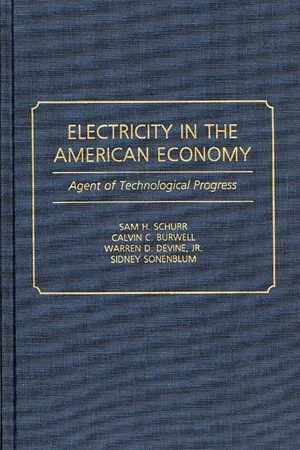
Electricity in the American Economy
Agent of Technological Progress
- 464 pages
- English
- PDF
- Available on iOS & Android
eBook - PDF
Electricity in the American Economy
Agent of Technological Progress
About this book
Information
Table of contents
- Contents
- Figures and Tables
- Preface
- Overview
- Part I: Electricity in Manufacturing: Its Role in the Organization of Production Systems
- Part II: Electricity in Manufacturing: Its Role in Materials Processing
- Part III: Electricity in Nonmanufacturing: Its Various Roles
- Part IV: Long-Term Quantitative Trends: Electricity Use, Productivity Growth, and Energy Conservation
- Appendix I: The Growth of Electricity Consumption in Historical Perspective
- Appendix II: Basic Statistical Data: Long-Term Quantitative Trends
- Author Index
- Subject Index
Trusted by 375,005 students
Access to over 1.5 million titles for a fair monthly price.
Study more efficiently using our study tools.
Frequently asked questions
Yes, you can cancel anytime from the Subscription tab in your account settings on the Perlego website. Your subscription will stay active until the end of your current billing period. Learn how to cancel your subscription
No, books cannot be downloaded as external files, such as PDFs, for use outside of Perlego. However, you can download books within the Perlego app for offline reading on mobile or tablet. Learn how to download books offline
Perlego offers two plans: Essential and Complete
- Essential is ideal for learners and professionals who enjoy exploring a wide range of subjects. Access the Essential Library with 800,000+ trusted titles and best-sellers across business, personal growth, and the humanities. Includes unlimited reading time and Standard Read Aloud voice.
- Complete: Perfect for advanced learners and researchers needing full, unrestricted access. Unlock 1.5M+ books across hundreds of subjects, including academic and specialized titles. The Complete Plan also includes advanced features like Premium Read Aloud and Research Assistant.
We are an online textbook subscription service, where you can get access to an entire online library for less than the price of a single book per month. With over 1.5 million books across 990+ topics, we’ve got you covered! Learn about our mission
Look out for the read-aloud symbol on your next book to see if you can listen to it. The read-aloud tool reads text aloud for you, highlighting the text as it is being read. You can pause it, speed it up and slow it down. Learn more about Read Aloud
Yes! You can use the Perlego app on both iOS and Android devices to read anytime, anywhere — even offline. Perfect for commutes or when you’re on the go.
Please note we cannot support devices running on iOS 13 and Android 7 or earlier. Learn more about using the app
Please note we cannot support devices running on iOS 13 and Android 7 or earlier. Learn more about using the app
Yes, you can access Electricity in the American Economy by Sam H. Schurr,Calvin C. Burwell,Warren S. Devine,Sidney Sonenblum in PDF and/or ePUB format, as well as other popular books in Physical Sciences & Energy. We have over 1.5 million books available in our catalogue for you to explore.