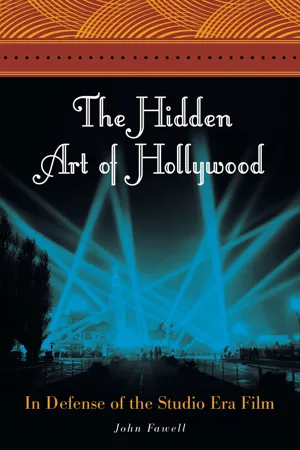
Although we tend to accord our highest praise to films with strong messages, Hollywood is resolutely unserious in its goals, and closer perhaps to music than to literature in this regard. Thus, in order to appreciate Hollywood's classic movies, we have to understand them as the result of a style of filmmaking that justifies itself through the grace and beauty of its form. This beauty, when seen, challenges our notion of film as the poorer cousin of the high arts, or as worthwhile only when it serves a social purpose. The Hidden Art of Hollywood draws from a huge fund of recorded interviews with the directors, writers, cinematographers, set designers, producers, and actors who were a part of the studio process, in order to give the filmmakers themselves the chance to explain a very elusive phenomenon: the glancing beauty of the Hollywood film.
While the greatness of the classic Hollywood film is, for many of us, settled business, there are also a great number who have difficulty understanding why these films—which can often seem dated and unrealistic compared to modern fare—are taken as seriously as they are. Although we tend to accord our highest praise to films with strong and often didactic messages, Hollywood is resolutely unserious in its goals, and closer perhaps to music than to literature in this regard. Thus, in order to appreciate classic American movies, we have to understand them as the result of a style of filmmaking that justifies itself not through ideas or social relevance, but through the grace and beauty of its form.
The beauty of the Hollywood film challenges our notion of film as the poorer cousin of the high arts, or as worthwhile only when it serves a social purpose. In his effort to answer the many questions that classic American cinema suggests, author John Fawell considers previous criticism of Hollywood, but also draws from a huge fund of recorded interviews with the directors, writers, cinematographers, set designers, producers, and actors who were a part of the studio process, in order to give the filmmakers themselves the chance to explain a very elusive phenomenon: the glancing beauty of the Hollywood film. The films of certain great auteurs, including Charlie Chaplin, Ernst Lubitsch, Preston Sturges, Alfred Hitchcock, Billy Wilder, John Ford, and Orson Welles, receive particular attention here, but this book is organized by ideas rather than films or artists, and it draws from a wide array of Hollywood films, both successes and failures, to make its points.
- 240 pages
- English
- PDF
- Available on iOS & Android
eBook - PDF
About this book
Information
Table of contents
- Contents
- Introduction
- 1. When Is Classic Hollywood?
- 2. Who Is the Artist?
- 3. What Is a Great Hollywood Film? The Difficulty in Establishing a Hierarchy
- 4. Taking Classic Hollywood Seriously
- 5. Hollywood’s Classicism
- 6. Hollywood: An Art of Silence and Ellipses
- 7. Hollywood, Style, and Decoration
- 8. The Artificiality of the Hollywood Film
- 9. Hollywood and Sentiment
- 10. Hollywood Acting
- 11. Character Actors
- 12. Hollywood Writing
- 13. Hollywood and Rhythm
- Conclusion
- Notes
- Bibliography
- Index
Trusted by 375,005 students
Access to over 1.5 million titles for a fair monthly price.
Study more efficiently using our study tools.
Frequently asked questions
Yes, you can cancel anytime from the Subscription tab in your account settings on the Perlego website. Your subscription will stay active until the end of your current billing period. Learn how to cancel your subscription
No, books cannot be downloaded as external files, such as PDFs, for use outside of Perlego. However, you can download books within the Perlego app for offline reading on mobile or tablet. Learn how to download books offline
Perlego offers two plans: Essential and Complete
- Essential is ideal for learners and professionals who enjoy exploring a wide range of subjects. Access the Essential Library with 800,000+ trusted titles and best-sellers across business, personal growth, and the humanities. Includes unlimited reading time and Standard Read Aloud voice.
- Complete: Perfect for advanced learners and researchers needing full, unrestricted access. Unlock 1.5M+ books across hundreds of subjects, including academic and specialized titles. The Complete Plan also includes advanced features like Premium Read Aloud and Research Assistant.
We are an online textbook subscription service, where you can get access to an entire online library for less than the price of a single book per month. With over 1.5 million books across 990+ topics, we’ve got you covered! Learn about our mission
Look out for the read-aloud symbol on your next book to see if you can listen to it. The read-aloud tool reads text aloud for you, highlighting the text as it is being read. You can pause it, speed it up and slow it down. Learn more about Read Aloud
Yes! You can use the Perlego app on both iOS and Android devices to read anytime, anywhere — even offline. Perfect for commutes or when you’re on the go.
Please note we cannot support devices running on iOS 13 and Android 7 or earlier. Learn more about using the app
Please note we cannot support devices running on iOS 13 and Android 7 or earlier. Learn more about using the app
Yes, you can access The Hidden Art of Hollywood by John Fawell in PDF and/or ePUB format, as well as other popular books in Media & Performing Arts & Film & Video. We have over 1.5 million books available in our catalogue for you to explore.