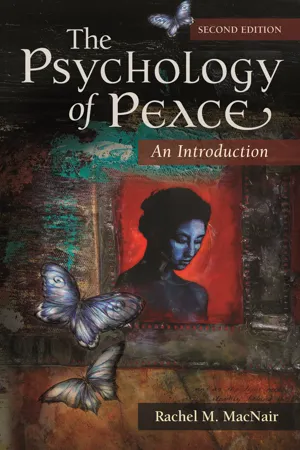
Despite our advances in technology and education, we still live in a world permeated by violence. This introductory textbook in the field of peace psychology addresses the psychological causes of violence and nonviolence, conflict resolution, nonviolent struggle, and the confluence of public policy and private lifestyles.
Just as health providers study disease and its prevention, understanding the causes of violent behavior and how to prevent such behavior is a basic cornerstone for those who are working towards a healthy society. Another parallel: maintaining physical health involves positive practices; similarly, positive nonviolent approaches need to be psychologically understood and encouraged. The second edition of The Psychology of Peace: An Introduction demonstrates what can be learned through the lens of peace psychology, providing a solid foundation in the psychological theories needed for building and maintaining a peaceful society and peaceful individuals.
This second edition incorporates the tremendous amount of new research and subsequent events since 2003, including post-2003 violent and nonviolent revolutions, such as the ongoing war in Iraq and Afghanistan, and the nonviolent overthrowing of dictators in Tunisia and Egypt. Author MacNair again outlines why application of psychological study to the soundness of decision-making for public policy—and to the policies themselves—is crucial knowledge, and how applying the study to private practices and even art can help build up a peaceful society.
- 278 pages
- English
- PDF
- Available on iOS & Android
eBook - PDF
About this book
Information
Table of contents
- Cover
- Contents
- Introduction
- 1. Psychological Causes of Violence
- 2. Psychological Effects of Violence
- 3. Psychological Causes of Nonviolence
- 4. Psychological Effects of Nonviolence
- 5. Conflict Resolution
- 6. Nonviolent Struggle and Social Movements
- 7. Public Policy Issues of Violence
- 8. Gentle Lives and Culture
- History of Peace Psychology
- References
- Index
Trusted by 375,005 students
Access to over 1.5 million titles for a fair monthly price.
Study more efficiently using our study tools.
Frequently asked questions
Yes, you can cancel anytime from the Subscription tab in your account settings on the Perlego website. Your subscription will stay active until the end of your current billing period. Learn how to cancel your subscription
No, books cannot be downloaded as external files, such as PDFs, for use outside of Perlego. However, you can download books within the Perlego app for offline reading on mobile or tablet. Learn how to download books offline
Perlego offers two plans: Essential and Complete
- Essential is ideal for learners and professionals who enjoy exploring a wide range of subjects. Access the Essential Library with 800,000+ trusted titles and best-sellers across business, personal growth, and the humanities. Includes unlimited reading time and Standard Read Aloud voice.
- Complete: Perfect for advanced learners and researchers needing full, unrestricted access. Unlock 1.5M+ books across hundreds of subjects, including academic and specialized titles. The Complete Plan also includes advanced features like Premium Read Aloud and Research Assistant.
We are an online textbook subscription service, where you can get access to an entire online library for less than the price of a single book per month. With over 1.5 million books across 990+ topics, we’ve got you covered! Learn about our mission
Look out for the read-aloud symbol on your next book to see if you can listen to it. The read-aloud tool reads text aloud for you, highlighting the text as it is being read. You can pause it, speed it up and slow it down. Learn more about Read Aloud
Yes! You can use the Perlego app on both iOS and Android devices to read anytime, anywhere — even offline. Perfect for commutes or when you’re on the go.
Please note we cannot support devices running on iOS 13 and Android 7 or earlier. Learn more about using the app
Please note we cannot support devices running on iOS 13 and Android 7 or earlier. Learn more about using the app
Yes, you can access The Psychology of Peace by Rachel M. MacNair in PDF and/or ePUB format, as well as other popular books in Psychologie & Histoire et théorie en psychologie. We have over 1.5 million books available in our catalogue for you to explore.