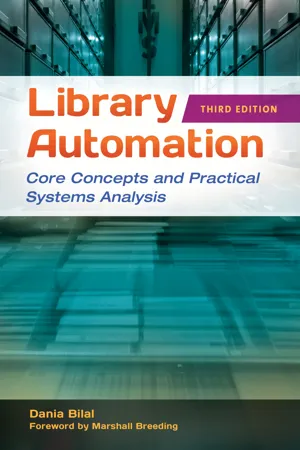
Recent advances in technology such as cloud computing, recent industry standards such as RFID, bibliographic standards like RDA and BIBFRAME, the increased adoption of open source integrated library systems (ILS), and continued shift in users' expectations have increased the complexity of the decision regarding ILS for all types of libraries. Recent advances in technology such as cloud computing, recent industry standards such as RFID, bibliographic standards like RDA and BIBFRAME, the increased adoption of open source integrated library systems (ILS), and continued shift in users' expectations have increased the complexity of the decision regarding ILS for all types of libraries. In a complete re-envisioning of the previous edition, Automating Media Centers and Small Libraries: A Microcomputer-Based Approach, Dania Bilal conceptualizes library automation in the Library Automation Life Cycle (LALC) that is informed by the systems development lifecycle (SDLC). She explains how the next-generation discovery services supported in the library services platforms (LSPs) provide a single point of access to library content in all types and formats, thereby offering a unified solution to managing library operations. The book covers methods of analyzing user requirements, describes how to structure these requirements in RFPs, and details proprietary and open-source integrated library systems (ILSs) and LSPs for school, public, special, and academic libraries. Up-to-date information is provided about ILS software installation and testing, software and hardware architecture such as single- and multi-tenant SaaS and Paas and IaaS, and usability assessment strategies for evaluating the ILS or LSP. The author concludes by describing what is likely coming next in the library automation arena.
- 312 pages
- English
- ePUB (mobile friendly)
- Available on iOS & Android
eBook - ePub
About this book
Information
Table of contents
- Cover
- Title
- Copyright
- Dedication
- Contents
- Illustrations
- Foreword
- Acknowledgments
- Introduction
- Chapter 1: Integrated Library System (ILS) Defined
- Chapter 2: Library Automation Life Cycle (LALC) Phase 1: System Identification and Planning
- Chapter 3: LALC Phase 2: Gathering User Requirements
- Chapter 4: LALC Phase 3: Structuring User Requirements and Selecting a System
- Chapter 5: LALC Phase 4: System Implementation. Part I. Preparing the Collection for the Integrated Library System
- Chapter 6: LALC Phase 4: System Implementation. Part II. Installation, Testing, Facility, Training, and Tracking System Use
- Chapter 7: Software, Hardware, and Network Architecture
- Chapter 8: System (ILS) Migration
- Chapter 9: LALC Phase 5: Evaluating System Use Through Usability
- Chapter 10: Library Automation “On the Move”
- Appendix: Sample Request for Proposal by the Brentwood Library, Brentwood, TN
- Glossary of Terms
- Index
Trusted by 375,005 students
Access to over 1.5 million titles for a fair monthly price.
Study more efficiently using our study tools.
Frequently asked questions
Yes, you can cancel anytime from the Subscription tab in your account settings on the Perlego website. Your subscription will stay active until the end of your current billing period. Learn how to cancel your subscription
No, books cannot be downloaded as external files, such as PDFs, for use outside of Perlego. However, you can download books within the Perlego app for offline reading on mobile or tablet. Learn how to download books offline
Perlego offers two plans: Essential and Complete
- Essential is ideal for learners and professionals who enjoy exploring a wide range of subjects. Access the Essential Library with 800,000+ trusted titles and best-sellers across business, personal growth, and the humanities. Includes unlimited reading time and Standard Read Aloud voice.
- Complete: Perfect for advanced learners and researchers needing full, unrestricted access. Unlock 1.5M+ books across hundreds of subjects, including academic and specialized titles. The Complete Plan also includes advanced features like Premium Read Aloud and Research Assistant.
We are an online textbook subscription service, where you can get access to an entire online library for less than the price of a single book per month. With over 1.5 million books across 990+ topics, we’ve got you covered! Learn about our mission
Look out for the read-aloud symbol on your next book to see if you can listen to it. The read-aloud tool reads text aloud for you, highlighting the text as it is being read. You can pause it, speed it up and slow it down. Learn more about Read Aloud
Yes! You can use the Perlego app on both iOS and Android devices to read anytime, anywhere — even offline. Perfect for commutes or when you’re on the go.
Please note we cannot support devices running on iOS 13 and Android 7 or earlier. Learn more about using the app
Please note we cannot support devices running on iOS 13 and Android 7 or earlier. Learn more about using the app
Yes, you can access Library Automation by Dania Bilal in PDF and/or ePUB format, as well as other popular books in Languages & Linguistics & Library & Information Science. We have over 1.5 million books available in our catalogue for you to explore.