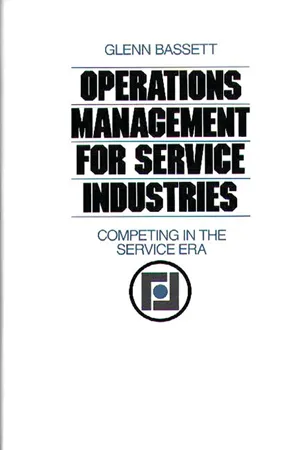
Effective service delivery requires a transition from high-volume, long-run operations to low-volume, short-run output. In conventional terms, inefficiency is inherent in such a shift. The Japanese experience suggests, however, that this convention is in error; success is available if we can only organize operations away from capital toward labor intensiveness with emphasis on multipurpose machinery and multiskilled workers as the foundation. Wholly new devices that accept the inevitability of bottlenecks and focus on managing them are required for managing work flow. A century of mass production has set in place habits and concepts of operations management that are inappropriate to the need. A new vision is needed. This book outlines an operations vision based on proven principles of management and organization science that can guide the way into an emerging service era.
Glenn Bassett looks at a variety of service industries from the perspective of cost and quality management. He argues the basic inevitablitity of suboptimized plant and equipment utilization. The potential for conflict between commodity and noncommodity dimensions of service is examined. Basic methods of cost control and work flow management are described. The varied and sometimes shifting bases of service quality are described in considerable detail, industry by industry where necessary. Methods for selecting and training effective service-providers are reviewed. Reform of government service as metaphor and model for the service revolution is detailed. The focus always is on sound, cost-effective, high-quality service delivery using the best available operations methods. It is sound operations management that will contribute genuine value to tomorrow's service industries. The basics of that discipline are the subject of this book.
- 278 pages
- English
- PDF
- Available on iOS & Android
eBook - PDF
Table of contents
- Contents
- Preface
- Chapter 1 Service: The Customization Imperative
- Chapter 2 Commodity and Service Aspects of Some Common Services Contrasted
- Chapter 3 Effective Service Delivery
- Chapter 4 Capacity for Service: The Fundamental Strategic Challenge
- Chapter 5 Building Inventories of Flexible Service Supplier Skill
- Chapter 6 Basic Operating Policy: Service versus Commodity
- Chapter 7 Planning/Forecasting to Meet Service Demand
- Chapter 8 Lead Time, Cost Breaks and Inventory Control in Service Operations
- Chapter 9 Work Load Modeling: Setting Priorities and Locating Bottlenecks
- Chapter 10 Discovering Service Quality
- Chapter 11 Roles, Skill Level and System Design as Foundations of Service Quality
- Chapter 12 Objective Dimensions of Service Quality
- Chapter 13 Measuring Service Quality
- Chapter 14 Building a Service Culture: Selecting and Training Service Givers
- Chapter 15 The Economics of Service Pricing
- Chapter 16 Government Reform as Metaphor and Model of the Service Revolution
- Chapter 17 Conclusion: Now, as We Enter the Service Era
- Selected Bibliography
- Index
Trusted by 375,005 students
Access to over 1.5 million titles for a fair monthly price.
Study more efficiently using our study tools.
Frequently asked questions
Yes, you can cancel anytime from the Subscription tab in your account settings on the Perlego website. Your subscription will stay active until the end of your current billing period. Learn how to cancel your subscription
No, books cannot be downloaded as external files, such as PDFs, for use outside of Perlego. However, you can download books within the Perlego app for offline reading on mobile or tablet. Learn how to download books offline
Perlego offers two plans: Essential and Complete
- Essential is ideal for learners and professionals who enjoy exploring a wide range of subjects. Access the Essential Library with 800,000+ trusted titles and best-sellers across business, personal growth, and the humanities. Includes unlimited reading time and Standard Read Aloud voice.
- Complete: Perfect for advanced learners and researchers needing full, unrestricted access. Unlock 1.5M+ books across hundreds of subjects, including academic and specialized titles. The Complete Plan also includes advanced features like Premium Read Aloud and Research Assistant.
We are an online textbook subscription service, where you can get access to an entire online library for less than the price of a single book per month. With over 1.5 million books across 990+ topics, we’ve got you covered! Learn about our mission
Look out for the read-aloud symbol on your next book to see if you can listen to it. The read-aloud tool reads text aloud for you, highlighting the text as it is being read. You can pause it, speed it up and slow it down. Learn more about Read Aloud
Yes! You can use the Perlego app on both iOS and Android devices to read anytime, anywhere — even offline. Perfect for commutes or when you’re on the go.
Please note we cannot support devices running on iOS 13 and Android 7 or earlier. Learn more about using the app
Please note we cannot support devices running on iOS 13 and Android 7 or earlier. Learn more about using the app
Yes, you can access Operations Management for Service Industries by Glenn Bassett in PDF and/or ePUB format, as well as other popular books in Business & Business generale. We have over 1.5 million books available in our catalogue for you to explore.