Based on the author's discovery of a new folktale type, the female trickster, Jurich's book identifies and celebrates those female protagonists in folktales who use trickery to save themselves and others, to find new directions for their lives, and to declare their individual autonomies, especially in societies that diminish and oppress women. Through creative strategies depending on verbal facility, psychological acuity, and diplomatic know-how, these women tricksters—better named trickstars—uncover the absurdity, hypocrisy, and corruption in the larger patriarchal society. Through the trickstar's efforts, the system is circumvented or foiled, often enlightened, and usually improved. This multicultural, comparative study reveals universal human traits as well as gender differences between female and male tricksters and realizes the values and attitudes which shape the trickstar's character and behavior. Trickstars also appear outside of the oral folktale tradition; the author discusses their roles in contemporary feminist revisionist tales, as well as in mythology, biblical narratives, Shakespearean comedy, novels, plays, and opera.
How the female trickster differs from her male counterpart is, for the first time in folklore studies, illustrated through a comparison of their functions in the narrative scheme of the tale. These functions include the diverting or amusing role, the morally ambiguous or reprehensible role, the role of the manipulator or strategist, and the role of the transformer or culture bringer who reforms and improves the nature of her society. Jurich delineates the specific types of tricksters who perform these functions, suggests how trickstar tales variously affect listeners and readers, and shows how particular types of trickstar characters contribute to the intent of the tale. Feminist views of the protagonists are analyzed as well as contemporary revisionist tales which seek to reverse negative female images and to present independent women characters who can and do make positive contributions to society. For the first time in folklore studies, both female and male tricksters are defined and differentiated, their functions are illustrated through analyzing narrative schemes, and the term trickstar, invented by the author, is used to define and describe a female trickster.
eBook - PDF
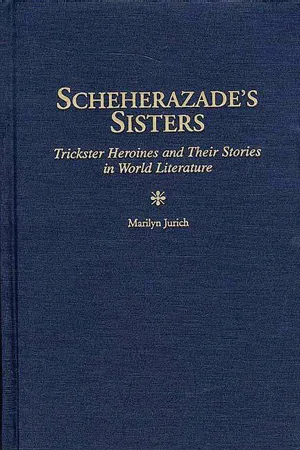
Scheherazade's Sisters
Trickster Heroines and Their Stories in World Literature
- 312 pages
- English
- PDF
- Available on iOS & Android
eBook - PDF
About this book
Information
Table of contents
- Contents
- Acknowledgments
- Introduction
- 1. Mean and Meaningful Tricks: Gender as Engendering and the Trickstar as Transformer
- 2. Folktale Females in Patriarchal Systems: Trickster and Gender in Mythology, History, Anthropology and Psychology, and the Emergence of Trickstar
- 3. The Rescuer
- 4. The Pursuer
- 5. The Empowered
- 6. The Province of Tricksterdom: A Comparison of Male and Female Tricksters, Feminist Discourses on Sexual Stereotyping in Folktales, and the Trickstar and Her Design for Transforming Gender and Society
- Overview of Tales: Chapters 1-5
- Bibliography
- Index
Trusted by 375,005 students
Access to over 1.5 million titles for a fair monthly price.
Study more efficiently using our study tools.
Frequently asked questions
Yes, you can cancel anytime from the Subscription tab in your account settings on the Perlego website. Your subscription will stay active until the end of your current billing period. Learn how to cancel your subscription
No, books cannot be downloaded as external files, such as PDFs, for use outside of Perlego. However, you can download books within the Perlego app for offline reading on mobile or tablet. Learn how to download books offline
Perlego offers two plans: Essential and Complete
- Essential is ideal for learners and professionals who enjoy exploring a wide range of subjects. Access the Essential Library with 800,000+ trusted titles and best-sellers across business, personal growth, and the humanities. Includes unlimited reading time and Standard Read Aloud voice.
- Complete: Perfect for advanced learners and researchers needing full, unrestricted access. Unlock 1.5M+ books across hundreds of subjects, including academic and specialized titles. The Complete Plan also includes advanced features like Premium Read Aloud and Research Assistant.
We are an online textbook subscription service, where you can get access to an entire online library for less than the price of a single book per month. With over 1.5 million books across 990+ topics, we’ve got you covered! Learn about our mission
Look out for the read-aloud symbol on your next book to see if you can listen to it. The read-aloud tool reads text aloud for you, highlighting the text as it is being read. You can pause it, speed it up and slow it down. Learn more about Read Aloud
Yes! You can use the Perlego app on both iOS and Android devices to read anytime, anywhere — even offline. Perfect for commutes or when you’re on the go.
Please note we cannot support devices running on iOS 13 and Android 7 or earlier. Learn more about using the app
Please note we cannot support devices running on iOS 13 and Android 7 or earlier. Learn more about using the app
Yes, you can access Scheherazade's Sisters by Marilyn Jurich in PDF and/or ePUB format, as well as other popular books in Literature & Literary Criticism. We have over 1.5 million books available in our catalogue for you to explore.