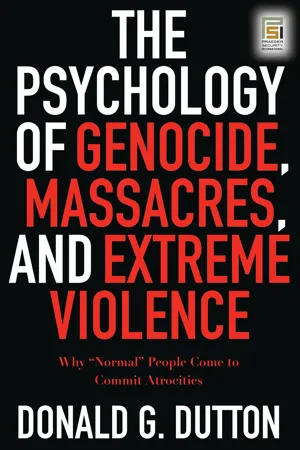
eBook - PDF
The Psychology of Genocide, Massacres, and Extreme Violence
Why Normal People Come to Commit Atrocities
- 214 pages
- English
- PDF
- Available on iOS & Android
eBook - PDF
The Psychology of Genocide, Massacres, and Extreme Violence
Why Normal People Come to Commit Atrocities
About this book
Chronicling horrific events that brought the 20th century to witness the largest number of systematic slaughters of human beings in any century across history, this work goes beyond historic details and examines contemporary psychological means that leaders use to convince individuals to commit horrific acts in the name of a politial or military cause. Massacres in Nanking, Rwanda, El Salvador, Vietnam, and other countries are reviewed in chilling detail. But the core issue is what psychological forces are behind large- scale killing; what psychology can be used to indoctrinate normal people with a Groupthink that moves individuals to mass murder brutally and without regret, even when the victims are innocent children. Dutton shows us how individuals are convinced to commit such sadistic acts, often preceded by torture, after being indoctrinated with beliefs that the target victims are unjust, inhuman or viral, like a virus that must be destroyed or it will destroy society.
Information
Table of contents
- Cover
- CONTENTS
- PREFACE
- CHAPTER 1: A HISTORY OF VIOLENCE
- CHAPTER 2: MASS VIOLENCE IN THE TWENTIETH CENTURY
- CHAPTER 3: GENOCIDES
- CHAPTER 4: THE HOLOCAUST
- CHAPTER 5: MILITARY MASSACRES
- CHAPTER 6: LYNCHINGS
- CHAPTER 7: PRISON RIOTS
- CHAPTER 8: SOCIETAL TRANSITIONS: THE NORMATIVE SHIFTS IN GENOCIDE
- CHAPTER 9: INDIVIDUAL TRANSITIONS TO EXTREME VIOLENCE
- CHAPTER 10: RAPE, SERIAL KILLERS, AND THE FORENSIC PSYCHOLOGY OF WAR
- CHAPTER 11: INDIVIDUAL DIFFERENCES IN VIOLENT AGGRESSION
- CHAPTER 12: FINALTHOUGHTS
- CHAPTER 13: POSTSCRIPT: THE FINAL SUMMATION
- EPILOGUE
- NOTES
- INDEX
Trusted by 375,005 students
Access to over 1.5 million titles for a fair monthly price.
Study more efficiently using our study tools.
Frequently asked questions
Yes, you can cancel anytime from the Subscription tab in your account settings on the Perlego website. Your subscription will stay active until the end of your current billing period. Learn how to cancel your subscription
No, books cannot be downloaded as external files, such as PDFs, for use outside of Perlego. However, you can download books within the Perlego app for offline reading on mobile or tablet. Learn how to download books offline
Perlego offers two plans: Essential and Complete
- Essential is ideal for learners and professionals who enjoy exploring a wide range of subjects. Access the Essential Library with 800,000+ trusted titles and best-sellers across business, personal growth, and the humanities. Includes unlimited reading time and Standard Read Aloud voice.
- Complete: Perfect for advanced learners and researchers needing full, unrestricted access. Unlock 1.5M+ books across hundreds of subjects, including academic and specialized titles. The Complete Plan also includes advanced features like Premium Read Aloud and Research Assistant.
We are an online textbook subscription service, where you can get access to an entire online library for less than the price of a single book per month. With over 1.5 million books across 990+ topics, we’ve got you covered! Learn about our mission
Look out for the read-aloud symbol on your next book to see if you can listen to it. The read-aloud tool reads text aloud for you, highlighting the text as it is being read. You can pause it, speed it up and slow it down. Learn more about Read Aloud
Yes! You can use the Perlego app on both iOS and Android devices to read anytime, anywhere — even offline. Perfect for commutes or when you’re on the go.
Please note we cannot support devices running on iOS 13 and Android 7 or earlier. Learn more about using the app
Please note we cannot support devices running on iOS 13 and Android 7 or earlier. Learn more about using the app
Yes, you can access The Psychology of Genocide, Massacres, and Extreme Violence by Donald G. Dutton in PDF and/or ePUB format, as well as other popular books in Politics & International Relations & Genocide & War Crimes. We have over 1.5 million books available in our catalogue for you to explore.