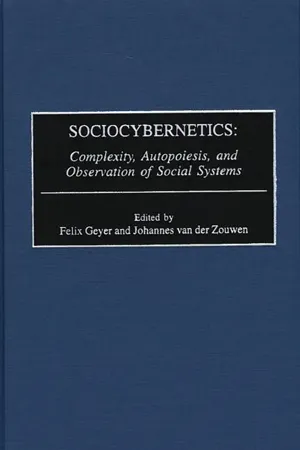
In an effort to shed light on recent developments in sociocybernetic research, this volume represents recent and advanced thinking in this rapidly developing field. The authors address the core problems in social science caused by increasing societal complexity and analyze the inadequacy of many of the methodological tools still used for grappling with nonlinear, self-organizing systems. Together, the 18 contributors propose elements of a new methodology based on sociocybernetic principles aimed at describing and explaining the growth of societal complexity, the contribution of autopoiesis of societal subunits to more societal complexity, and the new simulation-based methodology needed to observe complex social systems. This unique volume contributes to a greater understanding of sociocybernetics and its uses as a method for researching modern problems of increasing complexity and interdependence.
The first part of the book deals with increasing societal complexity and contains chapters on its overall development, the complexity of brain-environment interaction loops, organizational change, the development of human values, and the increasing interpenetration of societal subsystems. The second part concentrates on a current issue in sociocybernetics: autopoiesis, or self-production. The chapters included in Part II concentrate on embodied cognition, on the applicability of autopoiesis to business firms, on its roots in Aristotelian philosophy, and on the possibility of societal control and steering in democratic societies. Part III, more focused on methodology, discusses the difficulties inherent in observing complex social systems. The chapters deal with the problems of cross-cultural comparative research, simulation of the evolution of social systems, longitudinal simulation of education systems, and the methodological difficulties associated with analyzing the unexpected complexities of mutually interacting nonlinear systems.
eBook - PDF
Sociocybernetics
Complexity, Autopoiesis, and Observation of Social Systems
- 261 pages
- English
- PDF
- Available on iOS & Android
eBook - PDF
Sociocybernetics
Complexity, Autopoiesis, and Observation of Social Systems
About this book
Information
Table of contents
- Contents
- Preface
- Introduction to the Main Themes in Sociocybernetics
- Part I: Growing Societal Complexity
- Part II: Autopoiesis
- Part III: Observation of Social Systems
- Index
- About the Contributors
Trusted by 375,005 students
Access to over 1.5 million titles for a fair monthly price.
Study more efficiently using our study tools.
Frequently asked questions
Yes, you can cancel anytime from the Subscription tab in your account settings on the Perlego website. Your subscription will stay active until the end of your current billing period. Learn how to cancel your subscription
No, books cannot be downloaded as external files, such as PDFs, for use outside of Perlego. However, you can download books within the Perlego app for offline reading on mobile or tablet. Learn how to download books offline
Perlego offers two plans: Essential and Complete
- Essential is ideal for learners and professionals who enjoy exploring a wide range of subjects. Access the Essential Library with 800,000+ trusted titles and best-sellers across business, personal growth, and the humanities. Includes unlimited reading time and Standard Read Aloud voice.
- Complete: Perfect for advanced learners and researchers needing full, unrestricted access. Unlock 1.5M+ books across hundreds of subjects, including academic and specialized titles. The Complete Plan also includes advanced features like Premium Read Aloud and Research Assistant.
We are an online textbook subscription service, where you can get access to an entire online library for less than the price of a single book per month. With over 1.5 million books across 990+ topics, we’ve got you covered! Learn about our mission
Look out for the read-aloud symbol on your next book to see if you can listen to it. The read-aloud tool reads text aloud for you, highlighting the text as it is being read. You can pause it, speed it up and slow it down. Learn more about Read Aloud
Yes! You can use the Perlego app on both iOS and Android devices to read anytime, anywhere — even offline. Perfect for commutes or when you’re on the go.
Please note we cannot support devices running on iOS 13 and Android 7 or earlier. Learn more about using the app
Please note we cannot support devices running on iOS 13 and Android 7 or earlier. Learn more about using the app
Yes, you can access Sociocybernetics by Rudolf F. Geyer, Johannes van der Zouwen, Rudolf F. Geyer,Johannes van der Zouwen in PDF and/or ePUB format, as well as other popular books in Social Sciences & Sociology. We have over 1.5 million books available in our catalogue for you to explore.