Inder Singh examines why international organizations including the UN, OSCE, and Council of Europe advocated democratic governance, based on the rule of law and respect for human and minority rights, as the method by which states should try to accommodate their ethnically mixed populations. She discusses how realistic this advice has been, given the tension between the principle of the sovereignty of states and their international obligations, and the extent to which democratization had made for ethnic and political stability in post-communist Europe.
Inder Singh demonstrates that this advocacy of democracy to handle ethnic diversity questions the perception of nationalism as a cause of war and disorder. This pathbreaking study will be of appeal to academics and policy makers interested in how the management of ethnic diversity through democracy can enhance domestic and international security.
- 208 pages
- English
- PDF
- Available on iOS & Android
eBook - PDF
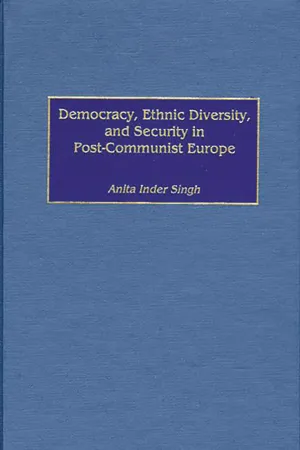
Democracy, Ethnic Diversity, and Security in Post-Communist Europe
About this book
Information
Table of contents
- Contents
- Acknowledgments
- Abbreviations
- Introduction
- 1 Democracy, Ethnic Diversity and Post–Cold War Security: The Practical and Conceptual Dilemmas
- 2 Managing Ethnic Diversity Through Political Structures and Ideologies: The Experiences of the Soviet Union, India, Spain and Sri Lanka
- 3 Self-Determination, Democracy, Minorities and Sovereignty: The Issues Raised by the Collapse of Yugoslavia and the USSR
- 4 Reconciling the International and Domestic Dimensions of Democracy
- 5 On the Absence of War in the Former Communist Bloc: Magyar and Russian Minorities in Countries Neighboring Hungary and Russia
- Conclusions
- Selected Bibliography
- Index
Trusted by 375,005 students
Access to over 1.5 million titles for a fair monthly price.
Study more efficiently using our study tools.
Frequently asked questions
Yes, you can cancel anytime from the Subscription tab in your account settings on the Perlego website. Your subscription will stay active until the end of your current billing period. Learn how to cancel your subscription
No, books cannot be downloaded as external files, such as PDFs, for use outside of Perlego. However, you can download books within the Perlego app for offline reading on mobile or tablet. Learn how to download books offline
Perlego offers two plans: Essential and Complete
- Essential is ideal for learners and professionals who enjoy exploring a wide range of subjects. Access the Essential Library with 800,000+ trusted titles and best-sellers across business, personal growth, and the humanities. Includes unlimited reading time and Standard Read Aloud voice.
- Complete: Perfect for advanced learners and researchers needing full, unrestricted access. Unlock 1.5M+ books across hundreds of subjects, including academic and specialized titles. The Complete Plan also includes advanced features like Premium Read Aloud and Research Assistant.
We are an online textbook subscription service, where you can get access to an entire online library for less than the price of a single book per month. With over 1.5 million books across 990+ topics, we’ve got you covered! Learn about our mission
Look out for the read-aloud symbol on your next book to see if you can listen to it. The read-aloud tool reads text aloud for you, highlighting the text as it is being read. You can pause it, speed it up and slow it down. Learn more about Read Aloud
Yes! You can use the Perlego app on both iOS and Android devices to read anytime, anywhere — even offline. Perfect for commutes or when you’re on the go.
Please note we cannot support devices running on iOS 13 and Android 7 or earlier. Learn more about using the app
Please note we cannot support devices running on iOS 13 and Android 7 or earlier. Learn more about using the app
Yes, you can access Democracy, Ethnic Diversity, and Security in Post-Communist Europe by Anita I. Singh in PDF and/or ePUB format, as well as other popular books in Politics & International Relations & Comparative Politics. We have over 1.5 million books available in our catalogue for you to explore.