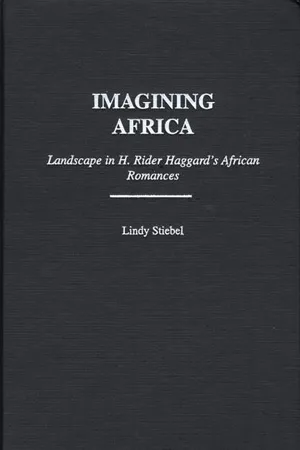
Best known as the author of such works as King Solomon's Mines and She, H. Rider Haggard was one of the most popular writers of the late-Victorian era, and his works continue to be influential today. To a large degree, his novels are captivating because of his image of Africa, and an understanding of his representation of the African landscape is central to a critical reading of his works. This book argues that Haggard created in his African romances a formulaic, ideological geography which provided a canvas onto which he projected his desires and fears, both personal and political, as well as those of his age.
The first full-length study of land and landscape in Haggard's African romances, this book approaches his construction of an imaginary African landscape as a product of late-Victorian wishful thinking about Africa, analyzing his African topography as a vast Eden, a wilderness, a dream underworld, a home to ancient white civilizations, and a sexualized metaphor for the human body. While the work looks primarily at his pre-1892 romances, which were his most powerful, it also gives attention to his nonfiction and unpublished papers. Because Haggard's writings embodied the spirit of his age, this book is an essential guide to late-Victorian concepts of Africa, colonization, and the British Empire.
- 173 pages
- English
- PDF
- Available on iOS & Android
eBook - PDF
About this book
Information
Table of contents
- Contents
- Preface
- Introduction
- Chapter 1: Towards a Discourse of “Africanism”
- Chapter 2: Imagining Africa
- Chapter 3: Rider Haggard—“King Romance”
- Chapter 4: Haggard's African Topography
- Chapter 5: The Haggard Legacy
- Chapter 6: Conclusion
- Bibliography
- Index
Trusted by 375,005 students
Access to over 1.5 million titles for a fair monthly price.
Study more efficiently using our study tools.
Frequently asked questions
Yes, you can cancel anytime from the Subscription tab in your account settings on the Perlego website. Your subscription will stay active until the end of your current billing period. Learn how to cancel your subscription
No, books cannot be downloaded as external files, such as PDFs, for use outside of Perlego. However, you can download books within the Perlego app for offline reading on mobile or tablet. Learn how to download books offline
Perlego offers two plans: Essential and Complete
- Essential is ideal for learners and professionals who enjoy exploring a wide range of subjects. Access the Essential Library with 800,000+ trusted titles and best-sellers across business, personal growth, and the humanities. Includes unlimited reading time and Standard Read Aloud voice.
- Complete: Perfect for advanced learners and researchers needing full, unrestricted access. Unlock 1.5M+ books across hundreds of subjects, including academic and specialized titles. The Complete Plan also includes advanced features like Premium Read Aloud and Research Assistant.
We are an online textbook subscription service, where you can get access to an entire online library for less than the price of a single book per month. With over 1.5 million books across 990+ topics, we’ve got you covered! Learn about our mission
Look out for the read-aloud symbol on your next book to see if you can listen to it. The read-aloud tool reads text aloud for you, highlighting the text as it is being read. You can pause it, speed it up and slow it down. Learn more about Read Aloud
Yes! You can use the Perlego app on both iOS and Android devices to read anytime, anywhere — even offline. Perfect for commutes or when you’re on the go.
Please note we cannot support devices running on iOS 13 and Android 7 or earlier. Learn more about using the app
Please note we cannot support devices running on iOS 13 and Android 7 or earlier. Learn more about using the app
Yes, you can access Imagining Africa by Lindy Stiebel in PDF and/or ePUB format, as well as other popular books in Literature & English Literary Criticism. We have over 1.5 million books available in our catalogue for you to explore.