Aspalter asserts that the belief that the development of high standard welfare states is primarily based on the ideology that pro-welfare, mostly leftwing, parties dominate welfare state literature and common thought in the Western world. Instead, in this examination of the welfare states of East Asia, Aspalter and his contributors show that they grew as naturally as they did in most Western countries, but that the reasons for this are other than pro-welfare ideologies. The five welfare states—Japan, South Korea, Hong Kong, Taiwan, and Singapore—are residual welfare states with low levels of welfare benefits and provision when compared to extended welfare states in Western Europe. While East Asian welfare states have experienced a hefty increase in welfare provision that has been regulated or provided by the state since the early 1970s, all five were set up and expanded by conservative governments with clear anti-welfare ideologies.
The case studies provided by Aspalter and his contributors suggest that welfare state development in East Asia is caused to a large extent by social protests in general, and, for welfare in particular, by competition in democratic elections, and by the changing role of women. Social and demographic factors, such as the rise of the age structure of the population, do not cause welfare state expansion in the first place. They cause street protests, and street protests convince all kinds of governments—if they rule out the use of force—to implement social welfare. Moreover, politicians, who are afraid to lose elections, also take up welfare issues, which they would not do without electoral competition between candidates and parties. As Aspalter makes clear, governments do not have to wait until major protests occur or until they have lost an election in order to promote social welfare. The anticipation of such an event is sufficient. This book provides new insights on the development of welfare systems that will be of particular interest to scholars, students, and other researchers involved with social welfare, East Asian studies, and comparative politics.
- 211 pages
- English
- PDF
- Available on iOS & Android
eBook - PDF
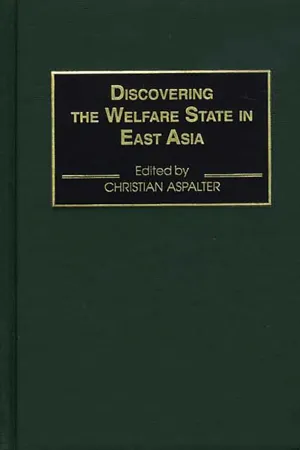
Discovering the Welfare State in East Asia
Table of contents
- Contents
- List of Tables
- List of Figures
- Acknowledgments
- 1. Introduction
- 2. Exploring Old and New Shores in Welfare State Theory
- 3. Gender and Welfare State Restructuring in Japan
- 4. The Korean Welfare State: Development and Reform Agenda
- 5. The Struggle of Welfare Development in Hong Kong
- 6. The Hong Kong Way of Social Welfare: An NGO-based Welfare System
- 7. Towards a Taiwanese Welfare State: Demographic Change, Politics, and Social Policy
- 8. Singapore: A Welfare State in a Class by Itself
- Index
- About the Contributors
Trusted by 375,005 students
Access to over 1.5 million titles for a fair monthly price.
Study more efficiently using our study tools.
Frequently asked questions
Yes, you can cancel anytime from the Subscription tab in your account settings on the Perlego website. Your subscription will stay active until the end of your current billing period. Learn how to cancel your subscription
No, books cannot be downloaded as external files, such as PDFs, for use outside of Perlego. However, you can download books within the Perlego app for offline reading on mobile or tablet. Learn how to download books offline
Perlego offers two plans: Essential and Complete
- Essential is ideal for learners and professionals who enjoy exploring a wide range of subjects. Access the Essential Library with 800,000+ trusted titles and best-sellers across business, personal growth, and the humanities. Includes unlimited reading time and Standard Read Aloud voice.
- Complete: Perfect for advanced learners and researchers needing full, unrestricted access. Unlock 1.5M+ books across hundreds of subjects, including academic and specialized titles. The Complete Plan also includes advanced features like Premium Read Aloud and Research Assistant.
We are an online textbook subscription service, where you can get access to an entire online library for less than the price of a single book per month. With over 1.5 million books across 990+ topics, we’ve got you covered! Learn about our mission
Look out for the read-aloud symbol on your next book to see if you can listen to it. The read-aloud tool reads text aloud for you, highlighting the text as it is being read. You can pause it, speed it up and slow it down. Learn more about Read Aloud
Yes! You can use the Perlego app on both iOS and Android devices to read anytime, anywhere — even offline. Perfect for commutes or when you’re on the go.
Please note we cannot support devices running on iOS 13 and Android 7 or earlier. Learn more about using the app
Please note we cannot support devices running on iOS 13 and Android 7 or earlier. Learn more about using the app
Yes, you can access Discovering the Welfare State in East Asia by Christian Aspalter in PDF and/or ePUB format, as well as other popular books in Economics & Business General. We have over 1.5 million books available in our catalogue for you to explore.