The outbreak of the French Revolution and the Industrial Revolution at the turn of the nineteenth century transformed the world and ushered in the modern age, whose currents challenged the traditional political order and the prevailing religious establishment. The new secular framework presented a potential threat to the papal leadership of the Catholic community, which was profoundly affected by the rush towards modernization. In the nineteenth century the transnational church confronted a world order dominated by the national state, until the emergence of globalization towards the close of the twentieth century. Here, Coppa focuses on Rome's response to the modern world, exploring the papacy's political and diplomatic role during the past two centuries. He examines the Vatican's impact upon major ideological developments over the years, including capitalism, nationalism, socialism, communism, modernism, racism, and anti-Semitism. At the same time, he traces the continuity and change in the papacy's attitude towards church-state relations and the relationship between religion and science.
Unlike many earlier studies of the papacy, which examine this unique institution as a self-contained unit and concentrate upon its role within the church, this study examines this key religious institution within the broader framework of national and international political, diplomatic, social, and economic events. Among other things, it explores such questions as the limits to be placed on national sovereignty; the Vatican's critique of capitalism and communism; the morality of warfare; and the need for an equitable international order.
- 286 pages
- English
- PDF
- Available on iOS & Android
eBook - PDF
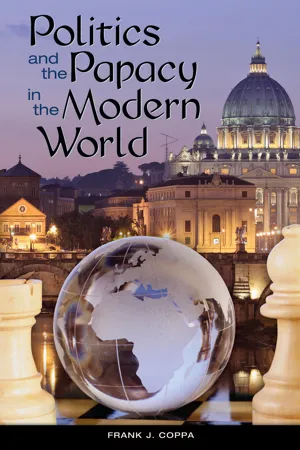
Politics and the Papacy in the Modern World
About this book
Information
Table of contents
- Contents
- 1. Introduction: Rome and the Powers in the Modern Age
- 2. The Papacy Between Revolutionary Upheaval and Restoration, 1789–1849
- 3. Rome Grapples with Liberalism, Nationalism, and Sectionalism, 1849–1878
- 4. The Papacy Confronts Social Issues, Modernism, and International Relations, 1878–1914
- 5. Benedict XV, the World War, and the League of Nations, 1914–1922
- 6. The Vatican in an Age of Dictatorship, Totalitarianism, and Anti-Semitism, 1922–1939
- 7. The Vatican’s “Impartiality,” “Silence,” and “Internationalism” During World War II and Beyond
- 8. The Papacy and the Cold War: The Confrontation Between Catholicism and Communism
- 9. The Second Vatican Council, Aggiornamento, and Papal Accommodation with the Modern World, 1958–1978
- 10. The Contemporary Papacy, Shuttle Diplomacy, and the Collapse of Communism, 1978–2005
- 11. Quo Vadis Benedict XVI?
- 12. Conclusion: Continuity and Change in Papal Policy
- Notes
- Select Bibliography
- Index
Trusted by 375,005 students
Access to over 1.5 million titles for a fair monthly price.
Study more efficiently using our study tools.
Frequently asked questions
Yes, you can cancel anytime from the Subscription tab in your account settings on the Perlego website. Your subscription will stay active until the end of your current billing period. Learn how to cancel your subscription
No, books cannot be downloaded as external files, such as PDFs, for use outside of Perlego. However, you can download books within the Perlego app for offline reading on mobile or tablet. Learn how to download books offline
We are an online textbook subscription service, where you can get access to an entire online library for less than the price of a single book per month. With over 1.5 million books across 990+ topics, we’ve got you covered! Learn about our mission
Look out for the read-aloud symbol on your next book to see if you can listen to it. The read-aloud tool reads text aloud for you, highlighting the text as it is being read. You can pause it, speed it up and slow it down. Learn more about Read Aloud
Yes! You can use the Perlego app on both iOS and Android devices to read anytime, anywhere — even offline. Perfect for commutes or when you’re on the go.
Please note we cannot support devices running on iOS 13 and Android 7 or earlier. Learn more about using the app
Please note we cannot support devices running on iOS 13 and Android 7 or earlier. Learn more about using the app
Yes, you can access Politics and the Papacy in the Modern World by Frank J. Coppa in PDF and/or ePUB format, as well as other popular books in Theologie & Religion & Religion. We have over 1.5 million books available in our catalogue for you to explore.