The persistence of a raced-based division of labor has been a compelling reality in all former slave societies in the Americas. One can trace this to nineteenth-century abolition movements across the Americas which did not lead to (and were not intended to result in) a transition from race-based slave labor to race-neutral wage labor for former slaves. Rather, the abolition of slavery led to the emergence of multi-racial societies wherein capital/labor relations were characterized by new forms of extra-market coercion that were explicitly linked to racial categories. Post-slavery Brazilian society is a classic example of this pattern.
Working within the context of the origin of the wage labor category in classical political economy, Baronov begins by questioning the central role of wage-labor within capitalist production through an examination of key works by Smith, Ricardo, and Marx, as well as the historical conditions informing their analyses. The study then turns to the specific case of Brazil between 1850-1888, comparing the abolition of slavery in three Brazilian regions: the northeast sugar region, the Paraiba Valley, and Western Sao Paulo. Through this analysis, Baronov provides a critique of the dominant interpretation of abolition (as a transition from slave labor to wage labor) and suggests an alternative interpretation that places a greater emphasis on the role of non-wage labor forms and extra-market factors in the shaping of the post-slavery social order.
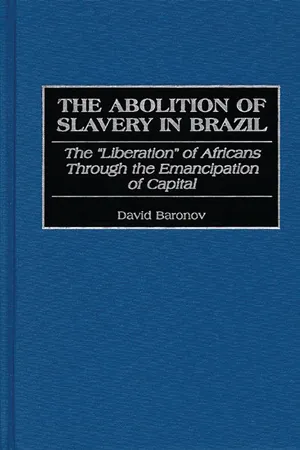
eBook - PDF
The Abolition of Slavery in Brazil
The Liberation of Africans Through the Emancipation of Capital
- 252 pages
- English
- PDF
- Available on iOS & Android
eBook - PDF
The Abolition of Slavery in Brazil
The Liberation of Africans Through the Emancipation of Capital
Table of contents
- Contents
- Tables
- Acknowledgments
- Introduction
- 1. The Historical and Theoretical Origins of the Modern Industrial Working Class (1700–1817)
- 2. The Historical and Theoretical Origins of the Modern Industrial Working Class (1817–1870)
- 3. The Abolition of Servile Labor East and West
- 4. The Legacy of Brazilian Slavery
- 5. Brazilian Abolition: The Preparation
- 6. Brazilian Abolition: The Process
- Appendix A: Example of a 19th-Century Colono Contract
- Bibliography
- Index
Trusted by 375,005 students
Access to over 1.5 million titles for a fair monthly price.
Study more efficiently using our study tools.
Frequently asked questions
Yes, you can cancel anytime from the Subscription tab in your account settings on the Perlego website. Your subscription will stay active until the end of your current billing period. Learn how to cancel your subscription
No, books cannot be downloaded as external files, such as PDFs, for use outside of Perlego. However, you can download books within the Perlego app for offline reading on mobile or tablet. Learn how to download books offline
Perlego offers two plans: Essential and Complete
- Essential is ideal for learners and professionals who enjoy exploring a wide range of subjects. Access the Essential Library with 800,000+ trusted titles and best-sellers across business, personal growth, and the humanities. Includes unlimited reading time and Standard Read Aloud voice.
- Complete: Perfect for advanced learners and researchers needing full, unrestricted access. Unlock 1.5M+ books across hundreds of subjects, including academic and specialized titles. The Complete Plan also includes advanced features like Premium Read Aloud and Research Assistant.
We are an online textbook subscription service, where you can get access to an entire online library for less than the price of a single book per month. With over 1.5 million books across 990+ topics, we’ve got you covered! Learn about our mission
Look out for the read-aloud symbol on your next book to see if you can listen to it. The read-aloud tool reads text aloud for you, highlighting the text as it is being read. You can pause it, speed it up and slow it down. Learn more about Read Aloud
Yes! You can use the Perlego app on both iOS and Android devices to read anytime, anywhere — even offline. Perfect for commutes or when you’re on the go.
Please note we cannot support devices running on iOS 13 and Android 7 or earlier. Learn more about using the app
Please note we cannot support devices running on iOS 13 and Android 7 or earlier. Learn more about using the app
Yes, you can access The Abolition of Slavery in Brazil by David Baronov in PDF and/or ePUB format, as well as other popular books in History & Latin American & Caribbean History. We have over 1.5 million books available in our catalogue for you to explore.