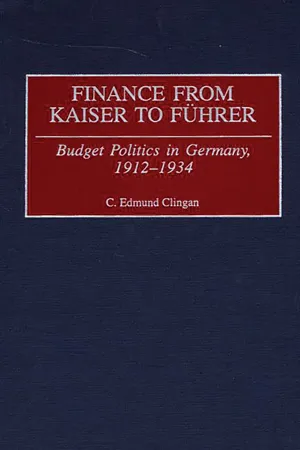
Germany's ability to support its war machine financially has long puzzled scholars. The young nation had exhausted itself paying for its loss in the First World War, had suffered a hyperinflation in the early 1920s, and had ended the 1920s with a terrible economic depression. This is the first book in any language to examine the budget policies of the middle years of the Weimar Republic and to look at how these policies changed the politics of the time. It is also the first work to support the government's aggressive use of deficit spending and fiscal stimuli to promote economic growth. Some findings even indicate that the German government could have used creative financial solutions to avoid the worst of the Depression and to avert the Nazi regime.
Clingan explores the changes and continuities in fiscal policy and budget-making politics, beginning in the last years of the Wilhelmine Empire and continuing into the 1930s. Although this is a story about money, it is also a story about men. Very few in Nazi Germany understood the intricacies of fiscal policy and budget making, and political parties tended to follow the lead of those who did. Clingan combines their personal stories with the tale of a country still growing into its economic power and still trying to learn both its limits and its strengths.
- 270 pages
- English
- PDF
- Available on iOS & Android
eBook - PDF
Table of contents
- Contents
- Figures and Tables
- Acknowledgments
- Abbreviations
- Introduction
- 1. The Twelve-Year Crisis, 1912–1924
- 2. The Soft Dictatorship and the Dawes Plan
- 3. Winter: The Luther/Schlieben Cabinet
- 4. Spring: Peter Reinhold as Finance Minister
- 5. The High Summer of the Weimar Republic
- 6. Autumn: The Köhler and Hilferding Years
- 7. Infinite Illusions: Fiscal Policy under Brüning
- 8. The Hard Dictatorship
- Aftermath and Assessment
- Selected Bibliography
- Index
Trusted by 375,005 students
Access to over 1.5 million titles for a fair monthly price.
Study more efficiently using our study tools.
Frequently asked questions
Yes, you can cancel anytime from the Subscription tab in your account settings on the Perlego website. Your subscription will stay active until the end of your current billing period. Learn how to cancel your subscription
No, books cannot be downloaded as external files, such as PDFs, for use outside of Perlego. However, you can download books within the Perlego app for offline reading on mobile or tablet. Learn how to download books offline
Perlego offers two plans: Essential and Complete
- Essential is ideal for learners and professionals who enjoy exploring a wide range of subjects. Access the Essential Library with 800,000+ trusted titles and best-sellers across business, personal growth, and the humanities. Includes unlimited reading time and Standard Read Aloud voice.
- Complete: Perfect for advanced learners and researchers needing full, unrestricted access. Unlock 1.5M+ books across hundreds of subjects, including academic and specialized titles. The Complete Plan also includes advanced features like Premium Read Aloud and Research Assistant.
We are an online textbook subscription service, where you can get access to an entire online library for less than the price of a single book per month. With over 1.5 million books across 990+ topics, we’ve got you covered! Learn about our mission
Look out for the read-aloud symbol on your next book to see if you can listen to it. The read-aloud tool reads text aloud for you, highlighting the text as it is being read. You can pause it, speed it up and slow it down. Learn more about Read Aloud
Yes! You can use the Perlego app on both iOS and Android devices to read anytime, anywhere — even offline. Perfect for commutes or when you’re on the go.
Please note we cannot support devices running on iOS 13 and Android 7 or earlier. Learn more about using the app
Please note we cannot support devices running on iOS 13 and Android 7 or earlier. Learn more about using the app
Yes, you can access Finance from Kaiser to Fuhrer by C. Edmund Clingan in PDF and/or ePUB format, as well as other popular books in Economics & Business General. We have over 1.5 million books available in our catalogue for you to explore.