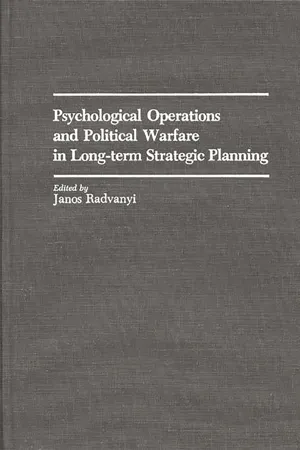
Written by a group of distinguished security experts, these eight previously unpublished papers focus on the hostile actions of the Soviet Union against the West in the form of psychological operations, power politics, and blackmail. Addressing military professionals, strategists, and international security specialists, the contributors examine the most effective measures the United States and its allies can take to counteract such measures. This is particularly important in the Gorbachev era, when Western security is perhaps more than ever dependent upon knowledge of Soviet psychological operations and political warfare. The book also explores the background of East European resistance to Soviet dominance and the subsequent Soviet countermeasures. Wide-ranging in coverage, the papers explore psychological operation in the United States, Poland, West Germany, France, and Latin America.
Following the editor's introduction to psychological operations, the contributors address such topics as the history and future of U.S. military psychological operations, new thinking and influence activities in the Gorbachev era, terrorism as a political strategy, and contemporary insurgent political and psychological warfare. A case study of the Polish experience illustrates communist regimes' psychological warfare against their own societies. The remaining papers discuss psychological operations and political warfare in long-term U.S. strategic planning, the French experience with Soviet hostile actions, and the argument that psychological warfare is no longer necessary in the age of perestroika and glasnost. The contributors are united in their belief that psychological operations and political warfare will not be eliminated by the sweeping changes affecting the Soviet Union and that the Western democracies are by their very nature particularly vulnerable to such operations. However, given the changing nature of external threats to the West, the contributors call for a reevaluation of strategy in the area of psychological operations, political warfare, and low intensity conflict.
eBook - PDF
Psychological Operations and Political Warfare in Long-term Strategic Planning
- 166 pages
- English
- PDF
- Available on iOS & Android
eBook - PDF
Psychological Operations and Political Warfare in Long-term Strategic Planning
About this book
Information
Table of contents
- Contents
- Acknowledgments
- 1 Introduction to Psyops
- 2 Psychological Operations and Political Warfare in Long-term U.S. Strategic Planning
- 3 U.S. Military Psychological Operations: Past, Present, and Future
- 4 Soviet Active Measures and Propaganda: "New Thinking" and Influence Activities in the Gorbachev Era
- 5 Terrorism as a Psychological Strategy
- 6 Soviet Diplomacy and Public Opinion: The Case of West Germany
- 7 Communist Regimes' Psychological Warfare Against Their Societies: The Case of Poland
- 8 The French Army and Psychological Warfare
- 9 Contemporary Insurgent Political and Psychological Warfare
- Selected Bibliography
- Index
- About the Editor and Contributors
Trusted by 375,005 students
Access to over 1.5 million titles for a fair monthly price.
Study more efficiently using our study tools.
Frequently asked questions
Yes, you can cancel anytime from the Subscription tab in your account settings on the Perlego website. Your subscription will stay active until the end of your current billing period. Learn how to cancel your subscription
No, books cannot be downloaded as external files, such as PDFs, for use outside of Perlego. However, you can download books within the Perlego app for offline reading on mobile or tablet. Learn how to download books offline
Perlego offers two plans: Essential and Complete
- Essential is ideal for learners and professionals who enjoy exploring a wide range of subjects. Access the Essential Library with 800,000+ trusted titles and best-sellers across business, personal growth, and the humanities. Includes unlimited reading time and Standard Read Aloud voice.
- Complete: Perfect for advanced learners and researchers needing full, unrestricted access. Unlock 1.5M+ books across hundreds of subjects, including academic and specialized titles. The Complete Plan also includes advanced features like Premium Read Aloud and Research Assistant.
We are an online textbook subscription service, where you can get access to an entire online library for less than the price of a single book per month. With over 1.5 million books across 990+ topics, we’ve got you covered! Learn about our mission
Look out for the read-aloud symbol on your next book to see if you can listen to it. The read-aloud tool reads text aloud for you, highlighting the text as it is being read. You can pause it, speed it up and slow it down. Learn more about Read Aloud
Yes! You can use the Perlego app on both iOS and Android devices to read anytime, anywhere — even offline. Perfect for commutes or when you’re on the go.
Please note we cannot support devices running on iOS 13 and Android 7 or earlier. Learn more about using the app
Please note we cannot support devices running on iOS 13 and Android 7 or earlier. Learn more about using the app
Yes, you can access Psychological Operations and Political Warfare in Long-term Strategic Planning by Janos Radvanyi in PDF and/or ePUB format, as well as other popular books in Politics & International Relations & American Government. We have over 1.5 million books available in our catalogue for you to explore.