In this pioneering volume, Howell addresses the extent to which fictional characters are legally recognized and protected as intellectual property. Through a judicious selection of cases chosen for their bearing on the popular arts, the author reviews the basic legal principles involved--copyright, trademark, unfair competition, and contract law--and analyzes their applications to fictional characters. In addition to tracing the evolution of the law relating to the protection of fictional characters, Howell explores the feasibility of isolating characters and protecting them via stringent copyright and/or trademark laws, addresses character merchandising and the associated legal issues, and suggests legal reforms aimed at protecting the creator. Detailed case information serves both to illustrate the legal principles and actions discussed and to stand as a model for the proprietors of future characters.
Divided into two major sections, the volume begins by offering a comprehensive introduction to intellectual property law. Specific topics addressed include basic concepts of property, statutory protection of intellectual property, elements of an infringement action, defenses to copyright infringement, unfair competition, and the application of trademark principles to literary properties. In the second section, Howell analyzes the extent to which the fictional character is legally regarded as intellectual property. She reviews situations in which copyright and trademark law have been invoked to protect the creator of a fictional character, examines cases involving such well-known characters as the Lone Ranger, Superman, and the crew of the Starship Enterprise, and presents an extended analysis of the case of Tarzan. Finally, Howell considers whether right of publicity and merchandising offer additional protection for fictional characters. In the concluding chapter, she offers an analysis of copyright decisions and a proposal for their reconciliation. Both practicing attorneys and students of entertainment law will find Howell's work an important contribution to the professional literature.
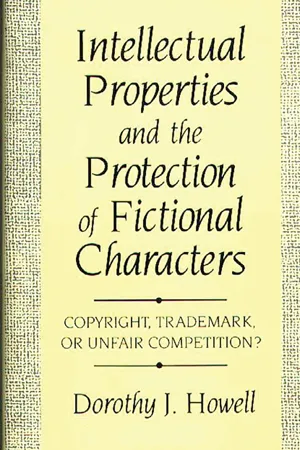
eBook - PDF
Intellectual Properties and the Protection of Fictional Characters
Copyright, Trademark, or Unfair Competition?
- 225 pages
- English
- PDF
- Available on iOS & Android
eBook - PDF
Intellectual Properties and the Protection of Fictional Characters
Copyright, Trademark, or Unfair Competition?
Table of contents
- Contents
- Preface
- PART I. INTRODUCTION TO INTELLECTUAL PROPERTY LAW
- PART II. CHARACTER AS AN INTELLECTUAL PROPERTY
- Select Bibliography
- Index
Trusted by 375,005 students
Access to over 1.5 million titles for a fair monthly price.
Study more efficiently using our study tools.
Frequently asked questions
Yes, you can cancel anytime from the Subscription tab in your account settings on the Perlego website. Your subscription will stay active until the end of your current billing period. Learn how to cancel your subscription
No, books cannot be downloaded as external files, such as PDFs, for use outside of Perlego. However, you can download books within the Perlego app for offline reading on mobile or tablet. Learn how to download books offline
Perlego offers two plans: Essential and Complete
- Essential is ideal for learners and professionals who enjoy exploring a wide range of subjects. Access the Essential Library with 800,000+ trusted titles and best-sellers across business, personal growth, and the humanities. Includes unlimited reading time and Standard Read Aloud voice.
- Complete: Perfect for advanced learners and researchers needing full, unrestricted access. Unlock 1.5M+ books across hundreds of subjects, including academic and specialized titles. The Complete Plan also includes advanced features like Premium Read Aloud and Research Assistant.
We are an online textbook subscription service, where you can get access to an entire online library for less than the price of a single book per month. With over 1.5 million books across 990+ topics, we’ve got you covered! Learn about our mission
Look out for the read-aloud symbol on your next book to see if you can listen to it. The read-aloud tool reads text aloud for you, highlighting the text as it is being read. You can pause it, speed it up and slow it down. Learn more about Read Aloud
Yes! You can use the Perlego app on both iOS and Android devices to read anytime, anywhere — even offline. Perfect for commutes or when you’re on the go.
Please note we cannot support devices running on iOS 13 and Android 7 or earlier. Learn more about using the app
Please note we cannot support devices running on iOS 13 and Android 7 or earlier. Learn more about using the app
Yes, you can access Intellectual Properties and the Protection of Fictional Characters by Dorothy J. Howell in PDF and/or ePUB format, as well as other popular books in Law & Financial Law. We have over 1.5 million books available in our catalogue for you to explore.