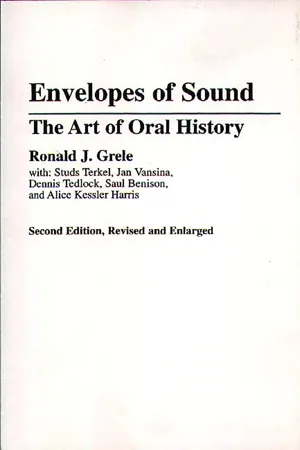
What is it that oral historians do? Prior to the publication of Envelopes of Sound oral history was regarded as an archival practice and interviews were considered the repositories of data. Envelopes shows that the interview is a series of dialectical relationships embedded in language, social practice, and historical imagination. It merges theory and method through the analysis of the basic structures of the interview. It incorporates new thinking on the nature of narrative and conversation, and it covers new ground in examining fieldwork in a number of disciplines. While strongly theoretical, it also has direct application in conducting oral history interviews. Ronald Grele is the dean of oral history in the United States, and Envelopes of Sound is the volume by which others will continue to be judged. Its contributions to methods and to meaning are still the place to start a serious discussion, whether with scholars or with high school students interviewing their grandparents.
Paul M. Buhle Director, Oral History of the American Left New York University
Grele's early, groundbreaking book on oral history remains a classic. It continues to challenge the practitioner to be more self-conscious of and attentive to the nuances of the oral history interview.
Sherna Berger Gluck Director, Oral History California State University, Long Beach
What is it that oral historians do? Prior to the publication of Envelopes of Sound oral history was regarded as an archival practice and interviews were considered the repositories of data. Envelopes shows that the interview is a series of dialectical relationships embedded in language, social practice, and historical imagination. It calls upon oral historians to begin to step back, to think seriously about what it is they do, and to ask what kind of documentation it is that they produce and how they can make it better.
This volume merges theory and method through the analysis of the basic structures of the interview. It incorporates new thinking on the nature of narrative and conversation, and it covers new ground in examining fieldwork in a number of disciplines. While strongly theoretical, it also has direct application in conducting oral history interviews. It moves from relatively easy and simple considerations to increasingly complex issues. Envelopes of Sound can be used by a variety of students in discplines ranging from history and sociology to anthropology and contemporary literature, and it can be used in a variety of ways to raise issues on a number of theoretical levels.
- 312 pages
- English
- PDF
- Available on iOS & Android
eBook - PDF
Table of contents
- Contents
- Preface to the Paperback Edition
- Preface to the Second Edition
- Preface to the First Edition
- Introduction
- I. Riffs and Improvisations: An Interview with Studs Terkel
- II. It’s Not the Song, It’s the Singing: Panel Discussion on Oral History
- III. Oral History as Poetry Dennis Tedlock
- IV. Movement Without Aim
- V. A Surmisable Variety: Interdisciplinarity and Oral History
- VI. Can Anyone Over Thirty Be Trusted? A Friendly Critique of Oral History
- VII. Listen to Their Voices: Two Case Studies in the Interpretation of Oral History Interviews
- VIII. Private Memories and Public Presentation: The Art of Oral History
Trusted by 375,005 students
Access to over 1.5 million titles for a fair monthly price.
Study more efficiently using our study tools.
Frequently asked questions
Yes, you can cancel anytime from the Subscription tab in your account settings on the Perlego website. Your subscription will stay active until the end of your current billing period. Learn how to cancel your subscription
No, books cannot be downloaded as external files, such as PDFs, for use outside of Perlego. However, you can download books within the Perlego app for offline reading on mobile or tablet. Learn how to download books offline
Perlego offers two plans: Essential and Complete
- Essential is ideal for learners and professionals who enjoy exploring a wide range of subjects. Access the Essential Library with 800,000+ trusted titles and best-sellers across business, personal growth, and the humanities. Includes unlimited reading time and Standard Read Aloud voice.
- Complete: Perfect for advanced learners and researchers needing full, unrestricted access. Unlock 1.5M+ books across hundreds of subjects, including academic and specialized titles. The Complete Plan also includes advanced features like Premium Read Aloud and Research Assistant.
We are an online textbook subscription service, where you can get access to an entire online library for less than the price of a single book per month. With over 1.5 million books across 990+ topics, we’ve got you covered! Learn about our mission
Look out for the read-aloud symbol on your next book to see if you can listen to it. The read-aloud tool reads text aloud for you, highlighting the text as it is being read. You can pause it, speed it up and slow it down. Learn more about Read Aloud
Yes! You can use the Perlego app on both iOS and Android devices to read anytime, anywhere — even offline. Perfect for commutes or when you’re on the go.
Please note we cannot support devices running on iOS 13 and Android 7 or earlier. Learn more about using the app
Please note we cannot support devices running on iOS 13 and Android 7 or earlier. Learn more about using the app
Yes, you can access Envelopes of Sound by Ronald J. Grele in PDF and/or ePUB format, as well as other popular books in History & World History. We have over 1.5 million books available in our catalogue for you to explore.