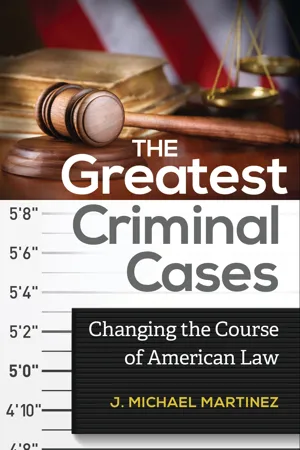
This fascinating book recounts the compelling stories behind 14 of the most important criminal procedure cases in American legal history.
Many constitutional protections that Americans take for granted today—the right to exclude illegally obtained evidence, the right to government-financed counsel, and the right to remain silent, among others—were not part of the original Bill of Rights, but were the result of criminal trials and judicial interpretations. The untold stories behind these cases reveal circumstances far more interesting than any legal dossier can evoke. Author J. Michael Martinez provides a brief introduction to the drama and intrigue behind 14 leading court cases in American law.
This engaging text presents a short summary of high-profile legal proceedings from the late 19th century through recent times and includes key landmark cases in which the court established the parameters of probable cause for searches, the features of due process, and the legality of electronic surveillance. The work offers concise explanations and analysis of the facts as well as the lasting significance of the cases to criminal procedure.
- 284 pages
- English
- PDF
- Available on iOS & Android
eBook - PDF
About this book
Information
Table of contents
- Cover
- Contents
- Introduction and Acknowledgments
- Chapter 1 Hurtado v. California (1884) and 19th-Century Criminal Procedure
- Chapter 2 Weeks v. United States (1914) and the Origins of the Exclusionary Rule
- Chapter 3 Olmstead v. United States (1928) and Wiretapping the “Baby Lieutenant”
- Chapter 4 Powell v. Alabama (1932) and the Scottsboro Boys
- Chapter 5 Brown v. Mississippi (1936) and Fundamental Fairness
- Chapter 6 Mapp v. Ohio (1961) and the Exclusionary Rule Redux
- Chapter 7 Gideon v. Wainwright (1963) and the Right to Counsel
- Chapter 8 Miranda v. Arizona (1966) and the Right to Remain Silent
- Chapter 9 Katz v. United States (1967) and the Right to Privacy
- Chapter 10 Terry v. Ohio (1968) and the Stop-and-Frisk Search
- Chapter 11 Chimel v. California (1969) and Searches Incident to Arrest
- Chapter 12 United States v. Leon (1984) and a Good Faith Exception to the Exclusionary Rule
- Chapter 13 California v. Hodari D. (1991) and Determining When a “Seizure” Occurs
- Chapter 14 Hamdan v. Rumsfeld (2006) and Trial by Jury
- Conclusion
- Bibliography
- Index
Trusted by 375,005 students
Access to over 1.5 million titles for a fair monthly price.
Study more efficiently using our study tools.
Frequently asked questions
Yes, you can cancel anytime from the Subscription tab in your account settings on the Perlego website. Your subscription will stay active until the end of your current billing period. Learn how to cancel your subscription
No, books cannot be downloaded as external files, such as PDFs, for use outside of Perlego. However, you can download books within the Perlego app for offline reading on mobile or tablet. Learn how to download books offline
Perlego offers two plans: Essential and Complete
- Essential is ideal for learners and professionals who enjoy exploring a wide range of subjects. Access the Essential Library with 800,000+ trusted titles and best-sellers across business, personal growth, and the humanities. Includes unlimited reading time and Standard Read Aloud voice.
- Complete: Perfect for advanced learners and researchers needing full, unrestricted access. Unlock 1.5M+ books across hundreds of subjects, including academic and specialized titles. The Complete Plan also includes advanced features like Premium Read Aloud and Research Assistant.
We are an online textbook subscription service, where you can get access to an entire online library for less than the price of a single book per month. With over 1.5 million books across 990+ topics, we’ve got you covered! Learn about our mission
Look out for the read-aloud symbol on your next book to see if you can listen to it. The read-aloud tool reads text aloud for you, highlighting the text as it is being read. You can pause it, speed it up and slow it down. Learn more about Read Aloud
Yes! You can use the Perlego app on both iOS and Android devices to read anytime, anywhere — even offline. Perfect for commutes or when you’re on the go.
Please note we cannot support devices running on iOS 13 and Android 7 or earlier. Learn more about using the app
Please note we cannot support devices running on iOS 13 and Android 7 or earlier. Learn more about using the app
Yes, you can access The Greatest Criminal Cases by J. Michael Martinez in PDF and/or ePUB format, as well as other popular books in Social Sciences & Criminal Law. We have over 1.5 million books available in our catalogue for you to explore.