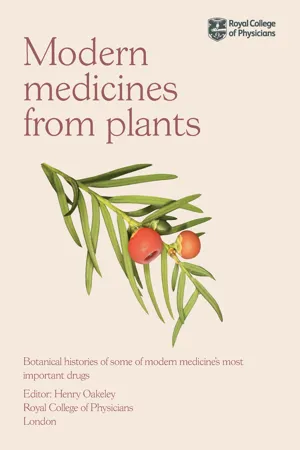
Modern Medicines from Plants
eBook - ePub

Modern Medicines from Plants

Botanical histories of some of modern medicine’s most important drugs

  1. 394 pages
  2. English
  3. ePUB (mobile friendly)
  4. Available on iOS & Android
eBook - ePub

Modern Medicines from Plants

Botanical histories of some of modern medicine’s most important drugs

About this book

The full colour, beautifully illustrated Modern Medicines from Plants: Botanical histories of some of modern medicine's most important drugs features information on plants from which we obtain modern prescription medicines. It outlines their historical uses as herbal medicines in the past two millennia, using primary sources, and describes how extracts from them, and their semisynthetic and synthetic derivatives, were developed to be today's therapeutic drugs and diagnostic chemicals. This book describes medicinal plants and their habitats, the diseases that their medicines treat, and the science of how they work.

This amazing and unique book is a wonderful read for those with an interest in both herbal and prescription medicines. Written with authority by physicians and gardeners at the Garden of Medicinal Plants at the Royal College of Physicians, London, chapters detail the history and modern scientific research on plants and their medicines. It is very useful to physicians, pharmacists, herbalists, historians and gardeners, bringing together information from every discipline to make it a work of interest as well as reference.

Features

  • Written for people interested in medicinal plants, where medicines come from, and how they treat our diseases
  • Contains information on 50 plants, mostly growing in the medicinal garden of the Royal College of Physicians in London, describing how they became the source of modern pharmaceutical medicines
  • Describes medicinal uses of plants in Classical Greece as written by Dioscorides, Pliny and Galen, through the flowering of Arabic medicine by physicians such as Paulus Aegineta, Mesue and Avicenna to the 12th to 14th century compilations of Serapion and Sylvaticus and the European Renaissance of Peter Treveris, William Turner, Leonard Fuchs, Pietro Mattioli, John Gerarde, John Parkinson, Nicholas Culpeper, and many others to the pharmacopoeias of the 16th century to the present day
  • Fully referenced including a glossary for explanation of technical terms

Trusted by 375,005 students

Access to over 1.5 million titles for a fair monthly price.

Study more efficiently using our study tools.

Information

Publisher
CRC Press
Year
2023
Print ISBN
9781032536170
eBook ISBN
9781000925616

Table of contents

  1. Cover Page
  2. Half Title Page
  3. Title Page
  4. Copyright Page
  5. Contents
  6. Preface
  7. Introduction
  8. Chapter 1 Ammi majus: The source of 8-methoxypsoralen (methoxsalen)
  9. Chapter 2 Artemisia annua: Thesource of artemisinin
  10. Chapter 3 Atropa belladonna Datura stramonium: And other plants containing antimuscarinic tropane alkaloids
  11. Chapter 4 Betula pendula: The source of β-sitosterol
  12. Chapter 5 Camellia sinensis Coffea arabica Theobroma cacao: Caffeine-containing plants – the source of many useful medicines
  13. Chapter 6 Camptotheca acuminata: The source of the anti-cancer drugs, camptothecin, topotecan and irinotecan
  14. Chapter 7 Capsicum annuum: The source of capsaicin
  15. Chapter 8 Catharanthus roseus: The source of vincristine and vinblastine
  16. Chapter 9 Cephalotaxus harringtonia: The source of harringtonine, homoharringtonine (omacetaxine) and cephalotaxine
  17. Chapter 10 Chondrodendron tomentosum: The source of tubocurarine
  18. Chapter 11 Cinchona: The source of quinine and quinidine
  19. Chapter 12 Citrus x limon: A source of vitamin C
  20. Chapter 13 Colchicum autumnale: The source of colchicine
  21. Chapter 14 Digitalis purpurea The source of digitoxin: Digitalis lanata The source of digoxin
  22. Chapter 15 Dioscorea polystachya Glycine max: The sources of diosgenin from which steroids were synthesised
  23. Chapter 16 Ephedra sinica: The source of ephedrine, pseudoephedrine and amphetamines
  24. Chapter 17 Erythroxylum coca: The source of cocaine
  25. Chapter 18 Euphorbia peplus: The source of ingenol mebutate
  26. Chapter 19 Galanthus nivalis: The source of galanthamine/galantamine
  27. Chapter 20 Galega officinalis: The source of metformin
  28. Chapter 21 Glycyrrhiza glabra: The source of carbenoxolone
  29. Chapter 22 Guaiacum officinale: Roughbark lignum-vitae, guaiacwood – reducing deaths from bowel cancer
  30. Chapter 23 Arjun Devanesan: The source of lidocaine
  31. Chapter 24 Hordeum vulgare Claviceps purpurea: The source of ergometrine and ergotamine
  32. Chapter 25 Hydrangea febrifuga: The source of halofuginone
  33. Chapter 26 Illicium anisatum and I. verum: The source of oseltamivir
  34. Chapter 27 Inula helenium: The source of inulin
  35. Chapter 28 Melilotus officinalis: The source of dicoumarol which gave rise to warfarin
  36. Chapter 29 Morus alba: The source of miglustat, migalastat and miglitol
  37. Chapter 30 Nicotiana tabacum: Source of nicotine as an aid to stopping smoking, with a note on Lobelia, and Laburnum anagyroides
  38. Chapter 31 Papaver rhoeas: The source of rhoeadine, thebaine and powerful opioids, with a note on other Papaveraceae
  39. Chapter 32 Papaver somniferum: The source of morphine, codeine, noscapine, protopine, papaverine and verapamil
  40. Chapter 33 Physostigma venenosum: The source of physostigmine and the basis for the synthetic analogue neostigmine
  41. Chapter 34 Pilocarpus microphyllus: The source of the drug pilocarpine
  42. Chapter 35 Podophyllum peltatum Podophyllum hexandrum: The source of podophyllotoxin, etoposide and teniposide
  43. Chapter 36 Rauvolfia serpentina Rauvolfia vomitoria: The source of reserpine, ajmaline and ajmalicine
  44. Chapter 37 Salix alba: The source of salicylic acid Filipendula ulmaria The source of aspirin Gaultheria procumbens The source of methyl salicylate
  45. Chapter 38 Silybum marianum: The source of silymarin and Legalon-SIL
  46. Chapter 39 Tanacetum cinerariifolium: The source of pyrethrins for pesticides
  47. Chapter 40 Taxus baccata and Taxus brevifolia: The source of paclitaxel, docetaxel and cabazitaxel
  48. Chapter 41 Valeriana officinalis: The source of sodium valproate
  49. Chapter 42 Veratrum album Veratrum californicum Veratrum nigrum: The sources of protoveratrine, cyclopamine and sonidegib
  50. Chapter 43 Visnaga daucoides: The source of nifedipine, amiodarone, sodium cromoglicate
  51. Chapter 44 Excipients and solvents: The plant sources of excipients and solvents
  52. Chapter 45 Vitamins: The plant sources of vitamins
  53. Appendix 1 Historical references before 1700 and Linnaeus
  54. Appendix 2 Dramatis personae. The main historical personages
  55. Appendix 3 Glossary
  56. Index Chemicals and Drugs
  57. Index Plant Names
  58. The authors

Frequently asked questions

Yes, you can cancel anytime from the Subscription tab in your account settings on the Perlego website. Your subscription will stay active until the end of your current billing period. Learn how to cancel your subscription
No, books cannot be downloaded as external files, such as PDFs, for use outside of Perlego. However, you can download books within the Perlego app for offline reading on mobile or tablet. Learn how to download books offline
Perlego offers two plans: Essential and Complete
  • Essential is ideal for learners and professionals who enjoy exploring a wide range of subjects. Access the Essential Library with 800,000+ trusted titles and best-sellers across business, personal growth, and the humanities. Includes unlimited reading time and Standard Read Aloud voice.
  • Complete: Perfect for advanced learners and researchers needing full, unrestricted access. Unlock 1.5M+ books across hundreds of subjects, including academic and specialized titles. The Complete Plan also includes advanced features like Premium Read Aloud and Research Assistant.
Both plans are available with monthly, semester, or annual billing cycles.
We are an online textbook subscription service, where you can get access to an entire online library for less than the price of a single book per month. With over 1.5 million books across 990+ topics, we’ve got you covered! Learn about our mission
Look out for the read-aloud symbol on your next book to see if you can listen to it. The read-aloud tool reads text aloud for you, highlighting the text as it is being read. You can pause it, speed it up and slow it down. Learn more about Read Aloud
Yes! You can use the Perlego app on both iOS and Android devices to read anytime, anywhere — even offline. Perfect for commutes or when you’re on the go.
Please note we cannot support devices running on iOS 13 and Android 7 or earlier. Learn more about using the app
Yes, you can access Modern Medicines from Plants by Henry Oakeley in PDF and/or ePUB format, as well as other popular books in Medicina & Teoria, pratica e riferimenti medici. We have over 1.5 million books available in our catalogue for you to explore.