A war of attrition is usually conceptualized as a bloody slogging match, epitomized by imagery of futile frontal assaults on the Western Front of the First World War. As such, many academics, politicians, and military officers currently consider attrition to be a wholly undesirable method of warfare. This first book-length study of wars of attrition challenges this viewpoint. A historical analysis of the strategic thought behind attrition demonstrates that it was often implemented to conserve casualties, not to engage in a bloody senseless assault. Moreover, attrition frequently proved an effective means of attaining a state's political aims in warfare, particularly in serving as a preliminary to decisive warfare, reducing risk of escalation, and coercing an opponent in negotiations.
Malkasian analyzes the thought of commanders who implemented policies of attrition from 1789 to the present. His study includes figures central to the study of war, such as the Duke of Wellington, Carl von Clausewitz, B. H. Liddell Hart, General William Slim, General Douglas MacArthur, General Matthew Ridgeway, and General William Westmoreland. While special attention is devoted to the Second World War in the Pacific and the Korean War, this study notes the utility of attrition during the Cold War, as the risk of a Third World War rendered more aggressive strategies unattractive. Increasingly, the United States finds itself facing conflicts that are not amenable to a decisive military solution in which opponents seek prolonged war that will inflict as many casualties as possible on American forces.
- 260 pages
- English
- PDF
- Available on iOS & Android
eBook - PDF
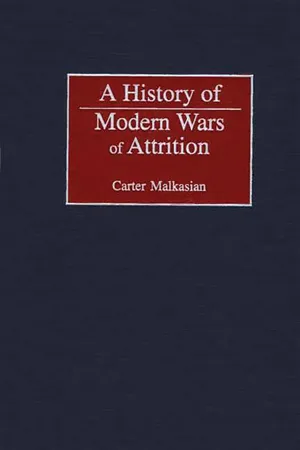
A History of Modern Wars of Attrition
Table of contents
- Contents
- Acknowledgments
- Abbreviations
- 1. The Straw Man of Attrition
- 2. Attrition and the Advent of Total War
- 3. Seasons in the Abyss
- 4. The Kokoda Trail
- 5. Undertow
- 6. The Burma Campaign
- 7. New Roots, Korea 1950–1951
- 8. Coercing Communist Concessions
- 9. Losing Momentum
- 10. Attrition after Korea
- 11. Attrition as an Operational Strategy
- Bibliography
- Index
- Map Essay
Trusted by 375,005 students
Access to over 1.5 million titles for a fair monthly price.
Study more efficiently using our study tools.
Frequently asked questions
Yes, you can cancel anytime from the Subscription tab in your account settings on the Perlego website. Your subscription will stay active until the end of your current billing period. Learn how to cancel your subscription
No, books cannot be downloaded as external files, such as PDFs, for use outside of Perlego. However, you can download books within the Perlego app for offline reading on mobile or tablet. Learn how to download books offline
Perlego offers two plans: Essential and Complete
- Essential is ideal for learners and professionals who enjoy exploring a wide range of subjects. Access the Essential Library with 800,000+ trusted titles and best-sellers across business, personal growth, and the humanities. Includes unlimited reading time and Standard Read Aloud voice.
- Complete: Perfect for advanced learners and researchers needing full, unrestricted access. Unlock 1.5M+ books across hundreds of subjects, including academic and specialized titles. The Complete Plan also includes advanced features like Premium Read Aloud and Research Assistant.
We are an online textbook subscription service, where you can get access to an entire online library for less than the price of a single book per month. With over 1.5 million books across 990+ topics, we’ve got you covered! Learn about our mission
Look out for the read-aloud symbol on your next book to see if you can listen to it. The read-aloud tool reads text aloud for you, highlighting the text as it is being read. You can pause it, speed it up and slow it down. Learn more about Read Aloud
Yes! You can use the Perlego app on both iOS and Android devices to read anytime, anywhere — even offline. Perfect for commutes or when you’re on the go.
Please note we cannot support devices running on iOS 13 and Android 7 or earlier. Learn more about using the app
Please note we cannot support devices running on iOS 13 and Android 7 or earlier. Learn more about using the app
Yes, you can access A History of Modern Wars of Attrition by Carter Malkasian in PDF and/or ePUB format, as well as other popular books in History & Military & Maritime History. We have over 1.5 million books available in our catalogue for you to explore.