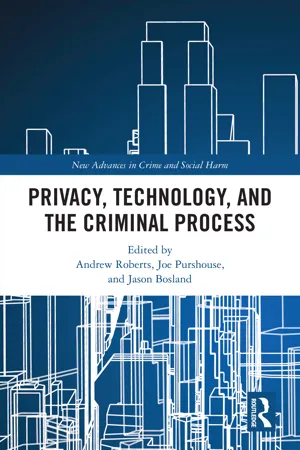
This collection considers the implications for privacy of the utilisation of new technologies in the criminal process. In most modern liberal democratic states, privacy is considered a basic right. Many national constitutions, and almost all international human rights instruments, include some guarantee of privacy. Yet privacy interests appear to have had relatively little influence on criminal justice policy making. The threat that technology poses to these interests demands critical re-evaluation of current law, policy, and practice. This is provided by the contributions to this volume. They offer legal, criminological, philosophical, and comparative perspectives. The book will be of interest to legal and criminological scholars and postgraduate students. Its interdisciplinary methodology and focus on the intersection between law and technology make it also relevant for philosophers and those interested in science and technology studies.
eBook - ePub
Privacy, Technology, and the Criminal Process
- 280 pages
- English
- ePUB (mobile friendly)
- Available on iOS & Android
eBook - ePub
Privacy, Technology, and the Criminal Process
About this book
Trusted by 375,005 students
Access to over 1.5 million titles for a fair monthly price.
Study more efficiently using our study tools.
Information
Table of contents
- Cover
- Half-Title
- Series
- Title
- Copyright
- Contents
- Notes on Contributors
- Introduction: Criminal Justice, Technology, and the Future of Privacy
- 1 Exploring Algorithmic Justice for Policing Data Analytics in the United Kingdom
- 2 Police Use of Intrusive Technology: Freedom, Privacy, and Political Legitimacy
- 3 Private Policing in the Data-Driven Society: The Flexible State Monopoly on Force Challenged but Not Abandoned
- 4 Citizen-Led Policing in the Digital Age and the Right to Respect for Private Life
- 5 Biometric Forensic Identity Databases in Europe: Precariously Balanced or Faulty Scales?
- 6 Facial Recognition Technology: The Particular Impacts on Children
- 7 Knowing Without Entering: How Remote Police Surveillance Affects Privacy of the Home
- 8 Frontline Perceptions of Body-Worn Cameras: Tools for Transparency in British Policing?
- 9 Apples, Oranges, and Time Machines: Regulating Police Use of Body-Worn Cameras in Europe and the United States
- 10 Investigating Rape Allegations: Artificial Intelligence and the ‘Digital Strip-Search’
- 11 Reporting Crime in the Wake of the Human Rights Act 1998: Privacy, Criminal Justice, and the Media in England & Wales
- 12 Privacy and Rehabilitation after a Criminal Conviction in the Digital Age
- Index
Frequently asked questions
Yes, you can cancel anytime from the Subscription tab in your account settings on the Perlego website. Your subscription will stay active until the end of your current billing period. Learn how to cancel your subscription
No, books cannot be downloaded as external files, such as PDFs, for use outside of Perlego. However, you can download books within the Perlego app for offline reading on mobile or tablet. Learn how to download books offline
Perlego offers two plans: Essential and Complete
- Essential is ideal for learners and professionals who enjoy exploring a wide range of subjects. Access the Essential Library with 800,000+ trusted titles and best-sellers across business, personal growth, and the humanities. Includes unlimited reading time and Standard Read Aloud voice.
- Complete: Perfect for advanced learners and researchers needing full, unrestricted access. Unlock 1.5M+ books across hundreds of subjects, including academic and specialized titles. The Complete Plan also includes advanced features like Premium Read Aloud and Research Assistant.
We are an online textbook subscription service, where you can get access to an entire online library for less than the price of a single book per month. With over 1.5 million books across 990+ topics, we’ve got you covered! Learn about our mission
Look out for the read-aloud symbol on your next book to see if you can listen to it. The read-aloud tool reads text aloud for you, highlighting the text as it is being read. You can pause it, speed it up and slow it down. Learn more about Read Aloud
Yes! You can use the Perlego app on both iOS and Android devices to read anytime, anywhere — even offline. Perfect for commutes or when you’re on the go.
Please note we cannot support devices running on iOS 13 and Android 7 or earlier. Learn more about using the app
Please note we cannot support devices running on iOS 13 and Android 7 or earlier. Learn more about using the app
Yes, you can access Privacy, Technology, and the Criminal Process by Andrew Roberts, Joe Purshouse, Jason Bosland, Andrew Roberts,Joe Purshouse,Jason Bosland in PDF and/or ePUB format, as well as other popular books in Law & Criminal Law. We have over 1.5 million books available in our catalogue for you to explore.