A groundbreaking history of fengshui’s roles in public life and law during China’s last imperial dynasty
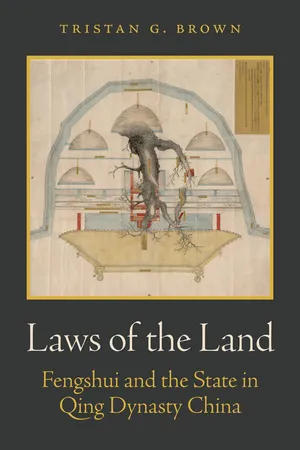
Today the term fengshui, which literally means “wind and water,” is recognized around the world. Yet few know exactly what it means, let alone its fascinating history. In Laws of the Land, Tristan Brown tells the story of the important roles—especially legal ones—played by fengshui in Chinese society during China’s last imperial dynasty, the Manchu Qing (1644–1912).
Employing archives from Mainland China and Taiwan that have only recently become available, this is the first book to document fengshui’s invocations in Chinese law during the Qing dynasty. Facing a growing population, dwindling natural resources, and an overburdened rural government, judicial administrators across China grappled with disputes and petitions about fengshui in their efforts to sustain forestry, farming, mining, and city planning. Laws of the Land offers a radically new interpretation of these legal arrangements: they worked. An intelligent, considered, and sustained engagement with fengshui on the ground helped the imperial state keep the peace and maintain its legitimacy, especially during the increasingly turbulent decades of the nineteenth century. As the century came to an end, contentious debates over industrialization swept across the bureaucracy, with fengshui invoked by officials and scholars opposed to the establishment of railways, telegraphs, and foreign-owned mines.
Demonstrating that the only way to understand those debates and their profound stakes is to grasp fengshui’s longstanding roles in Chinese public life, Laws of the Land rethinks key issues in the history of Chinese law, politics, science, religion, and economics.
- 336 pages
- English
- ePUB (mobile friendly)
- Available on iOS & Android
eBook - ePub
About this book
Information
Publisher
Princeton University PressYear
2023Print ISBN
9780691247175
9780691246734
eBook ISBN
9780691246727
Table of contents
- Cover Page
- Title Page
- Copyright Page
- Dedication
- Contents
- Acknowledgements
- Dates of Qing Era Names
- Weights, Measures, and Exchange Rates
- Qing Administrative Units for the Interior Lands (“China”)
- Conventions in the Text
- Map
- Epigraph
- Introduction
- 1. Litigating Graves
- 2. Mapping Fengshui
- 3. Examining Fortune
- 4. Mining Sichuan
- 5. Breaking the Land
- Concluding Remarks
- Appendices
- List of Chinese Terms
- Notes
- Bibliography
- Index
Trusted by 375,005 students
Access to over 1.5 million titles for a fair monthly price.
Study more efficiently using our study tools.
Frequently asked questions
Yes, you can cancel anytime from the Subscription tab in your account settings on the Perlego website. Your subscription will stay active until the end of your current billing period. Learn how to cancel your subscription
No, books cannot be downloaded as external files, such as PDFs, for use outside of Perlego. However, you can download books within the Perlego app for offline reading on mobile or tablet. Learn how to download books offline
Perlego offers two plans: Essential and Complete
- Essential is ideal for learners and professionals who enjoy exploring a wide range of subjects. Access the Essential Library with 800,000+ trusted titles and best-sellers across business, personal growth, and the humanities. Includes unlimited reading time and Standard Read Aloud voice.
- Complete: Perfect for advanced learners and researchers needing full, unrestricted access. Unlock 1.5M+ books across hundreds of subjects, including academic and specialized titles. The Complete Plan also includes advanced features like Premium Read Aloud and Research Assistant.
We are an online textbook subscription service, where you can get access to an entire online library for less than the price of a single book per month. With over 1.5 million books across 990+ topics, we’ve got you covered! Learn about our mission
Look out for the read-aloud symbol on your next book to see if you can listen to it. The read-aloud tool reads text aloud for you, highlighting the text as it is being read. You can pause it, speed it up and slow it down. Learn more about Read Aloud
Yes! You can use the Perlego app on both iOS and Android devices to read anytime, anywhere — even offline. Perfect for commutes or when you’re on the go.
Please note we cannot support devices running on iOS 13 and Android 7 or earlier. Learn more about using the app
Please note we cannot support devices running on iOS 13 and Android 7 or earlier. Learn more about using the app
Yes, you can access Laws of the Land by Tristan G. Brown in PDF and/or ePUB format, as well as other popular books in History & Chinese History. We have over 1.5 million books available in our catalogue for you to explore.