How Arabic influenced the evolution of vernacular literatures and anticolonial thought in Egypt, Indonesia, and Senegal
Sacred Language, Vernacular Difference offers a new understanding of Arabic’s global position as the basis for comparing cultural and literary histories in countries separated by vast distances. By tracing controversies over the use of Arabic in three countries with distinct colonial legacies, Egypt, Indonesia, and Senegal, the book presents a new approach to the study of postcolonial literatures, anticolonial nationalisms, and the global circulation of pluralist ideas.
Annette Damayanti Lienau presents the largely untold story of how Arabic, often understood in Africa and Asia as a language of Islamic ritual and precolonial commerce, assumed a transregional role as an anticolonial literary medium in the nineteenth and twentieth centuries. By examining how major writers and intellectuals across several generations grappled with the cultural asymmetries imposed by imperial Europe, Lienau shows that Arabic—as a cosmopolitan, interethnic, and interreligious language—complicated debates over questions of indigeneity, religious pluralism, counter-imperial nationalisms, and emerging nation-states.
Unearthing parallels from West Africa to Southeast Asia, Sacred Language, Vernacular Difference argues that debates comparing the status of Arabic to other languages challenged not only Eurocentric but Arabocentric forms of ethnolinguistic and racial prejudice in both local and global terms.
eBook - ePub
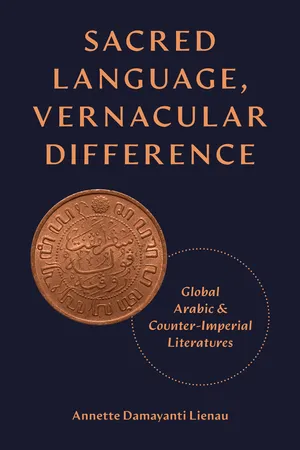
Sacred Language, Vernacular Difference
Global Arabic and Counter-Imperial Literatures
- 336 pages
- English
- ePUB (mobile friendly)
- Available on iOS & Android
eBook - ePub
Sacred Language, Vernacular Difference
Global Arabic and Counter-Imperial Literatures
About this book
Information
Publisher
Princeton University PressYear
2024Print ISBN
9780691249834
9780691249803
eBook ISBN
9780691249889
Table of contents
- Cover
- Title Page
- Copyright
- Dedication
- Epigraphs
- Contents
- Preface
- Acknowledgments
- Introduction: Arabic as a Contact Language
- Section I. Reframing the Arabophone
- Section II. Vernacular Difference and Emerging Nationalisms
- Section III. Connected Histories and Competing Literacies
- Conclusion: Comparative Literature and Transregional Arabophone Studies
- Notes
- Select Bibliography
- Index
Trusted by 375,005 students
Access to over 1.5 million titles for a fair monthly price.
Study more efficiently using our study tools.
Frequently asked questions
Yes, you can cancel anytime from the Subscription tab in your account settings on the Perlego website. Your subscription will stay active until the end of your current billing period. Learn how to cancel your subscription
No, books cannot be downloaded as external files, such as PDFs, for use outside of Perlego. However, you can download books within the Perlego app for offline reading on mobile or tablet. Learn how to download books offline
Perlego offers two plans: Essential and Complete
- Essential is ideal for learners and professionals who enjoy exploring a wide range of subjects. Access the Essential Library with 800,000+ trusted titles and best-sellers across business, personal growth, and the humanities. Includes unlimited reading time and Standard Read Aloud voice.
- Complete: Perfect for advanced learners and researchers needing full, unrestricted access. Unlock 1.5M+ books across hundreds of subjects, including academic and specialized titles. The Complete Plan also includes advanced features like Premium Read Aloud and Research Assistant.
We are an online textbook subscription service, where you can get access to an entire online library for less than the price of a single book per month. With over 1.5 million books across 990+ topics, we’ve got you covered! Learn about our mission
Look out for the read-aloud symbol on your next book to see if you can listen to it. The read-aloud tool reads text aloud for you, highlighting the text as it is being read. You can pause it, speed it up and slow it down. Learn more about Read Aloud
Yes! You can use the Perlego app on both iOS and Android devices to read anytime, anywhere — even offline. Perfect for commutes or when you’re on the go.
Please note we cannot support devices running on iOS 13 and Android 7 or earlier. Learn more about using the app
Please note we cannot support devices running on iOS 13 and Android 7 or earlier. Learn more about using the app
Yes, you can access Sacred Language, Vernacular Difference by Annette Damayanti Lienau in PDF and/or ePUB format, as well as other popular books in Literature & Literary Criticism for Comparative Literature. We have over 1.5 million books available in our catalogue for you to explore.