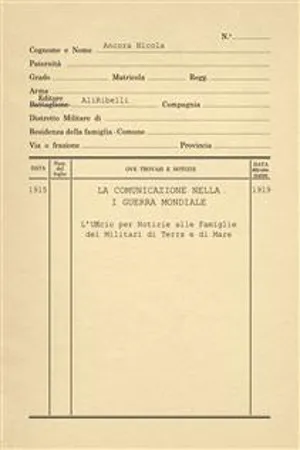
L'Ufficio per notizie alle famiglie dei militari di terra e di mare viene istituito nel 1915 e termina il suo lavoro nel 1919. Come ebbe a dire lo storico Albano Sorbelli, all'indomani della sua istituzione, l'Ufficio svolgeva il suo nobile ruolo "Accanto alla Guerra" la Prima guerra moderna (1914-1918). Un vero e proprio esercito di donne e 8400 uffici a garantirne il funzionamento. Riconosciuto come Ente Morale dal Ministero della Guerra, già nel 1915: il compito dei volontari e delle nobildonne facentene parte, era agevolare la comunicazione tra soldati e familiari, qualora questi ultimi non avessero notizie da tempo. La sede centrale era a Bologna (per i militari impegnati in operazioni di terra) e Roma (per i militari impegnati in operazioni marittime). Sezioni dipendenti all'Ufficio Centrale vennero istituite in città sedi di Corpi d'Armata e quelle più prossime al fronte di guerra. Sottosezioni vennero istituite in città sedi di distretto, centro di mobilitazione, ospedali. E, in ultimo, come non citare i Gruppi: uffici siti in piccoli paesi e dipendenti dalla Sottosezione di riferimento. Lo storico Nicola Ancora ne ricostruisce il funzionamento, soffermando il suo "case study" sulla Sezione di Napoli.
eBook - ePub
La Comunicazione nella Prima Guerra Mondiale: L'Ufficio per Notizie ai Militari di Terra e di Mare
- English
- ePUB (mobile friendly)
- Available on iOS & Android
eBook - ePub
La Comunicazione nella Prima Guerra Mondiale: L'Ufficio per Notizie ai Militari di Terra e di Mare
About this book
Information
Table of contents
- Introduzione
- Capitolo I
- Capitolo II
- Capitolo III
- Capitolo IV
- Conclusioni
- Bibliografia
- Note alle lettere e schede pubblicate in appendice
- Appendice I
- Appendice II
- Appendice III
Trusted by 375,005 students
Access to over 1.5 million titles for a fair monthly price.
Study more efficiently using our study tools.
Frequently asked questions
Yes, you can cancel anytime from the Subscription tab in your account settings on the Perlego website. Your subscription will stay active until the end of your current billing period. Learn how to cancel your subscription
No, books cannot be downloaded as external files, such as PDFs, for use outside of Perlego. However, you can download books within the Perlego app for offline reading on mobile or tablet. Learn how to download books offline
Perlego offers two plans: Essential and Complete
- Essential is ideal for learners and professionals who enjoy exploring a wide range of subjects. Access the Essential Library with 800,000+ trusted titles and best-sellers across business, personal growth, and the humanities. Includes unlimited reading time and Standard Read Aloud voice.
- Complete: Perfect for advanced learners and researchers needing full, unrestricted access. Unlock 1.5M+ books across hundreds of subjects, including academic and specialized titles. The Complete Plan also includes advanced features like Premium Read Aloud and Research Assistant.
We are an online textbook subscription service, where you can get access to an entire online library for less than the price of a single book per month. With over 1.5 million books across 990+ topics, we’ve got you covered! Learn about our mission
Look out for the read-aloud symbol on your next book to see if you can listen to it. The read-aloud tool reads text aloud for you, highlighting the text as it is being read. You can pause it, speed it up and slow it down. Learn more about Read Aloud
Yes! You can use the Perlego app on both iOS and Android devices to read anytime, anywhere — even offline. Perfect for commutes or when you’re on the go.
Please note we cannot support devices running on iOS 13 and Android 7 or earlier. Learn more about using the app
Please note we cannot support devices running on iOS 13 and Android 7 or earlier. Learn more about using the app
Yes, you can access La Comunicazione nella Prima Guerra Mondiale: L'Ufficio per Notizie ai Militari di Terra e di Mare by Nicola Ancora in PDF and/or ePUB format, as well as other popular books in History & World War I. We have over 1.5 million books available in our catalogue for you to explore.