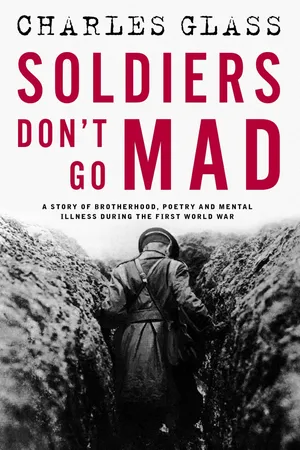
Soldiers Don't Go Mad
A Story of Brotherhood, Poetry and Mental Illness During the First World War
- 200 pages
- English
- ePUB (mobile friendly)
- Available on iOS & Android
Soldiers Don't Go Mad
A Story of Brotherhood, Poetry and Mental Illness During the First World War
About this book
A brilliant and poignant history of the friendship between two great war poets, Siegfried Sassoon and Wilfred Owen, alongside a narrative investigation of the origins of PTSD and the literary response to World War I
'Recommended not only to psychiatrists but also to those with an interest in the complex relationships created by war and the management of trauma' British Journal of Psychiatry
Second Lieutenant Wilfred Owen was twenty-four years old when he was admitted to the newly established Craiglockhart War Hospital for treatment of shell shock. A bourgeoning poet, trying to make sense of the terror he had witnessed, he read a collection of poems from a fellow officer, Siegfried Sassoon, and was impressed by his portrayal of the soldier's plight. One month later, Sassoon himself arrived at Craiglockhart, having refused to return to the front after being wounded during battle.
As their friendship evolved over their months as patients at Craiglockhart, each encouraged the other in their work, in their personal reckonings with the morality of war, as well as in their treatment. Therapy provided Owen, Sassoon, and fellow patients with insights that allowed them express themselves better, and for the 28 months that Craiglockhart was in operation, it notably incubated the era's most significant developments in both psychiatry and poetry.
Drawing on rich source materials, as well as Glass's own deep understanding of trauma and war, Soldiers Don't Go Mad tells for the first time the story of the soldiers and doctors who struggled with the effects of industrial warfare on the human psyche. As he investigates the roots of what we now know as post-traumatic stress disorder, Glass brings historical bearing to how we must consider war's ravaging effects on mental health, and the ways in which creative work helps us come to terms with even the darkest of times.
Frequently asked questions
- Essential is ideal for learners and professionals who enjoy exploring a wide range of subjects. Access the Essential Library with 800,000+ trusted titles and best-sellers across business, personal growth, and the humanities. Includes unlimited reading time and Standard Read Aloud voice.
- Complete: Perfect for advanced learners and researchers needing full, unrestricted access. Unlock 1.4M+ books across hundreds of subjects, including academic and specialized titles. The Complete Plan also includes advanced features like Premium Read Aloud and Research Assistant.
Please note we cannot support devices running on iOS 13 and Android 7 or earlier. Learn more about using the app.
Information
Table of contents
- Cover
- Praise for Soldiers Don’t Go Mad
- Title Page
- Dedication
- Epigraph
- Contents
- Introduction
- Chapter One. The Hydro
- Chapter Two. The War Hospital
- Chapter Three. Interpreting Dreams
- Chapter Four. A Complete and Glorious Loaf
- Chapter Five. Out of Place
- Chapter Six. A Young Huntsman
- Chapter Seven. The Protest
- Chapter Eight. Poet by Day, Sick by Night
- Chapter Nine. High Summer
- Chapter Ten. Mentors and Novices
- Chapter Eleven. Who Die as Cattle
- Chapter Twelve. The Celestial Surgeon
- Chapter Thirteen. A Grand Gesture
- Chapter Fourteen. Fight to a Finish
- Chapter Fifteen. Love Drove Me to Rebel
- Chapter Sixteen. Things Might Be Worse
- Chapter Seventeen. A Second Chance
- Chapter Eighteen. Drastic Changes Were Necessary
- Chapter Nineteen. Mad Jack Returns
- Chapter Twenty. The Loathsome Ending
- Epilogue
- Plate Section
- Acknowledgments
- Notes
- Image Credits
- Index
- Also by Charles Glass
- About the Author
- Copyright
- About the Publisher