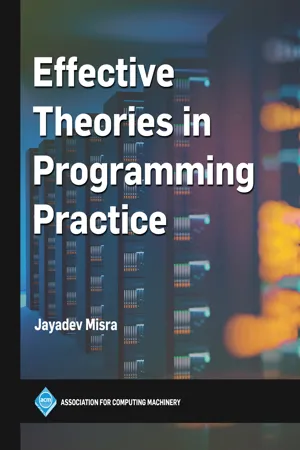
Effective Theories in Programming Practice
eBook - ePub

Effective Theories in Programming Practice

  1. 562 pages
  2. English
  3. ePUB (mobile friendly)
  4. Available on iOS & Android
eBook - ePub

Effective Theories in Programming Practice

About this book

Set theory, logic, discrete mathematics, and fundamental algorithms (along with their correctness and complexity analysis) will always remain useful for computing professionals and need to be understood by students who want to succeed. This textbook explains a number of those fundamental algorithms to programming students in a concise, yet precise, manner. The book includes the background material needed to understand the explanations and to develop such explanations for other algorithms. The author demonstrates that clarity and simplicity are achieved not by avoiding formalism, but by using it properly.

The book is self-contained, assuming only a background in high school mathematics and elementary program writing skills. It does not assume familiarity with any specific programming language. Starting with basic concepts of sets, functions, relations, logic, and proof techniques including induction, the necessary mathematical framework for reasoning about the correctness, termination and efficiency of programs is introduced with examples at each stage. The book contains the systematic development, from appropriate theories, of a variety of fundamental algorithms related to search, sorting, matching, graph-related problems, recursive programming methodology and dynamic programming techniques, culminating in parallel recursive structures.

Frequently asked questions

Yes, you can cancel anytime from the Subscription tab in your account settings on the Perlego website. Your subscription will stay active until the end of your current billing period. Learn how to cancel your subscription.
No, books cannot be downloaded as external files, such as PDFs, for use outside of Perlego. However, you can download books within the Perlego app for offline reading on mobile or tablet. Learn more here.
Perlego offers two plans: Essential and Complete
  • Essential is ideal for learners and professionals who enjoy exploring a wide range of subjects. Access the Essential Library with 800,000+ trusted titles and best-sellers across business, personal growth, and the humanities. Includes unlimited reading time and Standard Read Aloud voice.
  • Complete: Perfect for advanced learners and researchers needing full, unrestricted access. Unlock 1.4M+ books across hundreds of subjects, including academic and specialized titles. The Complete Plan also includes advanced features like Premium Read Aloud and Research Assistant.
Both plans are available with monthly, semester, or annual billing cycles.
We are an online textbook subscription service, where you can get access to an entire online library for less than the price of a single book per month. With over 1 million books across 1000+ topics, we’ve got you covered! Learn more here.
Look out for the read-aloud symbol on your next book to see if you can listen to it. The read-aloud tool reads text aloud for you, highlighting the text as it is being read. You can pause it, speed it up and slow it down. Learn more here.
Yes! You can use the Perlego app on both iOS or Android devices to read anytime, anywhere — even offline. Perfect for commutes or when you’re on the go.
Please note we cannot support devices running on iOS 13 and Android 7 or earlier. Learn more about using the app.
Yes, you can access Effective Theories in Programming Practice by Jayadev Misra in PDF and/or ePUB format, as well as other popular books in Ciencia de la computación & Programación. We have over one million books available in our catalogue for you to explore.

Information

Table of contents

  1. Cover
  2. Halftitle
  3. Title Page
  4. Copyright Page
  5. Dedication
  6. Contents
  7. Preface
  8. Chapter 1 Introduction
  9. Chapter 2 Set Theory, Logic and Proofs
  10. Chapter 3 Induction and Recursion
  11. Chapter 4 Reasoning About Programs
  12. Chapter 5 Program Development
  13. Chapter 6 Graph Algorithms
  14. Chapter 7 Recursive and Dynamic Programming
  15. Chapter 8 Parallel Recursion
  16. Bibliography
  17. Author’s Biography
  18. Index