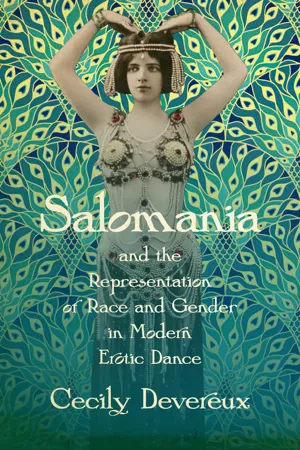
Salomania and the Representation of Race and Gender in Modern Erotic Dance
eBook - PDF

Salomania and the Representation of Race and Gender in Modern Erotic Dance

  1. English
  2. PDF
  3. Available on iOS & Android
eBook - PDF

Salomania and the Representation of Race and Gender in Modern Erotic Dance

About this book

Salomania and the Representation of Race and Gender in Modern Erotic Dance situates the 1908 dance craze, which The New York Times called "Salomania," as a crucial event and a turning point in the history of the modern business of erotic dance. Framing Salomania with reference to imperial ideologies of motherhood and race, it works toward better understanding the increasing value of the display of the undressed female body in the 19th and early 20th centuries.

This study turns critical attention to cultures of maternity in the late 19th century, primarily with reference to the ways in which women are defined in relation to their genitals as patriarchal property and space and are valued according to reproduction as their primary labour. Erotic dance as it takes shape in the modern representation of Salome insists both that the mother is and is not visible in the body of the dancer, a contradiction this study characterizes as reproductive fetishism.

Looking at a range of media, the study traces the modern figure of Salome through visual art, writing, early psychoanalysis and dance, from "hootchie kootch" to the performances dancer Maud Allan called "mimeo-dramatic" to mid-20th-century North American films such as Billy Wilder's Sunset Boulevard and Charles Lamont's Salome, Where She Danced to the 21st-century HBO series The Sopranos.

Frequently asked questions

Yes, you can cancel anytime from the Subscription tab in your account settings on the Perlego website. Your subscription will stay active until the end of your current billing period. Learn how to cancel your subscription.
No, books cannot be downloaded as external files, such as PDFs, for use outside of Perlego. However, you can download books within the Perlego app for offline reading on mobile or tablet. Learn more here.
Perlego offers two plans: Essential and Complete
  • Essential is ideal for learners and professionals who enjoy exploring a wide range of subjects. Access the Essential Library with 800,000+ trusted titles and best-sellers across business, personal growth, and the humanities. Includes unlimited reading time and Standard Read Aloud voice.
  • Complete: Perfect for advanced learners and researchers needing full, unrestricted access. Unlock 1.4M+ books across hundreds of subjects, including academic and specialized titles. The Complete Plan also includes advanced features like Premium Read Aloud and Research Assistant.
Both plans are available with monthly, semester, or annual billing cycles.
We are an online textbook subscription service, where you can get access to an entire online library for less than the price of a single book per month. With over 1 million books across 1000+ topics, we’ve got you covered! Learn more here.
Look out for the read-aloud symbol on your next book to see if you can listen to it. The read-aloud tool reads text aloud for you, highlighting the text as it is being read. You can pause it, speed it up and slow it down. Learn more here.
Yes! You can use the Perlego app on both iOS or Android devices to read anytime, anywhere — even offline. Perfect for commutes or when you’re on the go.
Please note we cannot support devices running on iOS 13 and Android 7 or earlier. Learn more about using the app.
Yes, you can access Salomania and the Representation of Race and Gender in Modern Erotic Dance by Cecily Devereux in PDF and/or ePUB format, as well as other popular books in Media & Performing Arts & Feminist Literary Criticism. We have over one million books available in our catalogue for you to explore.

Table of contents

  1. Cover
  2. Half Title
  3. Title
  4. Copyright
  5. Dedication
  6. Contents
  7. Acknowledgements
  8. Introduction: Maud Allan and the Salome dance in 1908
  9. Chapter 1: Erotic dance and the culture of imperial motherhood
  10. Chapter 2: “Salomé, c’est moi”: male artists and the image of the dancer
  11. Chapter 3: Enter Herodias: the phallic mother and the reproductive fetish
  12. Chapter 4: On not seeing Salome in Sunset Boulevard
  13. Chapter 5: The fetish and the reproduction of whiteness from the Salome corpus to Salome, Where She Danced
  14. Chapter 6: “Pathmakers for Salome”: the danse du ventre, the hootchie kootch, and “Little Egypt”
  15. Chapter 7: Oscar Wilde, Loie Fuller, and Maud Allan
  16. Chapter 8: Salomania and the memetic moment
  17. Epilogue: Salomania’s legacies
  18. Notes
  19. Works Cited
  20. Copyright Acknowledgements
  21. Index