Beginning in the 18th century, a turning point in labour history as work encountered an industrialising modernity, this book explores how different forms of work have been valued up to the present day. Focusing on the cultural, intellectual, social and political implications of wages, the chapters in this collection historicise the labour market, conceiving it as complex system of social relations which evolve through time and differ according to space. They show how the level of wages and other forms of remuneration reflect not only marginal productivity and scarcity but also the nature of work relations and wider political, social and economic circumstances.
With examples ranging across several centuries and different parts of the globe, it shows how wages are influenced by the specific organization and processes of work, conflict and power, social status and hierarchies between workers, custom and identity, family structure and professional ethics, ideology, politics and policy. Combining quantitative and qualitative approaches The Value of Work since the 18th Century also addresses two interlinked questions; how did theoretical interpretations and techniques of wage measurement emerge and evolve, and to what extent does this matter in understanding the social and political history of work?
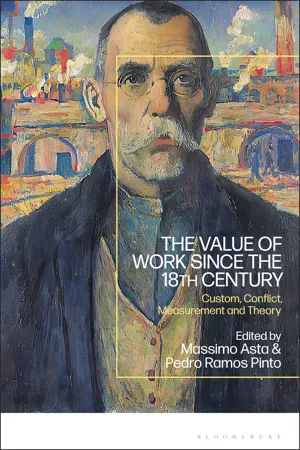
eBook - ePub
The Value of Work since the 18th Century
Custom, Conflict, Measurement and Theory
- 348 pages
- English
- ePUB (mobile friendly)
- Available on iOS & Android
eBook - ePub
The Value of Work since the 18th Century
Custom, Conflict, Measurement and Theory
About this book
Information
Table of contents
- Cover
- Half-Title Page
- Title Page
- Contents
- List of Illustrations
- List of Contributors
- Acknowledgements
- Introduction: Exploring the Political Economy of Wages
- Part One Custom and Conflict
- 1 Conceptualizing the Earnings of Wool Spinners in England before Industrialization
- 2 Wage Practices at a Red Bread Factory (Ghent, 1880–1914)
- 3 Papers and Wages: Identity Documents and Work in Habsburg Austria During the Late Nineteenth and Early Twentieth Century
- 4 Custom, Wages, and Hobsbawm’s ‘Rules of the Game’: New Perspectives on Eighteenth-Century Wages
- 5 Regulating Wage, Realizing Rights: Domestic Workers in India
- 6 Enumerating Fairness: Wages and Labour Contractors in Pre-1949 China
- 7 Everywhere but in the Strike Statistics? Wage Systems and Work Stoppages in Sweden, 1863–1927
- Part Two Measurement and Theory
- 8 From Poverty Lines to Equal Pay for Equal Work: Commensuration Struggles in Apartheid South Africa
- 9 Wages Measurement in the Belgian Congo and French Sub-Saharan Africa from 1919 to Independence: a Challenge?
- 10 Down with the Caro-vita! A Social and Intellectual History of the Cost-of-Living Statistics in Italy, 1910s–1930s
- 11 Adam Smith on Wages and Labour: Social Norms and Institutions as Necessary Limits to Competition
- 12 Devaluing Labour and Radical Theories of Worker Discrimination in North America in the Late Twentieth Century
- 13 Rethinking the Concept of the Living Wage: Ontological Presuppositions of Emancipatory Action
- Selected Bibliography
- Index
- Copyright
Trusted by 375,005 students
Access to over 1.5 million titles for a fair monthly price.
Study more efficiently using our study tools.
Frequently asked questions
Yes, you can cancel anytime from the Subscription tab in your account settings on the Perlego website. Your subscription will stay active until the end of your current billing period. Learn how to cancel your subscription
No, books cannot be downloaded as external files, such as PDFs, for use outside of Perlego. However, you can download books within the Perlego app for offline reading on mobile or tablet. Learn how to download books offline
Perlego offers two plans: Essential and Complete
- Essential is ideal for learners and professionals who enjoy exploring a wide range of subjects. Access the Essential Library with 800,000+ trusted titles and best-sellers across business, personal growth, and the humanities. Includes unlimited reading time and Standard Read Aloud voice.
- Complete: Perfect for advanced learners and researchers needing full, unrestricted access. Unlock 1.5M+ books across hundreds of subjects, including academic and specialized titles. The Complete Plan also includes advanced features like Premium Read Aloud and Research Assistant.
We are an online textbook subscription service, where you can get access to an entire online library for less than the price of a single book per month. With over 1.5 million books across 990+ topics, we’ve got you covered! Learn about our mission
Look out for the read-aloud symbol on your next book to see if you can listen to it. The read-aloud tool reads text aloud for you, highlighting the text as it is being read. You can pause it, speed it up and slow it down. Learn more about Read Aloud
Yes! You can use the Perlego app on both iOS and Android devices to read anytime, anywhere — even offline. Perfect for commutes or when you’re on the go.
Please note we cannot support devices running on iOS 13 and Android 7 or earlier. Learn more about using the app
Please note we cannot support devices running on iOS 13 and Android 7 or earlier. Learn more about using the app
Yes, you can access The Value of Work since the 18th Century by Massimo Asta, Pedro Ramos Pinto, Massimo Asta,Pedro Ramos Pinto in PDF and/or ePUB format, as well as other popular books in Histoire & Histoire économique. We have over 1.5 million books available in our catalogue for you to explore.